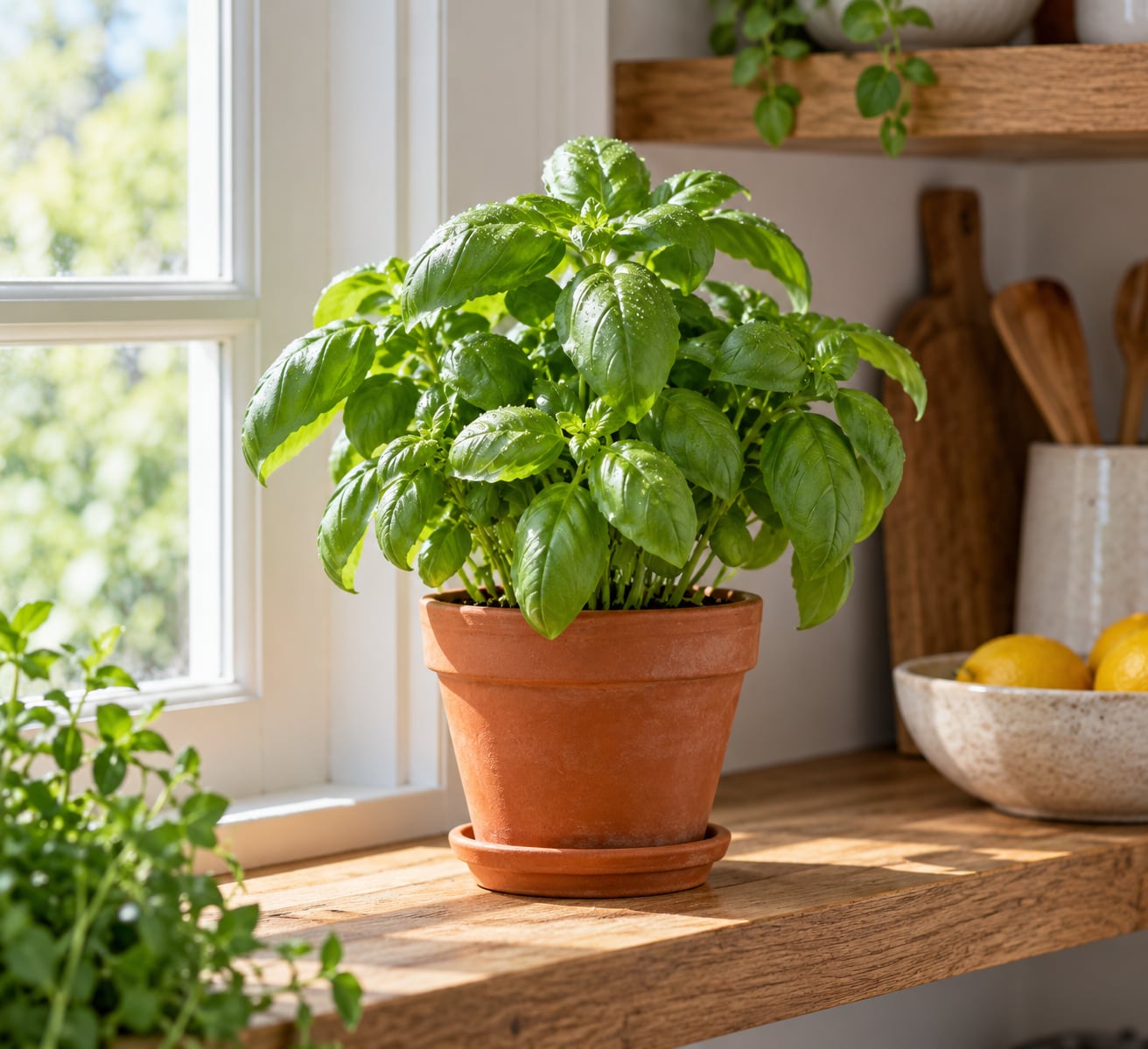
Yes, you can grow basil year round indoors, and it takes less effort than most people expect. Give it 6 to 8 hours of strong light a day, keep the room warm at around 70°F (21°C), and plant it in a pot of light, free-draining mix. Everything else is routine. From seed to first harvest takes roughly eight to ten weeks.
The catch is light. Basil is a hungry, sun-loving annual, and most indoor plants that fail on a windowsill fail for one reason: not enough energy reaches the leaves. Fix the light and the plant usually looks after itself.
Table of Contents
- 1What You Need
- 2Step-by-Step
- 3Step 1: Start with the brightest spot in the room
- 4Step 2: Fill the pot with a light, free-draining mix
- 5Step 3: Plant seeds shallow or set a start at soil level
- 6Step 4: Water when the top 2-3cm (about 1in) is dry
- 7Step 5: Keep it warm and out of drafts
- 8Step 6: Pinch above a leaf pair every week
- 9Step 7: Repot when roots circle the pot
- 10Step 8: Troubleshoot what breaks when you grow basil year round indoors
- 11Common Mistakes
- 12Frequently Asked Questions
- 13Can basil grow indoors all year?
- 14How much light does indoor basil need?
- 15Should I grow basil from seed or buy a plant?
- 16Why are my basil leaves turning yellow?
- 17Can you dig up basil and bring it inside for winter?
- 18How do I harvest basil so it grows back bushier?
What You Need
You need very little, and most of it you may already own:
- A pot with drainage holes. Around 12-15cm (5-6in) across for a single plant, 18-22cm (7-9in) if you want two or three in one container.
- Potting mix, not garden soil. Look for a peat-free multipurpose mix, and add a handful of perlite if it looks dense.
- Seeds or a small nursery start. Both work. Seeds take longer but cost almost nothing and let you choose the variety.
- A bright window or a grow light. A south- or west-facing sill is the starting point. A full-spectrum LED bar on a timer is what makes the year-round promise realistic.
- Water and a spray bottle. A small watering can with a fine rose is ideal.
- Clean scissors or your fingers. Pinching is a core part of the method, not an optional extra.
- A liquid feed, optional. Diluted seaweed or tomato feed once a fortnight through winter, when growth slows.
If your space is a countertop or a shallow shelf, pick a compact variety. Genovese and Minette behave well indoors and stay smaller, Thai basil is tougher and more heat-tolerant, and Red Rubin has deep purple leaves that hold their colour even in lower light. A dwarf type in a six-inch pot on a windowsill is a better bet than a sprawling Genovese in a twelve-inch pot on the floor.
Step-by-Step
Step 1: Start with the brightest spot in the room
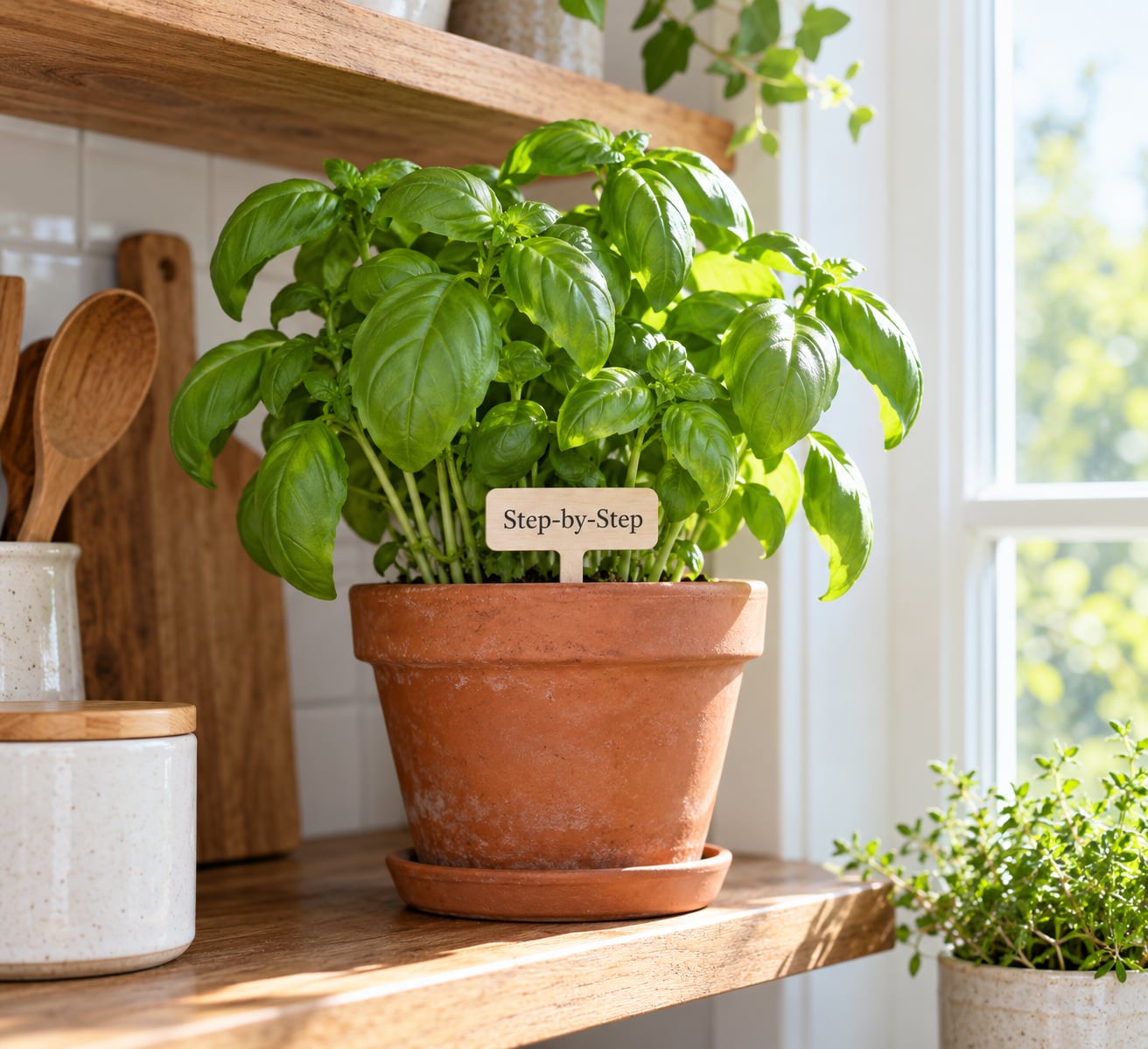
Find the spot that gets the most sun and put the pot there before you buy anything else. Direct sun through glass is stronger than people assume, and a south-facing sill is genuinely useful. Bright indirect light, a few feet back from a big window, is workable but slower.
Watch the plant rather than the compass. New leaves that are small, pale and widely spaced mean the light is too weak, and no amount of watering fixes that. Stems leaning hard toward the glass mean the same thing.
If your kitchen is dim, a north-facing room, or gets no direct sun at all, a grow light is not a luxury. Set a full-spectrum LED bar 6-12in above the canopy and run it 12-16 hours a day on a timer. The light reaching the leaves matters more than the number printed on the box, so raise the lamp as the plant grows to keep that gap.
| Light source | Hours a day | Realistic result indoors |
|---|---|---|
| South or west window | 6-8, less in winter | Good from spring to autumn, marginal in midwinter |
| North or east window | 4-6 | Usually too dim alone; expect pale, stretched growth |
| LED grow bar on a timer | 12-16 | Reliable year-round, including a windowless room |
| Standard room LED bulb | Varies | Not enough intensity for sustained leaf production |
One more habit matters more than any single light choice: rotate the pot a quarter turn each week so growth stays even instead of all leaning at the glass.
Step 2: Fill the pot with a light, free-draining mix
Choose a container with holes in the base, and put a layer of pebbles or a saucer underneath to catch the runoff. Fill with potting mix amended with perlite, roughly one part perlite to three parts mix.
Garden soil is the wrong material. It compacts indoors, holds water far too long and usually arrives carrying whatever fungal problems the bed had. A dense multipurpose mix straight from the bag has the opposite problem, staying wet for a week and starving the roots of air. The mix you want is damp after watering and noticeably lighter within a day.
Fill to about 2cm (1in) below the rim so watering has somewhere to sit before it runs out of the holes.
Step 3: Plant seeds shallow or set a start at soil level
Basil seeds germinate faster if you soak them for a few hours in lukewarm water first. Sow them about half a centimetre deep, barely covered, and keep the surface moist. Seedlings appear in five to ten days. A heat mat set to around 21-24°C (70-75°F) speeds things along noticeably, particularly in a cool room.
When the seedlings show three or four true leaves, move each one into its own pot, burying the stem slightly deeper than before to hold it upright. Water them in gently and keep them out of harsh midday sun for the first few days while they settle.
If you are starting with a plant from a garden centre or a supermarket bunch, skip all of that. Split crowded supermarket pots into separate containers first, because four basil plants sharing one small pot will never produce four healthy plants. Then move the whole pot into a shaded spot for about a week before introducing it to brighter conditions. This slow reintroduction prevents the light shock and sudden collapse that kills most supermarket basil within a month.
Step 4: Water when the top 2-3cm (about 1in) is dry
Stop watering on a schedule and start checking the soil. Push a finger 2-3cm down. Water when it feels dry at that depth, then water thoroughly until it runs out of the base, and empty the saucer afterwards. Repeat. That cycle is the whole watering method.
Standing water in the saucer or a pot with no holes causes root rot, which shows up as yellow leaves, a soft stem near the soil and a plant that collapses days after it looked fine. Wilting in dry soil is different: the leaves droop and the pot feels light, and a thorough soak fixes it within an hour.
Bottom watering works well for pots sitting in a tray, especially in winter when the air is dry. It also keeps the leaves dry, which lowers the risk of fungal problems.
Indoor basil slows down in winter and the mix stays wet longer because the room is cooler and the plant drinks less, so check more often and water less. In summer a pot on a sunny sill can dry out in two days, so check daily. Watering in the morning or evening avoids shocking the plant with cold water at midday.
Step 5: Keep it warm and out of drafts
Basil is happiest between 70-85°F (21-29°C). Below about 55°F (13°C) the leaves blacken and collapse, and cold glass is worse than cold air because it chills the leaves against the pane all night.
Keep the pot away from radiators, heating vents, air conditioning units and doorways that open often. Basil should not share a windowsill with herbs that like dry conditions, such as sage or rosemary, because one watering routine cannot serve both.
Humidity is not a major requirement in an ordinary home. A pebble tray helps in a dry winter room, but misting the leaves leaves them wet for hours, which invites grey mould. Moving air matters more: a fan on low, a few feet away, keeps the leaves dry and stops fungal problems forming in a crowded pot.
Step 6: Pinch above a leaf pair every week
This is the trick to a full, bushy plant. When a stem has grown a pair of leaves, pinch the growing tip just above them with your fingers or clean scissors. Two side shoots then develop below that point, and each of those can be pinched in turn.
Harvest no more than about a third of the plant at a time, taking whole stem tips from the top down. A cut stem left long enough for a couple of leaves lower down will keep rooting in water and become a free new plant.
Pinch off flower buds as soon as you see them. Flowering, known as bolting, changes the plant’s priorities: the leaves turn tougher and more bitter, growth slows, and the season effectively ends. A healthy indoor plant you keep pinching may never flower. If one does bolt anyway, let the heads dry on the plant, shake the seeds into a paper bag and you have next year’s sowing for free.
Step 7: Repot when roots circle the pot
Basil grows fast and can fill a pot in a season. Lift it gently and look at the root ball: if roots are circling the base or pushing out of the drainage holes, move up one pot size, about 2-3cm (1in) wider. Jumping to a much larger pot leaves wet soil the roots cannot reach, which invites rot.
Refresh the top layer of old mix every couple of months during the growing season rather than repotting constantly. When stems turn woody and hollow and the plant produces thin, weak growth, that is a signal to take healthy cuttings, root them in water, and start again from fresh mix.
Step 8: Troubleshoot what breaks when you grow basil year round indoors
Almost every indoor basil problem traces back to light, water or airflow. Match the symptom, then change one thing at a time so you know what worked. Most advice on how to grow basil year round indoors stops at watering, but airflow and pot size cause half of the failures people blame on light.
| Symptom | Likely cause | Fix |
|---|---|---|
| Long stems, small pale leaves, leaning toward glass | Not enough light, or intensity too low | Move to a brighter sill or add a grow light 6-12in above the canopy; pinch the tips to force branching |
| Yellow lower leaves, soft stem, sudden wilt | Overwatering and poor drainage | Check soil 2-3cm down, let it dry, empty the saucer, confirm the pot has holes |
| Dry crispy leaf edges, pot feels light | Underwatering, or dry air in winter | Soak thoroughly and drain; move away from a heat vent |
| Leaves blackened overnight | Cold glass or a cold draft | Pull the pot back from the pane and off the sill edge |
| Grey fuzzy growth on lower leaves | Still, damp, humid air with poor airflow | Remove affected leaves, water only at the soil, add gentle air movement |
| Cloudy white insects that flutter when disturbed | Whitefly, drawn to stressed plants | Isolate the pot, rinse leaves, treat with insecticidal soap on a schedule |
| Fine webbing, stippled pale leaves | Spider mites, favoured by hot dry air | Isolate, wash the plant, raise humidity and airflow around it |
| Tough bitter leaves, flower spikes | The plant has bolted | Remove spikes, harvest harder, and start a new plant from seed |
Check the undersides of leaves every week while you are pinching. Pests spread fast through a small indoor collection, and one pot on a windowsill can reach the whole shelf in a fortnight. Isolation is easier than treatment.
Common Mistakes
Trusting a dim windowsill. Bright indirect light through a north-facing window is usually not enough. Add a grow light rather than waiting for a leggy plant to explain the problem.
Watering on a schedule. Water when the top 2-3cm is dry and no sooner. A fixed twice-weekly habit is the leading cause of yellowing leaves and root rot indoors.
Letting a saucer fill with water. Standing water under the pot is as damaging as overwatering. Empty it after every drink.
Leaving flowers on the plant. Pinch buds the moment they appear. Bolting ends your leaf harvest, and bitter leaves follow.
Taking too much at once. Harvesting more than a third of the plant shocks it. Take stem tips and leave the lower leaf pairs in place.
Overfeeding. A weak solution of liquid seaweed or tomato feed once a fortnight is plenty. Heavy feeding pushes soft growth that pests prefer and can burn roots in a small pot.
Forgetting plants slow down in winter. Growth nearly stops, the mix stays wet longer, and watering needs drop. Do not compensate with extra heat or more water.
Discarding bolting plants entirely. Save the seed, or root fresh cuttings, and the supply keeps going rather than restarting from nothing each season.
A steady harvest comes down to two weekly habits. Check the soil with a finger, and pinch every growing tip you find. Do those two things for a month and the plant keeps producing new stems instead of stretching for the window.
Frequently Asked Questions
Can basil grow indoors all year?
Yes. Basil can grow indoors year-round if it receives enough light, warm temperatures and consistently appropriate watering. A sunny window may be enough from spring to autumn, but most homes need a grow light on a 12 to 16 hour timer to carry the plant through midwinter. Keep it warm, water only when the top layer dries, and pinch the tips so growth stays bushy.
How much light does indoor basil need?
Indoor basil performs best with bright light for at least six hours a day, and closer to eight or more if you can manage it. Direct sun through a south- or west-facing window helps. When you use a grow light, place it 6 to 12 inches above the canopy and leave it on 12 to 16 hours daily. Raise it as the plant grows, and rotate the pot weekly for even growth.
Should I grow basil from seed or buy a plant?
Seeds are inexpensive and open up the full range of varieties, but they take roughly eight to ten weeks from sowing to first harvest. A nursery start gives you leaves within a few days and suits beginners. If you buy one, split crowded supermarket pots into separate containers and move the whole pot into shade for a week before giving it full light.
Why are my basil leaves turning yellow?
Yellow leaves most often point to overwatering, poor drainage, or simply lower leaves aging as the plant grows upward. Check the soil 2 to 3 centimeters below the surface and water only when it is beginning to dry, then empty the saucer. Remove yellow leaves at the base, confirm the pot has drainage holes, and let the plant recover in bright light before adding any feed.
Can you dig up basil and bring it inside for winter?
Yes, if you act before the first frost. Cut back the top third, dig up the root ball carefully, pot it into a container that is only slightly larger, and place it in bright indoor conditions away from cold glass. Expect some leaf drop during the adjustment. In spring, move it back outside gradually over a week or two rather than straight into full sun.
How do I harvest basil so it grows back bushier?
Pinch each stem tip just above a pair of leaves, which forces two side shoots to form below the cut. Do it weekly, taking no more than about a third of the plant at a time, and remove flower buds as soon as they appear. Harvest from the top down, and leave the lower leaf pairs on the stem. Cuttings taken this way root in water and give you free replacement plants.
Start with one pot on your brightest sill, fill it with a light free-draining mix, and check the soil with a finger before you water. Give it six to eight hours of light, pinch the tips every week, and you will have a steady supply of leaves within two months of sowing.