To interview an elder about plant knowledge, you agree on consent and ownership first, then ask open questions in a semi-structured format while recording audio and writing field notes, and finally transcribe, identify the plants properly, and return the results to the elder before anything is published. Expect to spend two to three hours in preparation for every hour at the table. The knowledge is the elder’s, not yours.
Plant knowledge held by elders encodes the details written records rarely preserve: how a plant is told apart from its lookalikes, when it is picked, which part is used, and how a remedy is prepared. When that knowledge is recorded without consent or credit, it is also taken from the community, which is why the ethics side of this conversation matters as much as the method.
This guide works for students, researchers, heritage groups, journalists and families recording oral history, whatever the technical depth of the project. Two things stay constant: an interview is documentation, not a dosing recommendation, and nobody should taste, brew or apply anything on the strength of what was said in the room.
Table of Contents
- 1What You Need
- 2Step-by-Step
- 3How to prepare the interview and explain your purpose
- 4How to ask questions about plants and traditional knowledge
- 5How to record answers without distorting them
- 6How to clarify preparation and safety information carefully
- 7How to verify names and details without embarrassing the elder
- 8How to close the interview and preserve the record
- 9Common Mistakes
- 10Frequently Asked Questions
- 11How should I ask an elder about medicinal plants without suggesting answers?
- 12Do I need written consent to record an elder’s plant knowledge?
- 13How do I document plant names in a local language?
- 14What if the elder and a botanist identify a plant differently?
- 15Can I publish a traditional remedy in an article?
- 16How should I handle knowledge that may be dangerous or sensitive?
- 17Conclusion
What You Need
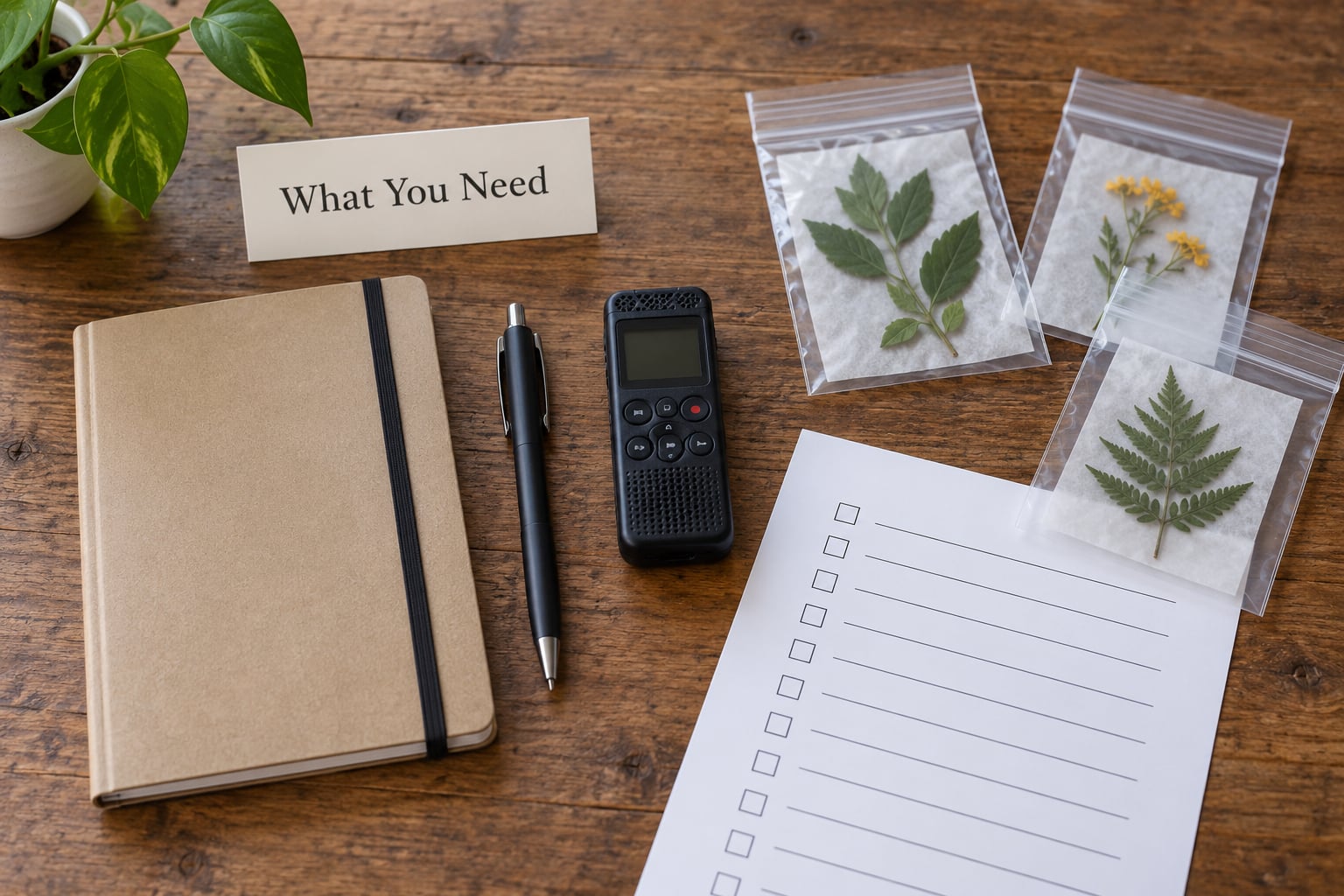
Most of this is cheap or free, and the gaps cause more problems than the gear ever will. A recorder you have tested on the actual memory card matters more than a good microphone, and a notebook you can write in fast matters more than a clever form.
- Consent material. A short written consent form in plain language, plus a scope sheet listing exactly what you plan to record, publish and deposit. Read the form aloud as well as leaving it in the elder’s hands.
- Consent script. An eighty-word version you can say out loud without reading verbatim. Consent that only exists on paper, in a language the elder reads slowly, is not really consent.
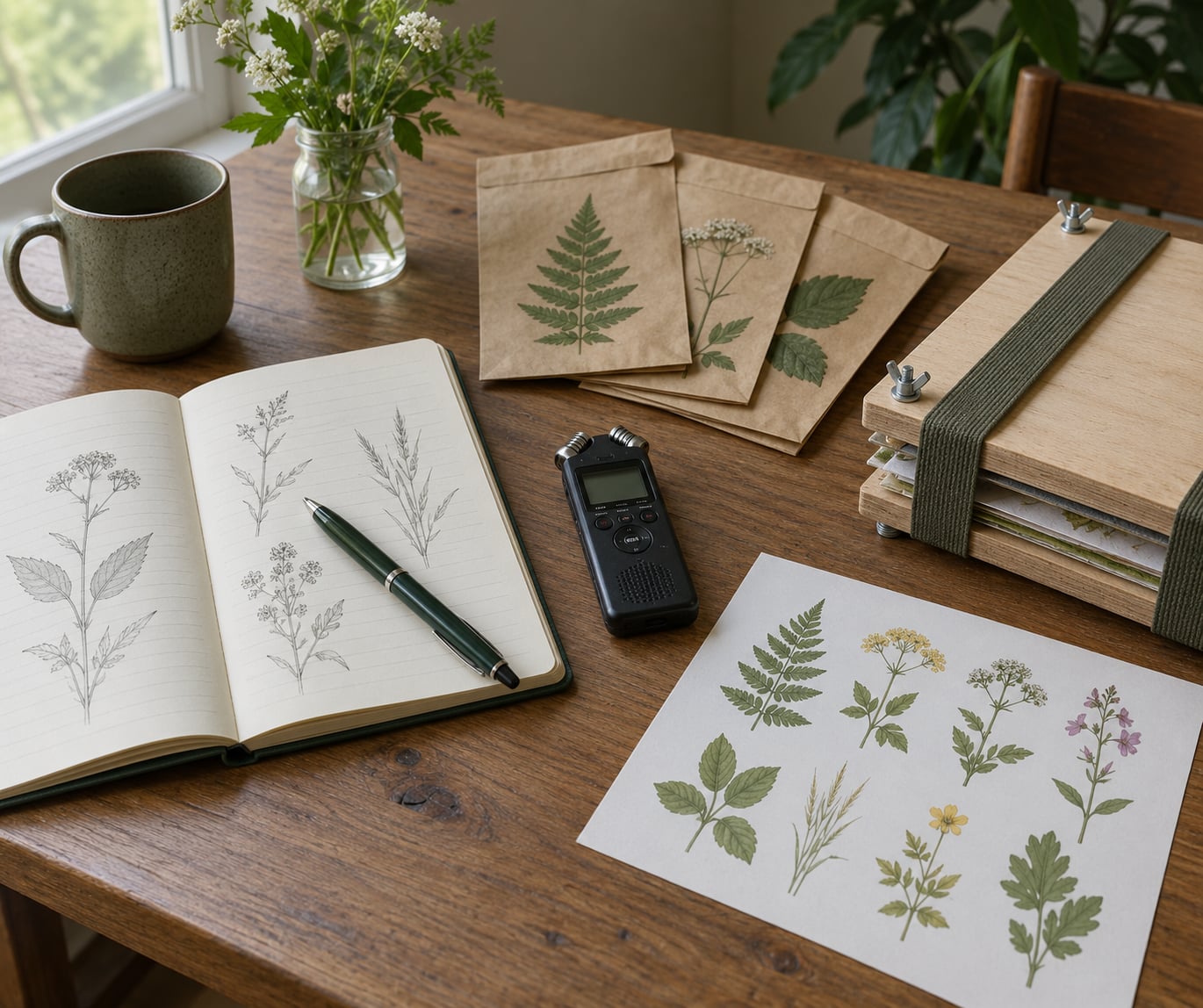
- Audio recorder plus a backup. Two devices recording the same session, spare batteries or a charged card, and a backup drive you can reach without asking anyone’s permission.
- Field notebook and two pens. Paper fails in a way that a phone does not, and the notebook stays in your pocket when the recorder runs down.
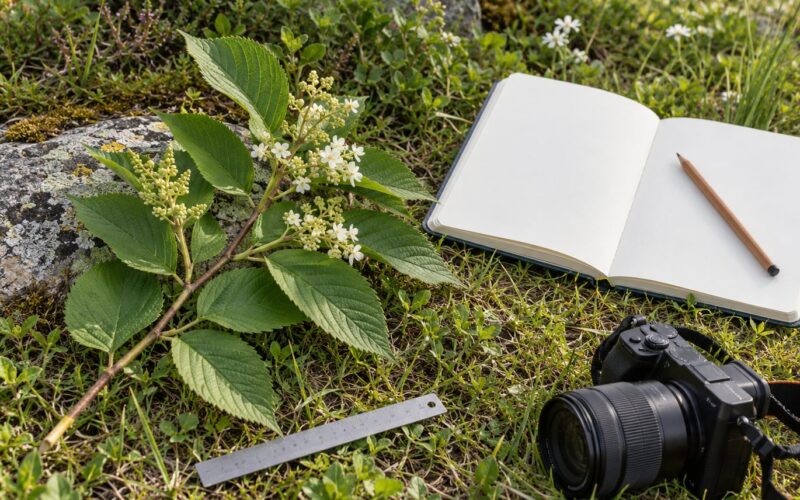
- Plant press and specimen labels. Card stock, a plant press or a heavy book and boards, and waterproof labels written in pencil. Collect only with permission and only where collecting is allowed.
- Language support. A fluent interpreter rather than a family member where possible, and the time to brief them on consent wording before you start.
- Access planning. A seated meeting spot away from machinery, somewhere to move for a stretch break, and a plan for transport if the venue is not at the door.
- Something to give. A cash or transfer stipend, a printed copy of the finished work, or a copy of the recording. Turning up empty-handed and asking for a lifetime of knowledge is its own answer.
Skip the plant press if no herbarium is involved. It adds weight and fuss, and an unprepared specimen that wilts in a plastic bag teaches you nothing.
Step-by-Step
The sequence below runs before, during and after the session, and it is the difference between a record that holds up and a folder of lost audio files.
How to prepare the interview and explain your purpose
Write your research question on one page before you travel. If it runs past three sentences, it is too broad to be useful in a conversation.
- Define the scope. One question, one place, one group of people. “What plants from the river valley are used for skin problems” is workable. “All traditional plant medicine” is a decade, not a visit.
- Name the audience. Decide now whether this is a private family record, a community archive, a thesis, or a published article, because what you may record changes with the answer.
- Explain it in one minute. Say what you want to know, why you want it, who will hear it, how long the recording is kept, and that the elder may stop at any point. Then stop talking and let the answer land.
- Ask permission for the recording separately. Someone may happily talk and still refuse to be recorded. Notes only is a legitimate outcome, not a failure.
- Let the elder set the order. Offer a question list but say plainly that you will follow their lead. A good interview is usually the one the elder would recognise as theirs.
Say something close to this: “I am writing a record of how people in this area use plants. I would like to record our conversation, and I will keep the recording for my research only. Nothing goes anywhere without asking you first. You can stop, or skip any question, or ask me to delete a part later, and that is completely fine. Is that alright?”
How to ask questions about plants and traditional knowledge
Ask questions that return stories and specifics rather than yes-or-no answers, and treat the local name as the answer you most want to hear.
Open with three questions that work almost every time. “Who taught you about plants?” gets you a lineage and a place. “Which plant do people know best here?” gets you a shared reference point. “What is a plant people should be careful around?” gets you warnings, which are often the most practically valuable part of the conversation.
Then work by theme, using the wording you will actually say out loud:
- Names and identity. “What do people here call this plant?” “Is there more than one name for it?” “Which name do you use?”
- Identification. “How would you tell it apart from the plant that looks like it?” “Where does it grow?”
- Timing. “When do people pick it?” “Does that change through the year?”
- Parts and preparation. “Which part is used?” “What is done to it before it is used?”
- Restraint. “Who is it not for?” “How much is usual?”
- Meaning. “Is it something people grow on purpose, or something you find?” “Is there anything about this plant that is not to be talked about or shared?”
That last question is not optional. Ask it plainly, accept “no” without pushing, and let the answer shape what you record.
How to record answers without distorting them
Your notes are not a transcript, and your memory is not one either. Capture the exact word the elder used for the plant, the sentence as they said it, and anything you saw rather than inferred.
- Write the local name as spoken. Get the elder to say it twice, note the pronunciation in your own shorthand, and never substitute an English or botanical name in its place.
- Mark uncertainty. Write “unclear” rather than a guess. A gap in the record is honest; an invented spelling is not recoverable later.
- Keep inference separate. If you think the plant they mean is the same one growing by the fence, write that as a question for later, not as a finding.
- Mark provenance. Note whether they used this plant themselves or whether it came from a parent, grandparent or healer. That distinction is the whole point of oral history.
- Note the non-answers. “Declined,” “asked me to stop recording,” and “said my sister knows more” are data.
Photograph the plant in place if you are permitted, including a scale reference and the growth habit, not just the leaf. Housekeeping first: copy both recordings and all photographs to a second drive the same evening.
How to clarify preparation and safety information carefully
You are documenting what was done, not instructing anyone to do it. Keep the frame around the answer consistent.
Ask “how was it prepared in the past?” rather than “how much should I use?” Ask who used it and what they took it for, because that keeps the answer historical and specific. Record contraindications, warnings and restrictions in the elder’s own words, because those are often the clearest safety signal in the entire interview.
When someone describes a treatment they personally received, record that as their account and not as advice for anyone else. Do not suggest, confirm or improve a quantity, and never extrapolate from one person’s experience to a general recommendation. If the conversation turns to what the reader might do with this, say plainly that your record is not a treatment recommendation and that a clinician or pharmacist is the right person for individual advice.
How to verify names and details without embarrassing the elder
Verification is a matter of documentation, not confrontation. Your job is to record the disagreement accurately, not to settle it in the room.
Check spelling and pronunciation back at the end of the session, while the person is still there to confirm. Photograph specimens with locality, date and a scale reference, and press one only with permission and only where collection is permitted.
Local plant names rarely map cleanly onto botanical species, and one local name often covers several species while another covers one. An identification app is a starting point at best and a source of confident error at worst. Send specimens to a herbarium or a trained botanist, and file what comes back alongside the elder’s wording rather than over it.
When two elders describe the same plant differently, record both accounts separately with each source attached, note the discrepancy plainly, and if the community has a review process, take it there. Do not average two traditions into one tidy version, and do not tell either person the other was wrong. Disagreement in the record is honest ethnobotany; smoothing it over is a fabricated finding.
How to close the interview and preserve the record
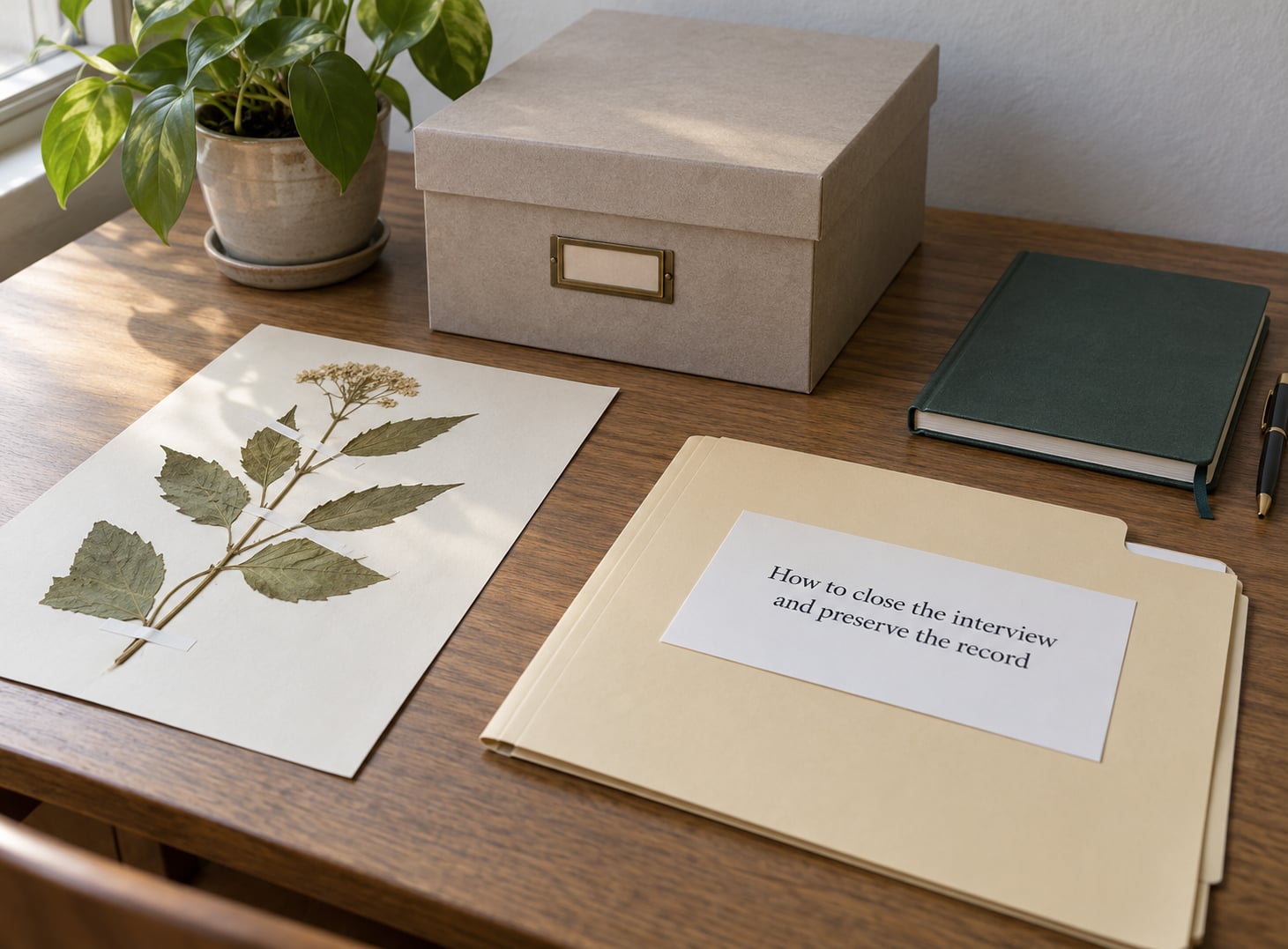
Ending well is what makes a second interview possible, and a second interview is usually where the real material sits.
- Summarise back. Say the main points in two or three sentences and ask what is wrong or missing.
- Ask the open question. “What should I have asked you about?” pulls out the material you did not know to ask for.
- Confirm permission again. Ask separately about the recording, the photographs and the notes, because they can be consented to separately.
- Say what happens next. Explain where the files live, who will hear them, when copies will come back to the elder, and how to reach you. Put the contact details on paper and leave it.
- Thank them properly. Reciprocity is not a tip; it is the research relationship.
- Store securely and promptly. Back up to encrypted storage, restrict access to the people named in the consent, and follow the retention period you promised.
Then transcribe, return a plain-language copy to the elder for correction, credit them by the name they asked to use, and ask whether they want co-authorship rather than assuming a citation line is enough. Deposit the specimens where you said you would, and close the loop by telling the community what came of the work.
Common Mistakes
Most bad plant-knowledge interviews fail on method or on manners, usually both in the same conversation.
- Leading questions. “Is this the plant for headaches?” invites agreement. Ask “What is it used for?” and write down whatever comes.
- Treating a folk classification as a botanical species. A local category can be broader or narrower than any species name. Keep both records side by side instead of translating one into the other.
- Writing down one elder’s knowledge as universal. Attribute every statement to a named source, with date and place, and note where accounts differ.
- Getting consent as a signature. A form signed without understanding is not Free, Prior and Informed Consent, which means agreement given freely, before the fact, with full information about what will happen to the material.
- Pushing past a boundary. When someone says a plant is not for outsiders to discuss, that is the answer. Record the refusal and stop.
- Asking for preparation detail as though it were a recipe to repeat. Ask how it was done, by whom, and for what. Do not gather quantities for someone else’s use.
- Recording without a backup. One device, one file, no second copy. This is the most common way a whole project disappears.
- Publishing a remedy as medical advice. Report the knowledge as reported. Never turn an interview into a recommendation to take or apply something.
Two frameworks catch most of these before they happen. OCAP® sets out Ownership, Control, Access and Possession, meaning the community holds the rights to its own knowledge and data. The CARE Principles for Indigenous Data Governance add Collective benefit, Authority to control, Responsibility and Ethics. Where a national or regional process exists, such as the Nagoya Protocol on access and benefit-sharing, it may also set the legal frame for using genetic resources and associated traditional knowledge.
Frequently Asked Questions
How should I ask an elder about medicinal plants without suggesting answers?
Ask open questions that return detail, not agreement. Use prompts such as what do people here call this plant, how would you tell it apart from the one that looks like it, which part is used, and what is it used for. Avoid anything phrased as a proposal such as is this the plant for headaches, because it asks the elder to confirm you rather than describe their own knowledge. Record the answer in their words, including uncertainty, and follow up with why or tell me more rather than a new question.
Do I need written consent to record an elder’s plant knowledge?
Written consent is the minimum, not the whole process. Free, Prior and Informed Consent means the person agrees freely, before the recording is made, and with a clear understanding of who will hear it, how long it is kept, and where it may be published. Say all of that out loud, leave the form in their hands, and treat the permission for recording, photography and publication as three separate permissions. Consent can be withdrawn later, so tell them that too.
How do I document plant names in a local language?
Write the name exactly as the elder says it, ask them to repeat it, and record a phonetic guide in your own shorthand next to it. Photograph the plant in place with a scale reference, note the locality and date, and keep the local name attached to that specimen record for the rest of the project. Do not substitute a botanical name, because one local name can cover several species and one species can carry several names. Have the identification confirmed by a herbarium or trained botanist later.
What if the elder and a botanist identify a plant differently?
Record both accounts and keep them attached to the same entry rather than choosing between them. The botanist works from physical features and keys; the elder’s identification carries habitat, season and use, and those are the differences that matter in ethnobotany. Note the discrepancy plainly, attribute each identification to its source, and check whether the disagreement comes from a name referring to a wider group of plants. Where the community has a review process, that is the right place to raise it.
Can I publish a traditional remedy in an article?
You can report what was said and who said it, and you should get the person’s agreement to the specific wording first. You cannot present it as medical advice, add a dose the elder did not give, or imply that a remedy is safe for readers. Keep warnings and contraindications in the record in the elder’s own words, since those are the most useful safety information you will collect. State plainly in the piece that it documents traditional knowledge and is not a treatment recommendation, and point readers to a clinician or pharmacist for personal advice.
How should I handle knowledge that may be dangerous or sensitive?
Ask directly and early whether there is anything the elder does not want recorded or shared, and accept a no without negotiating it. Mark anything restricted in your notes, keep it out of quotations, photographs and public summaries, and agree in advance on what will happen if a restricted detail becomes important to your argument. Where a community has cultural protocols or a review process, follow them before publication. Sensitive knowledge that is published against the wishes of the holder is lost to the community permanently.
Conclusion
Start with the relationship and the consent, not the recording equipment. Explain who you are, what you want and who will hear it, then let an elder tell you which plants matter in their own order.
From there it is careful listening and careful paperwork: open questions, the local name as spoken, warnings recorded verbatim, two backups, and a copy of the finished work returned to the person who gave it to you. Keep every statement attributed, keep every boundary intact, and treat the result as a culturally situated record rather than a stand-alone medical recommendation.