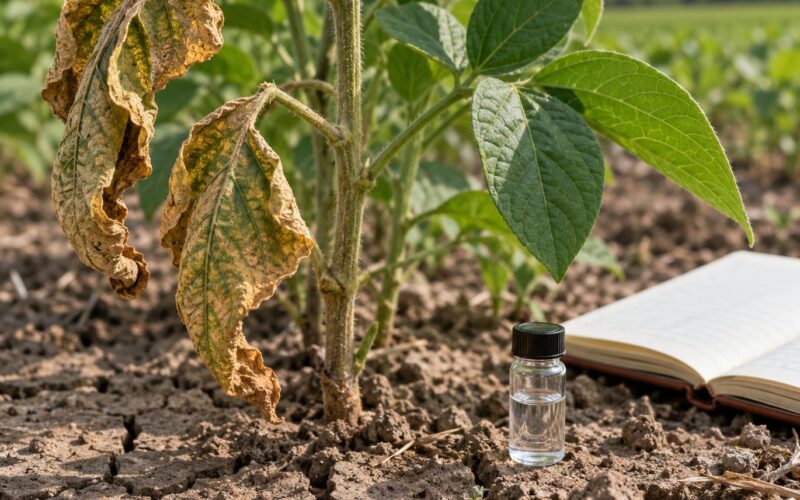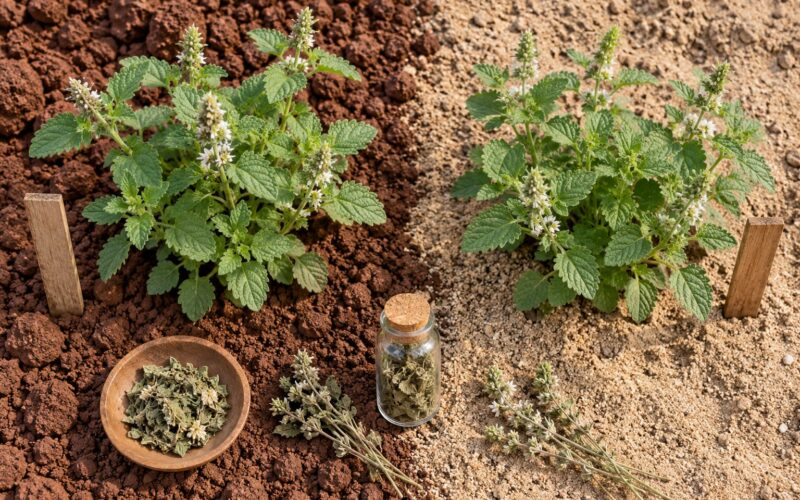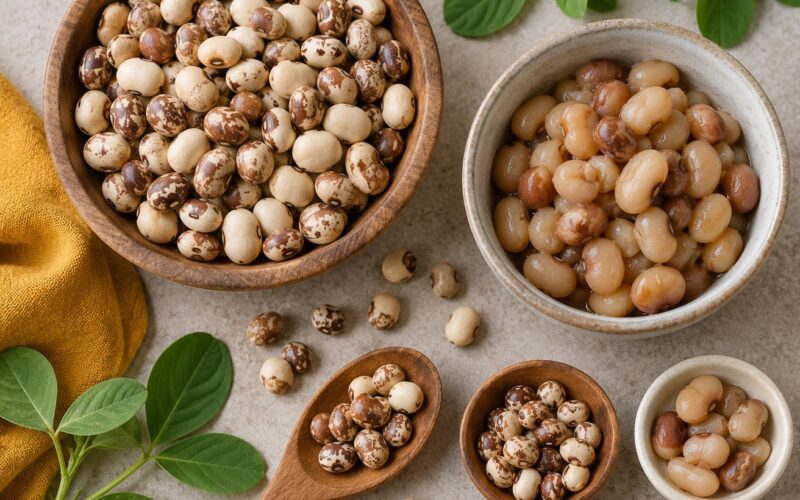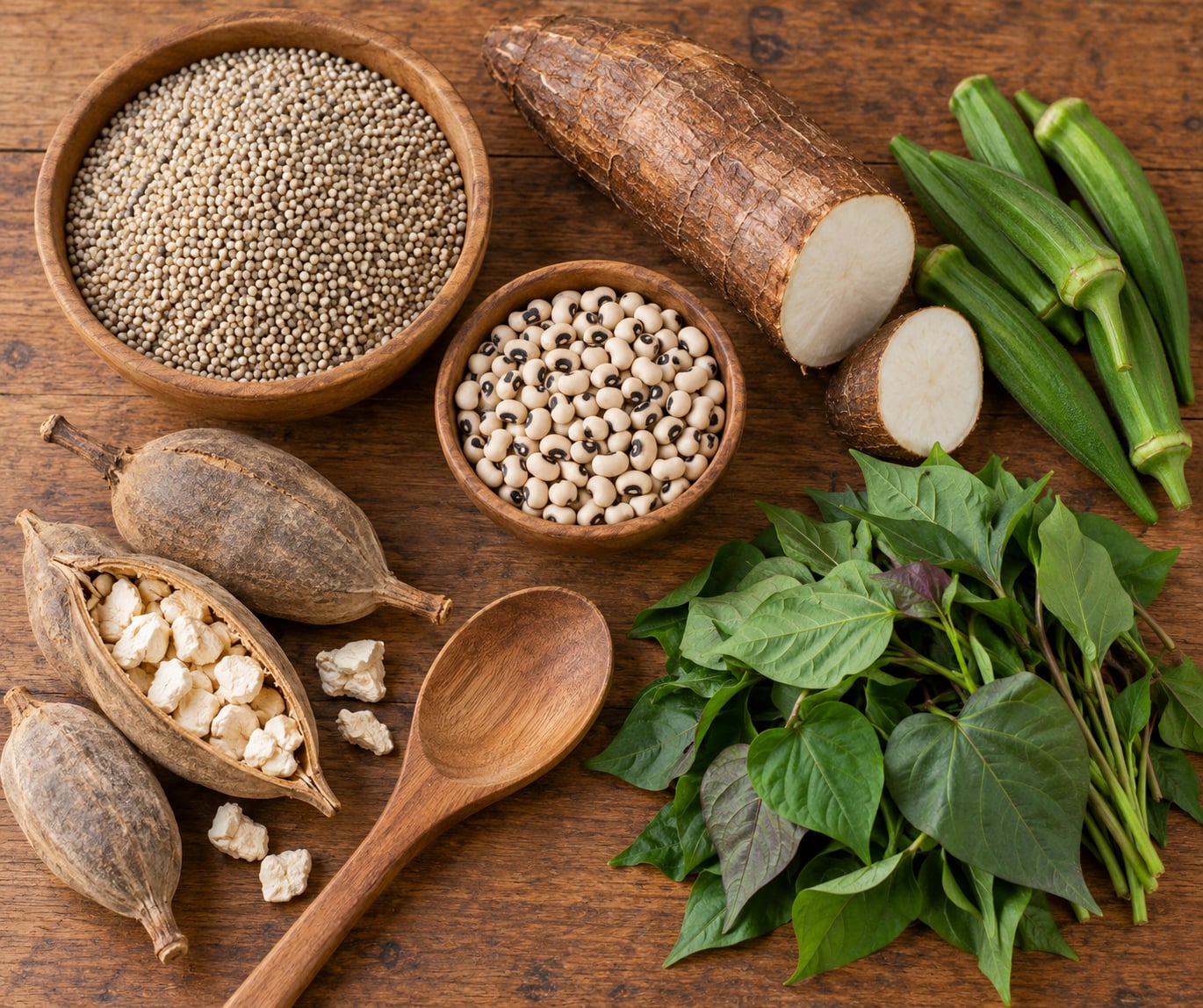
Indigenous crops and food security are linked because most of the crops that smallholder farmers in Africa, Asia and Latin America grow for themselves are locally domesticated, locally adapted and often ignored by commercial agriculture. These plants supply the calories, vitamins, minerals and cash that keep rural households fed through a bad season, and they do it with less water and fewer purchased inputs than the major world cereals.
They are not a solution on their own. This guide explains what indigenous crops are, how each of the four pillars of food security depends on them, where their limits lie, and what it takes to keep them in the field and on the plate.
Table of Contents
- 1What Are Indigenous Crops?
- 2The words that describe them, and why they changed
- 3Why Were Indigenous Crops Historically Overlooked?
- 4How Do Indigenous Crops Support Food Security?
- 5Which Indigenous Crops Are Important Across Africa?
- 6What Is the Role of Indigenous Crops in Nutrition?
- 7How Do These Crops Affect Climate Resilience?
- 8Farming systems, not single crops, carry the resilience
- 9Why Are Farmers Still Choosing Modern and Local Crops Together?
- 10What Challenges Limit Indigenous Crop Food Systems?
- 11How Can Indigenous Crops Be Better Supported?
- 12Keep seed systems local and funded
- 13Put research on a farmer-first footing
- 14Buy food from schools and hospitals
- 15Invest in small local processing
- 16Make markets fair and information honest
- 17Frequently Asked Questions
- 18What does indigenous mean when applied to crops?
- 19What are indigenous food systems?
- 20What is the biggest cause of food insecurity?
- 21How do indigenous crops support food security in practice?
- 22Are indigenous crops more nutritious than common commercial crops?
- 23Why are indigenous crops neglected by researchers and policymakers?
- 24Conclusion
What Are Indigenous Crops?
Indigenous crops are plant species domesticated, selected and stewarded by a particular people in a particular region over many generations. That long local selection is what makes them distinctive: the varieties carry traits that suit local soils, rainfall patterns and pests, and they carry the knowledge of how to grow, cook and store them.
Three terms get mixed together in everyday writing. Native means the species originated in that region without human selection. Indigenous means it was domesticated and has been stewarded there by local people. Indigenous food systems go further and describe the whole practice: the crops, the wild foods gathered alongside them, the processing, the seasonal calendars, the language and the rules about who harvests and shares what.
You will also see orphan crops, neglected crops, forgotten crops and underutilised crops in the literature. These are research categories, not community ones, and the framing has drawn criticism. A 2022 essay in Trends in Plant Science argued that calling these plants orphans erases the people who have selected, traded and improved them for centuries. I use indigenous crops here because it credits the stewards rather than the neglect.
The words that describe them, and why they changed
Researchers have needed a category for crops that fall outside the major commodities, and the labels drifted over decades. Underutilised crops were described as having unrealised potential. Neglected and minor crops were described as having been passed over. Forgotten crops were described as having dropped out of active cultivation. The word orphan came later and stuck, mostly because it is memorable, which is also its problem.
The argument against the framing is not cosmetic. If a variety is only neglected because research funding, commercial breeding and trade policy ignore it, then the fix is policy and money, not a new name. Describing these plants as neglected implies nobody is using them, when in many districts they are the food half of the household diet. Community organisations have asked for terms like neglected and underutilised to be used critically, with the reason for the neglect stated plainly.
A useful glossary for the rest of this guide: agrobiodiversity is the variety of crops, wild relatives and farming practices within a food system. Germplasm means the living seed and plant material that carries that variety. A smallholder farmer is someone farming a few hectares or less with family labour, which describes most of the farmers this article is about.
Why Were Indigenous Crops Historically Overlooked?
Four things stacked up, and none of them was that farmers lost interest.
Research funding follows trade volume. Millets, sorghum and teff are important regionally, but the money, the journals and the breeding programmes followed the crops that moved through global commodity markets, above all wheat, rice and maize. Anything below a certain tonnage stayed on the shelf, and its genetics went uncharacterised for decades. The argument that European and North American research systems also prioritised species and problems inside their own regions has been made repeatedly in the plant science literature.
Research infrastructure was built around the biology of those same crops. Genome references, marker-assisted selection protocols and field trial networks all assumed traits such as a self-pollinating spike or a standardised grain size. Crops with complicated reproductive biology, including many legumes and vegetatively propagated roots, needed different techniques and were simply not easy to include.
Commercial breeding is a business, and breeding pays where the market pays. A vegetable line that fails germination in one trial cycle wipes out the investment. Add limited shelf life, low market price and no guaranteed buyer, and a breeder has a clear reason to move on. The same logic pushed many of these crops out of commercial catalogues, which is the problem seed savers across several continents keep running into: the variety exists, but it cannot be bought.
What has changed is tooling. Affordable DNA sequencing, high-throughput phenotyping that measures whole plots rather than single plants, and speed breeding that can push generations in months now make it possible to study crops that were previously too awkward. Breeders working on heat and drought tolerance in wheat, rice and maize are actively looking to wild relatives and under-studied crops for the traits they need.
That shift raises a question about who benefits and who is paid. When a locally stewarded variety ends up inside a commercial breeding programme or a patent, the communities that selected it were not necessarily asked, and much of the benefit goes elsewhere. Informed participation, prior consent and benefit sharing are the terms these communities and organisations use, and the research ethics conversation has not settled on common rules yet.
None of this means these crops are untouched by the global food system. Many are widely traded, and the same variety can be indigenous in one region and an introduced cash crop in another. The labels describe a relationship between a plant and the people who keep it, not a permanent property of the seed itself.
How Do Indigenous Crops Support Food Security?
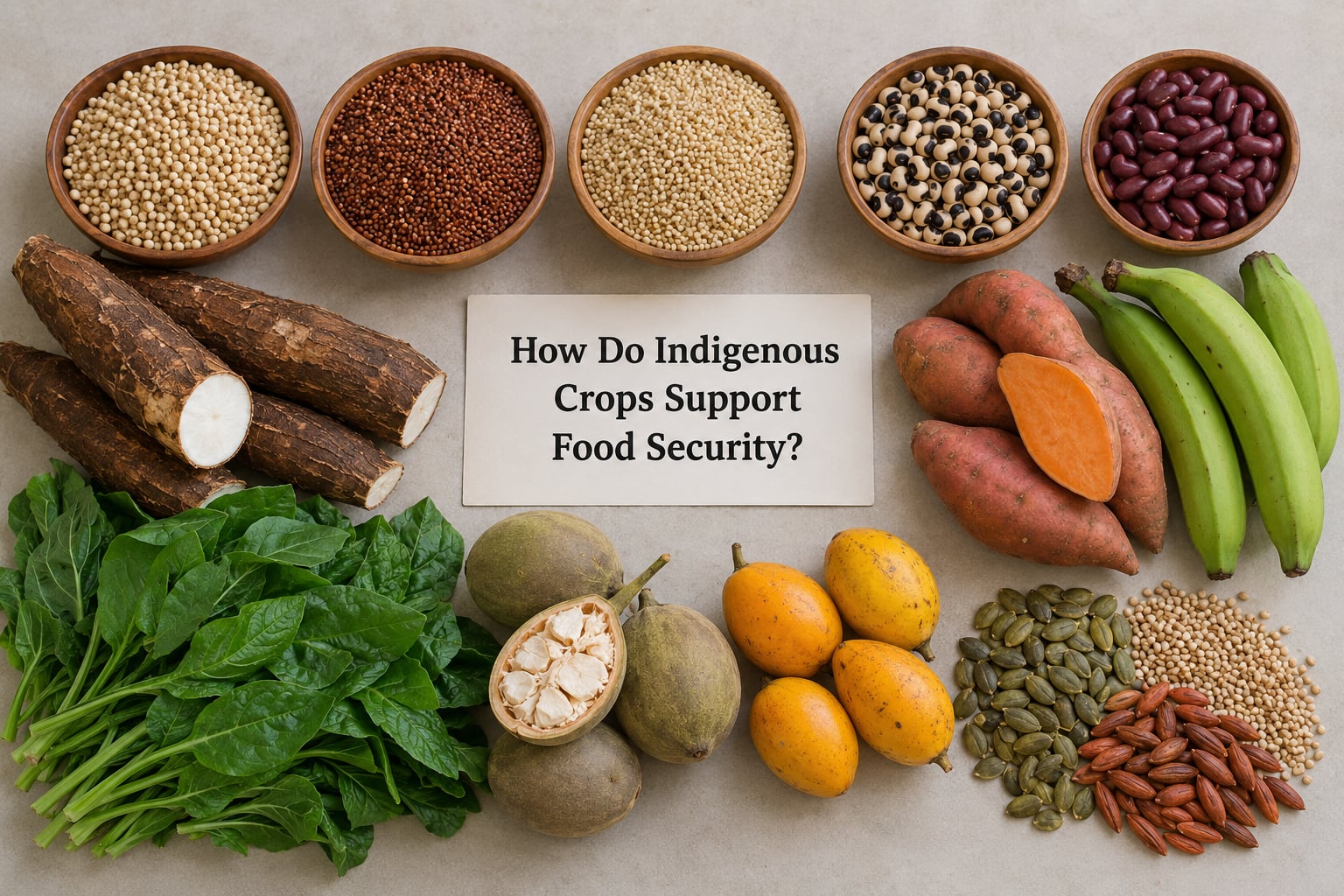
Food security means all people have physical, economic and social access to sufficient, safe and nutritious food at all times. The Food and Agriculture Organization of the United Nations splits that into four pillars, and each one has a specific link to crop diversity.
| Pillar | What it asks | How indigenous crops contribute | Where it can fall short |
|---|---|---|---|
| Availability | Is there enough food produced? | Crops that mature fast, tolerate heat and drought, and hold in storage cover seasons when a single staple fails | Many grow well but yield less per hectare than improved cereals |
| Access | Can people afford it? | Smallholders produce the same food they buy, so production and income land in the same household | Cash crops, land pressure and seed cost can push households out of growing |
| Utilisation | Does the diet nourish? | Legumes, millets, leafy greens and fruit add protein, iron, zinc and vitamins to starch-heavy diets | Traditional foods can be eaten in small quantities, which limits real intake |
| Stability | Is food there year after year? | Many species in one system means a pest or weather shock hits one crop, not the whole harvest | Seed access, processing and market distance reduce the buffer |
The pillars interact. A crop that survives drought only helps if people can store it, sell it at a fair price and eat a meaningful portion of it. A leafy green rich in iron and vitamin A does little for nutrition if it is gathered occasionally as a side dish rather than eaten most days of the week.
Indigenous food systems also carry wild foods that never appear in yield statistics at all: forest fruits, tubers, leaves, honey and meat from managed landscapes. In many rural communities those wild foods are eaten more regularly than the harvest crops, and they arrive exactly in the lean months before grain ripens.
Which Indigenous Crops Are Important Across Africa?
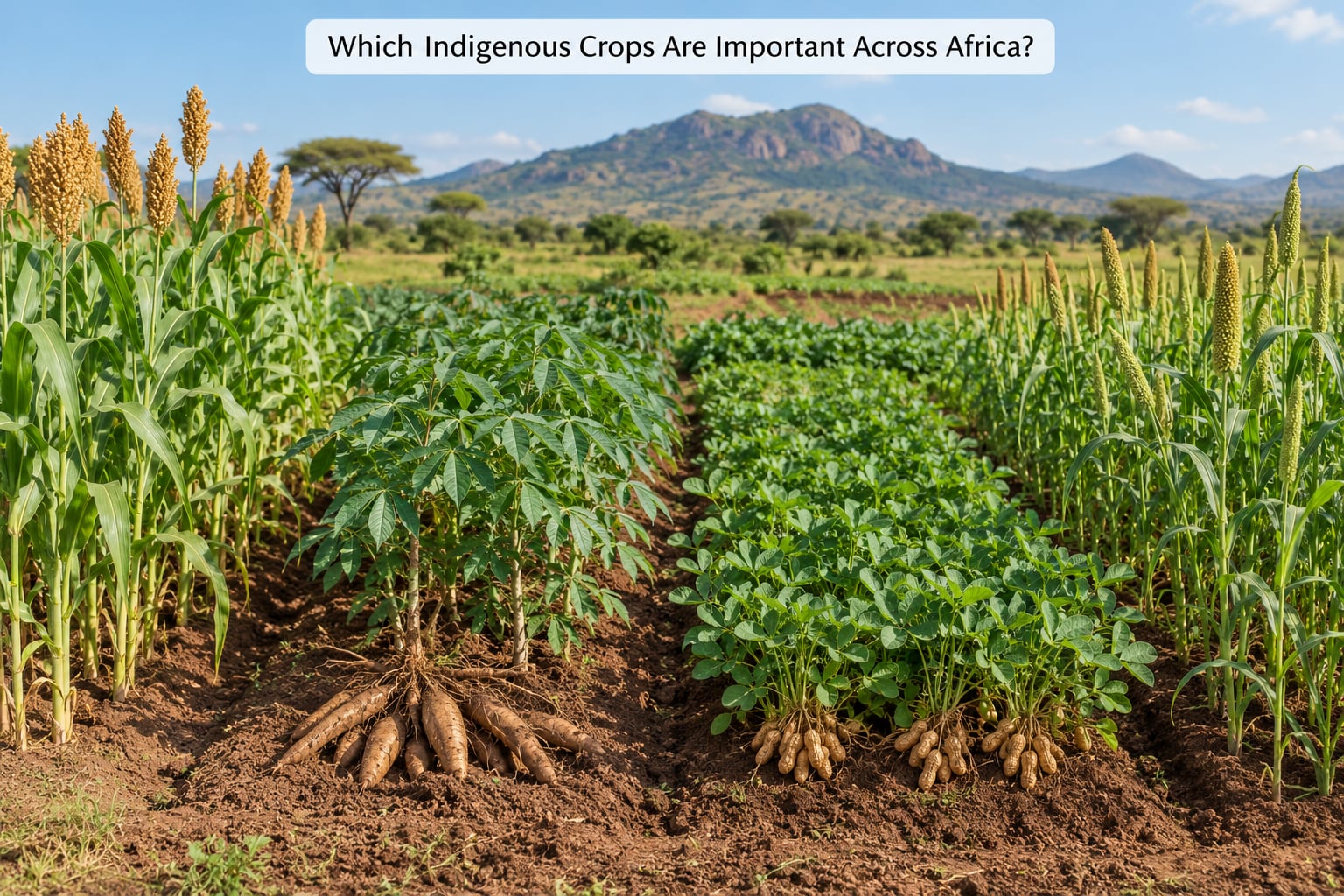
Crops differ by region, and nothing on this list is universal. Teff, for instance, is a staple in Ethiopia but almost unknown at the coast, while plantain is central in West and Central Africa and rare in the Sahel. The table below gives representative examples with the roles they play and the conditions they handle.
| Crop | Group | Main food role | Strengths | Where it matters |
|---|---|---|---|---|
| Pearl millet | Cereal | Porridge, flatbreads, flour | Short cycle, drought and heat tolerant, stores well | Sahel and Sudan savanna |
| Sorghum | Cereal | Porridge, flatbreads, brewing | Deep roots, handles poor soil, good storage | Dry eastern and southern Africa |
| Fonio | Cereal | Porridge and couscous-type dishes | Matures in weeks, tolerates sandy soil | West African highlands |
| Teff | Pseudocereal | Injera and flatbread | Fine grain, naturally gluten-free, high mineral content | Ethiopia and Eritrea |
| Maize | Cereal | Porridge, maize meal, livestock feed | High yield potential, many uses | Central, eastern and southern Africa |
| Cowpea | Legume | Beans, leaves, groundnut-style dishes | Fixes nitrogen, tolerates dry spells | West Africa and the Sahel |
| Bambara groundnut | Legume | Pulses and flour | Heat and drought tolerant, long storage life | West African savannas |
| Pigeonpea | Legume | Pulses, leaves, animal feed | Deep rooted, fixes nitrogen, tolerates poor soils | East and southern Africa |
| Cowpea leaves and okra | Leafy and fruit vegetables | Sauces, soups, relish | Fresh supply, nutrient dense, multiple harvests | Across West and Central Africa |
| Cassava | Root tuber | Fufu, gari, chips | Very high yield on poor soil, survives drought spells | Cassava belt from West to East Africa |
| Yams | Root tuber | Boiled or pounded yam dishes | Stores for months, culturally central | West Africa and the Lower Niger |
| Sweet potato | Root tuber | Roots, leaves, animal feed | Wide harvest window, grows at altitude | East African highlands |
| Baobab leaves and fruit | Tree fruit and leafy | Sauces, soups, confectionery | Deep roots, survives dry seasons | Sahel, East and Southern Africa |
| Moringa leaves and drumsticks | Tree leaf and pod | Sauces, soups, leaves | Fast-growing, leafy year round | East Africa and the Sahel |
A word on origins. Maize, cassava, sweet potato, plantain and amaranth reached Africa through historical trade and were then adopted and reshaped by African farmers into far more than a dozen local varieties each. Indigenous status is not fixed at the moment of arrival; it belongs to long, continuous local stewardship, including the selection of the varieties grown today.
What Is the Role of Indigenous Crops in Nutrition?
The nutritional case rests on diversity rather than on any single superfood. Millets, sorghum, teff and fonio are cereals, so they mostly supply carbohydrate, but they also bring iron, zinc and protein levels that often look good for their size.
Legumes are where the biggest shift in diet quality comes from. Cowpea, pigeonpea, Bambara groundnut and African yam bean combine carbohydrate and protein, fix nitrogen for the following crop, and add protein to a plate that would otherwise be starch with a sauce.
Leaves and fruits do different work again. Okra, Ethiopian kale, sweet potato leaves, moringa leaves and baobab leaves appear as vitamin A, iron, folate and calcium sources in diets that are short on animal protein. Fruit such as baobab, masau and wild berries supply vitamin C around the lean season when staples run down.
Traditional foods complement rather than automatically replace a varied diet. Several points matter. Harvesting models set a ceiling: a leaf eaten once a week does not fix a deficiency. Processing changes nutrient levels, and soaking, fermenting, drying or cooking alters what survives in the plate. Portion sizes are small and often bulked with starch, so the practical contribution is lower than the food composition tables suggest.
This is general information, not dietary or medical advice. Anyone with a specific nutritional need, including children, pregnant people and those managing a health condition, should ask a doctor or a registered dietitian for individual guidance.
How Do These Crops Affect Climate Resilience?
Resilience comes from several separate traits, and it helps to keep them apart. Short growing cycles matter when the rains start late, because a variety that matures in 90 days can still ripen in a season that would kill a 140-day crop. Deep rooting and good heat tolerance let plants keep drawing water during short dry spells.
Crop diversity is the bigger buffer. When a family grows five species, a rust outbreak or a caterpillars outbreak that destroys one leaves the rest. When the same field grows only maize in one variety, one pathogen can take the entire harvest and the family’s income with it.
Seed-saving practices add another layer. Growers who keep seed from their own best plants adapt year by year to their own soil and rainfall pattern. Seed kept in a community seed bank preserves many varieties at once, which is why they matter for conservation as much as for farming.
The honest side of this is that no crop is climate-proof. Heat tolerance at the flowering stage still matters; a crop can survive drought and then lose its grain if temperatures spike during pollination. Pests and diseases move as the climate shifts, and some insect and fungal pressures are already higher in some regions than the varieties were selected for. Rainfall patterns are changing in ways that reward short cycles in some districts and hurt them in others. Resilience is a portfolio, not a single variety.
Wild and tree foods add another dimension. Baobab, shea, moringa and many forest fruit trees hold their leaves or fruit through dry periods when annual crops have failed entirely, and agroforestry spreads risk across soil, canopy and annual crop at once.
Farming systems, not single crops, carry the resilience
No one of these crops is climate-proof on its own, and most of the useful evidence sits at the level of the whole system.
Intercropping puts two or more species in the same field at the same time. Millet or sorghum alongside cowpea means the legume covers the ground the cereal cannot shade, fixes nitrogen for the following season, and puts protein on the table. The risk is split, the labour is spread across the season, and the household harvests two things instead of one.
Agroforestry layers the system vertically. Trees supply fruit, leaves, fodder and shade while annual crops grow underneath and in between. Because tree crops mature over years rather than months, they hold value through a drought that wipes out a cereal harvest, and they keep living soil covered.
Conservation agriculture leans on the soil rather than the plant: minimal disturbance, continuous cover, and rotations that keep roots in the ground. Practices like this pair well with indigenous crops because many of them already suit short cycles, low input and residue that can be left on the surface.
Rain-fed farming is the baseline condition for most of the households discussed here, not a special case. Varieties chosen for a 400 millimetre season will not necessarily perform in a 700 millimetre season, which is the practical argument for keeping many local varieties in circulation instead of narrowing to a few nationally promoted lines.
Why Are Farmers Still Choosing Modern and Local Crops Together?
Very few farmers choose one system. Most plant a mix, and the interesting question is why each piece stays in the field. Improved varieties win on yield, uniformity and storage in good years with good inputs. Local landraces win on reliability in bad years and on taste, fodder and cultural fit. A mixed plot usually out-performs either extreme.
| Criterion | Indigenous and local landraces | Improved varieties | Mixed systems |
|---|---|---|---|
| Yield per hectare in good weather | Often lower and more variable | Higher and more uniform | Between the two, with less total risk |
| Performance in drought or heat | Usually selected for local stress | Varies by trait, better in some lines | Loss in one species is covered by others |
| Nutritional range | High, because many species are grown | Focused on calories and yield | Calories plus micronutrients |
| Processing burden | Husking, dehulling or pounding takes time | Less hand processing | Divided between household members |
| Market access | Thin demand outside local markets | Well understood by buyers and millers | Steady cash crop plus food and fodder |
| Seed access | Depends on community storage and exchange | Bought each season, sometimes costly | Lower cash outlay, more options |
Food security and food sovereignty are often confused. Food security is the outcome, defined by the FAO and measured at household and national level. Food sovereignty is the movement position: control of seed, land, labour and food policy should sit with the people producing the food. A household can be food secure and not food sovereign, and it can hold sovereignty in seed while still going hungry in a bad year.
That is the honest answer: the promise is real, the constraints are real, and the crops belong in a portfolio rather than in a replacement narrative. A cereal that tolerates drought can still lose its yield if rain arrives at the wrong moment, and a leafy green can be nutritionally excellent and eaten twice a month.
What Challenges Limit Indigenous Crop Food Systems?
These barriers are connected, and solving one in isolation rarely helps. Seed access is the starting point. Commercial catalogues offer a narrow set of hybrids, so community-specific varieties are hard to find outside the region, and every season spent buying seed is money out of the household. Where seed is saved and exchanged locally, that cost disappears.
Processing is the quiet bottleneck. Dehulling, milling, pounding and drying take hours that frequently fall on women, and mechanical equipment is rarely affordable at farm scale. Crops that sit unprocessed in the field are crops that rot in the field.
Land pressure follows from population growth, urban expansion and the expansion of commercial and industrial agriculture. Indigenous crops are often the ones displaced first, because they carry no input requirement and no guaranteed buyer. Deforestation removes wild food species that nobody had to plant.
Markets work the other way too. A millet or tamarind harvest with one buyer and no storage option gives the buyer most of the bargaining power, so farmers shift toward crops with guaranteed markets and away from food crops they know how to eat.
Then there is knowledge. Documentation by outside researchers has often recorded crop names and uses without recording who holds that knowledge or sharing any benefit from it. Loss of language removes the vocabulary that encodes medicinal, culinary and seasonal knowledge of a plant. Women hold much of the processing and nutrition knowledge, and they carry the heaviest labour load at the same time. Youth see few economic reason to stay in low-return food crop farming.
Nutrition awareness completes the picture. A traditional vegetable can be nutritionally valuable and still be eaten rarely, because it is treated as a poor person’s dish or as a side dish, not as a staple. Public health advice that promotes variety without naming specific affordable local foods does not change plates.
How Can Indigenous Crops Be Better Supported?
Most of the interventions that work are unglamorous. Here is what the evidence keeps pointing to, without prescribing what any particular community should do.
Keep seed systems local and funded
Community seed banks, seed fairs and farmer-to-farmer exchange preserve many varieties and keep seed costs near zero. They need steady support for storage, documentation and record-keeping, because a bank that is not funded for a few seasons quietly loses lines.
Put research on a farmer-first footing
Farmer-led and participatory variety selection, where growers choose among lines under their own conditions, tends to produce results that fit the field. Breeders elsewhere draw on the same genetic diversity for heat and drought tolerance, which is a benefit-sharing question as much as a science one: where a locally stewarded variety is used in a commercial programme, the community should be consulted and compensated.
Buy food from schools and hospitals
Public procurement creates a predictable market and puts traditional staples into institutional meals where children eat them regularly. One of the strongest effects is familiarity, and familiarity is what changes how often a crop is eaten at home.
Invest in small local processing
Mechanical dehullers, solar dryers and village mills remove hours of hand work and cut postharvest loss. Processing close to the farm also keeps more of the value in the community.
Make markets fair and information honest
Storage facilities, quality standards and clear price information reduce the power imbalance between a single smallholder and a single buyer. Nutrition education works best when it names actual crops, actual dishes and actual prices rather than advising variety in the abstract.
Gardeners and seed savers outside these regions have a smaller but real role. Growing regionally adapted landraces, buying seed through community exchanges, and respecting the boundaries between learning about a plant and claiming it are all useful. The framing matters: the practice of saving and passing seed on is the cultural value, not just the genetics in the packet.
Frequently Asked Questions
What does indigenous mean when applied to crops?
Indigenous means the crop was domesticated and selected by local people in that region and has been stewarded there over generations. It is different from native, which only means the species grew there originally without human selection, and different from local, which can describe any variety grown nearby. The word credits the people who kept the variety in cultivation.
What are indigenous food systems?
Indigenous food systems are the whole practice, not just the seed list: locally domesticated crops plus wild foods, the processing methods, seasonal calendars, food customs, and the rules about who harvests and shares. They are managed as whole landscapes that include agroforestry, forests and livestock. Understanding indigenous crops and food security explained means looking at the system, not counting the harvest.
What is the biggest cause of food insecurity?
There is no single cause. The most cited drivers are conflict and displacement, poverty, unstable prices and climate shocks, followed by weak access to land, water, credit and markets. In much of sub-Saharan Africa the biggest constraint is access rather than aggregate food supply, which is why household production of crops that tolerate local conditions matters so much.
How do indigenous crops support food security in practice?
They work through all four pillars at once. Short growing cycles and drought tolerance protect availability in a bad season, home production protects access to both food and income, legumes and leafy greens add protein and micronutrients to the diet, and several species spread risk so one pest or weather event does not wipe out a whole harvest.
Are indigenous crops more nutritious than common commercial crops?
Not automatically. Many are rich in iron, zinc, protein and vitamin A, and eaten together they give a broader nutrient range than a diet built on a few cereals. But real intake depends on how often a crop is eaten, how much of it is eaten, and how it is processed. Small portions and infrequent use limit the practical benefit.
Why are indigenous crops neglected by researchers and policymakers?
Historically research money followed the major world calorie crops, and European research systems prioritised species and problems outside their own region. Complex breeding biology, low market value and thin seed markets added to the gap. Cheaper DNA sequencing and high-throughput phenotyping are now opening the field, and many communities object to the older orphan crop framing.
Conclusion
Indigenous crops and food security explained comes down to one relationship: crops that people have been selecting for generations are adapted to the places they are actually grown, and the households that keep them are the same households that eat them. That covers all four pillars of food security at once, from availability in a dry season to nutrition on the plate and stability across years.
The practical first step is unglamorous. Keep the seed moving through community seed banks and local exchange, support local processing so the crops can actually be stored and eaten, and make sure the buying, growing and teaching around them is done with the communities who steward them rather than on their behalf. Protect the diversity, and fix access to it.