Climate change affects medicinal plants through four linked pathways: warming and erratic rainfall shrink the habitats where they grow, change their chemical makeup, reduce and destabilise harvests, and raise the risk of contamination. The pressures are well documented; the effect on any single species is far less certain, and varies widely.
That distinction matters more than it sounds. Readers often hear that medicinal plants are “being changed by climate” and assume a uniform trend. There isn’t one. A high-altitude species with nowhere left to move is in a completely different position from a widespread woodland tree, and a drought-tolerant root used in traditional medicine responds to water stress differently from a moisture-loving leaf.
Table of Contents
- 1How Climate Change Affects Medicinal Plants: Key Effects
- 2Why Climate Change Is a Threat to Medicinal Plants
- 3How Climate Change Affects Plant Growth, Harvests and Survival
- 4Altered rainfall and higher temperatures
- 5Range shifts and uphill migration
- 6Flowering and leaf timing
- 7Drought, flooding and waterlogging stress
- 8Pests, disease and pollinators
- 9Changes in useful plant compounds
- 10What Evidence Exists for African Medicinal Plants
- 11Named species worth watching
- 12Effects on Traditional Knowledge, Livelihoods and Health
- 13What Can Protect Medicinal Plants and Their Knowledge
- 14Frequently Asked Questions
- 15Are all African medicinal plants becoming rarer because of climate change?
- 16Can higher temperatures make medicinal plants more potent?
- 17How do scientists know when a medicinal plant is changing?
- 18What is the safest response for someone who relies on traditional medicines?
- 19Conclusion
How Climate Change Affects Medicinal Plants: Key Effects
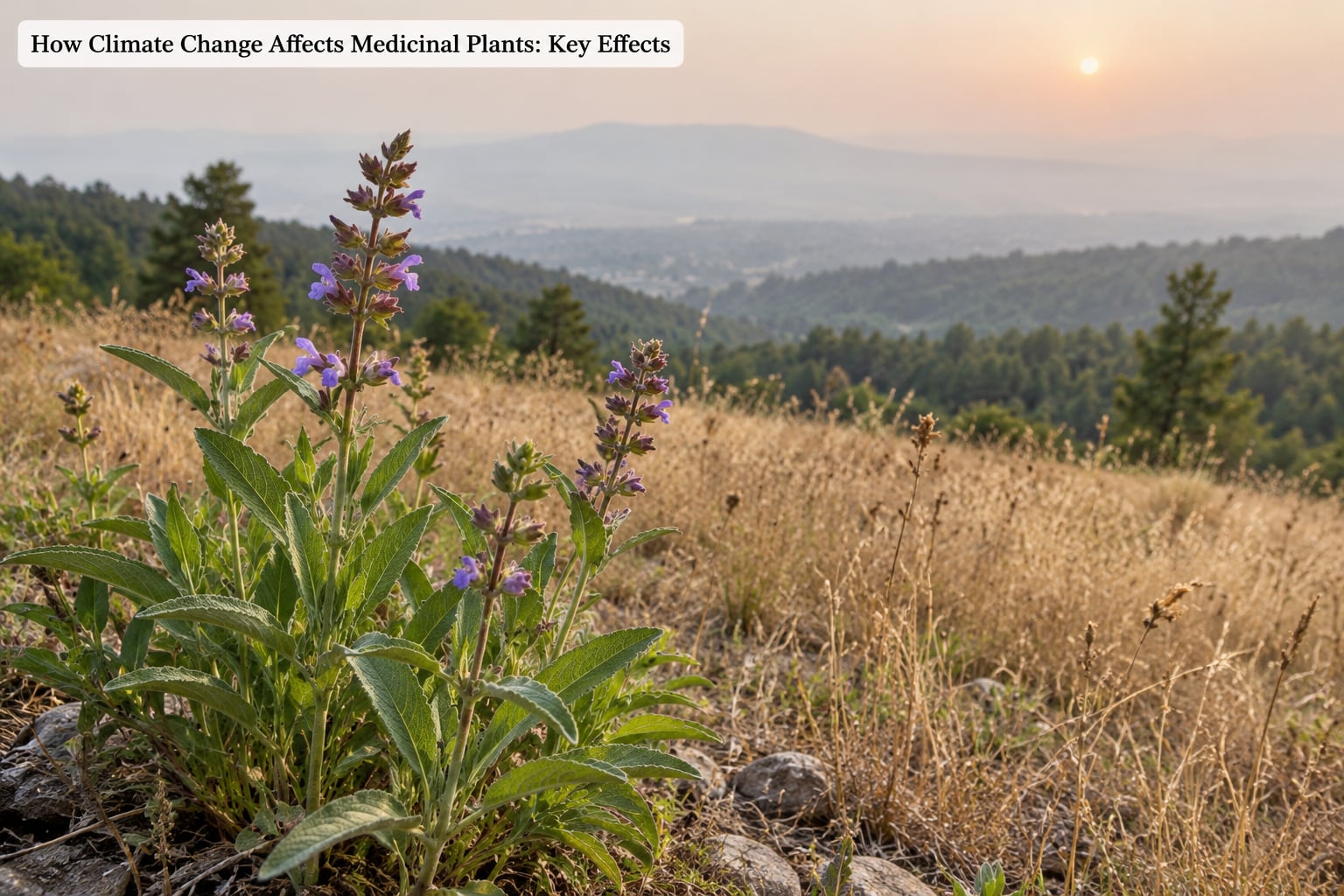
The main ways climate change affects medicinal plants fall into eight groups, and they compound each other rather than arriving separately.
- Range contraction: suitable habitat shrinks at warm range edges and moves uphill or polewards.
- Phenological shifts: flowering, fruiting and leaf flush happen earlier, sometimes outside the window collectors and pollinators expect.
- Altered chemistry: heat, drought, extra carbon dioxide and UV-B shift the production of alkaloids, terpenoids, flavonoids and tannins.
- Drought and heat stress: growth slows, leaf area drops, essential oil yields move, and plants fail to set seed.
- Flooding and waterlogging: root rots and root-rot pathogens expand into areas that were previously well drained.
- New pest and disease pressure: insect vectors and fungal pathogens spread into ranges that were previously too cold.
- Pollinator disruption: flowering and pollinator activity drift out of sync, cutting fruit and seed set.
- Regeneration failure: mature plants survive but seedlings do not, so populations thin out from below without obvious collapse.
Those eight effects are the mechanism layer. Everything else in this article sits on top of them.
Why Climate Change Is a Threat to Medicinal Plants
Medicinal plants are unusually exposed because a large share of traded material is wild collected, and wild plants have no irrigation, no canopy management and no reserve. A farmer who loses a crop season can replant next year. A slow-growing woodland tree harvested for bark may take decades to replace what one season of poor recruitment removed.
Several traits make a species fragile under warming. Restricted range is the big one: an endemic confined to one mountain or one coastal strip has nowhere to migrate to when its local climate crosses a threshold. Dependence on a narrow rainfall pattern is another, because many medicinal plants track specific seasonal cues to flower or germinate. Slow growth and a long generation time mean populations cannot recover quickly from a failed recruitment year. Habitat specialisation matters too, since a plant tied to a specific soil, altitude band or forest type cannot simply move.
None of this means every medicinal species will decline at the same rate. Some benefit from warmer conditions over part of their range, and a few expand into new areas. The honest summary is that climate change removes options for slow-moving species, and that option loss, not a single trend line, is the core risk.
One more complication sits alongside climate. Overharvesting, agricultural expansion and infrastructure remove plants from habitats that warming is already stressing. Climate and land-use pressure compound, so a wild stand can fail for reasons that have nothing to do with temperature alone.
How Climate Change Affects Plant Growth, Harvests and Survival
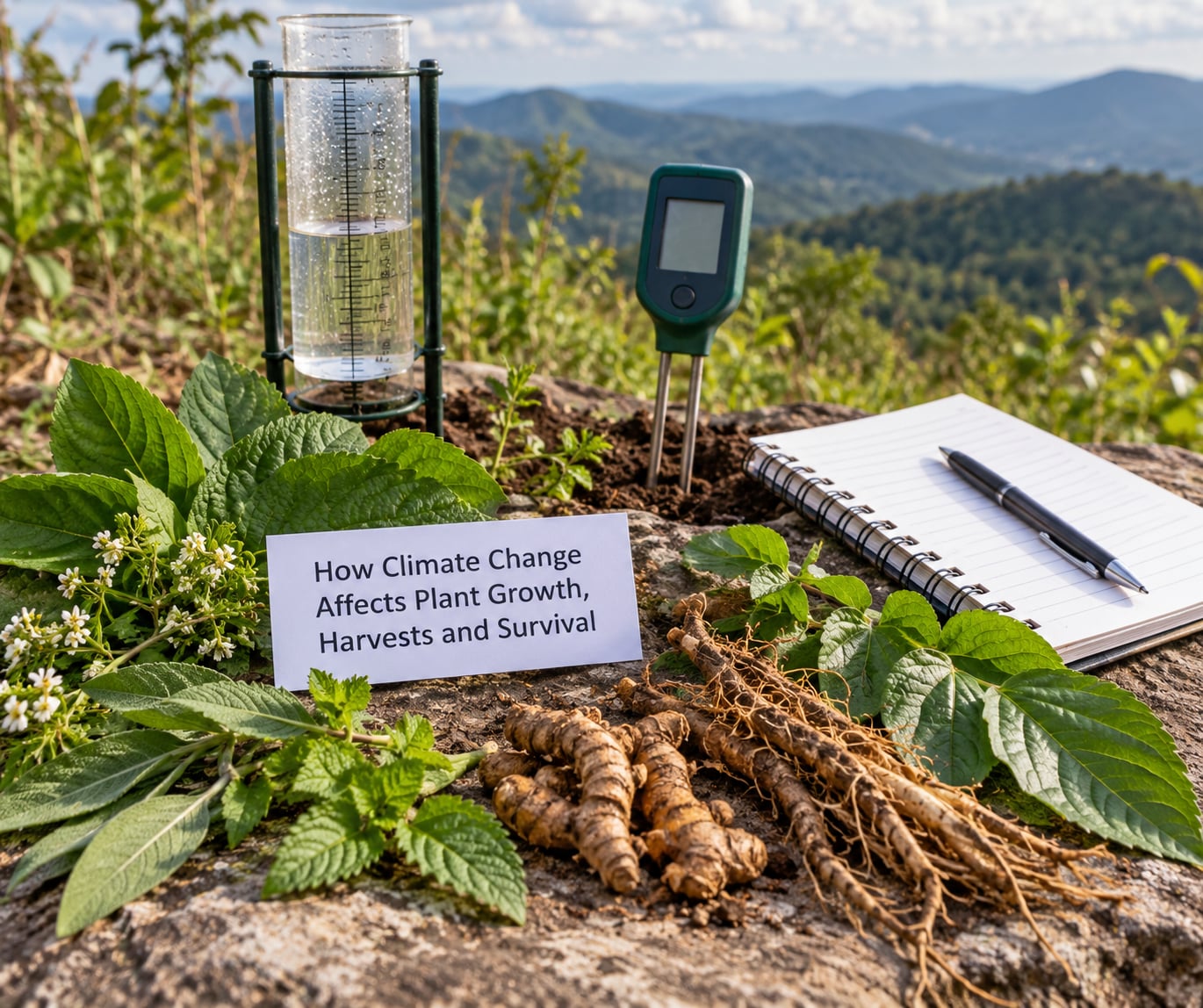
Altered rainfall and higher temperatures
Rainfall in most of Africa is becoming more variable rather than simply lower: longer dry spells punctuated by heavier events. That pattern matters more than the annual total, because many medicinal species germinate and flower on the timing of specific rains.
Heat adds a second, compounding stress. Plants close their stomata to conserve water, which cuts carbon fixation, growth slows, and flowering arrives early with fewer viable seeds. Sustained heat above a species’ thermal limit also damages leaf tissue directly, which shows up later as quality problems in dried material rather than as visible plant death.
Range shifts and uphill migration
As temperatures rise, the band of climate a species can tolerate moves upslope and towards the poles. For a plant already near a mountaintop, that band eventually slides off the top of the mountain. Modelling studies run for Himalayan medicinal plants have projected substantial losses of climatically suitable area for several high-elevation species, and a 2022 study in Ecology and Evolution documented that distributional change in Nepal’s Himalaya.
These are projections, not counts of dead plants, and they come with real caveats. Models work from climate layers and occurrence records, and African species distribution records are sparse in exactly the places that matter. Treat a percentage change in suitable area as a signal about direction, not a number to quote at a village meeting.
Flowering and leaf timing
Warmer springs pull leaf flush and flowering forward. For a household that has harvested the same plant in the same week for decades, the practical effect is that the collection calendar shifts underneath them, and material harvested on the old date may be thinner or less mature than before.
This is where practitioners report the most immediate disruption. Conversations in herbalist communities describe noticing earlier springs and flowering windows that no longer line up with remembered dates, and plants arriving later in a region than they used to. That kind of observation is anecdotal, but it is consistent in direction with the phenology literature.
Drought, flooding and waterlogging stress
Prolonged drought reduces biomass, which matters directly for harvested material: less leaf, thinner root, lower essential oil yield. Work on Bulbine species in South Africa reported that temperature fluctuations and water deficits significantly impede reproductive processes, which is a quieter problem than death, because populations can look healthy while seed supply falls.
The opposite extreme gets less attention. Heavier rainfall events raise water tables in low-lying harvesting areas, and waterlogged roots invite rot pathogens in soils where those pathogens could not previously persist.
Pests, disease and pollinators
Warmer conditions extend the active season for insect vectors and fungal pathogens, moving them into areas that were previously too cold. When the pathogen arrives before the plant has the chemistry to defend itself, losses can be severe in a single season.
Pollinator mismatch is subtler and increasingly common. If a plant flowers earlier than its insects emerge, fruit and seed set drop even in a year with no visible damage. For a harvested root or fruit, that shows up as a bad year for propagation rather than a bad year for medicine.
Changes in useful plant compounds
This is the part people find counter-intuitive, so it is worth being precise. Secondary metabolites are the compounds with medicinal activity: alkaloids, terpenoids, flavonoids, tannins, saponins, essential oils. The plant makes them for defence and signalling, not for us.
When a plant is stressed, carbon and nitrogen get reallocated between growth and defence. Under moderate stress, defensive compounds often go up, which is why drought-stressed plants can taste more bitter or resinous. Under severe stress the plant cannot afford defence at all, and levels fall. Carbon dioxide enrichment, which boosts growth in many species, tends to dilute nitrogen-containing compounds such as alkaloids and tannins, while some phenolics and terpenes rise. The direction of the effect depends on the species, the tissue, the season, and how severe and how long the stress was.
The 2023 meta-analysis in Global Change Biology by Sun and colleagues is useful precisely because it pools results across species rather than asserting one trend. It supports the general finding that climate drivers measurably change secondary metabolite content, and it supports the caveat that responses are species-specific. Any source telling you climate change simply makes herbs stronger or simply makes them weaker is oversimplifying the literature.
| Climate stressor | Likely plant response | Consequence for medicinal material | Evidence limitation |
|---|---|---|---|
| Higher temperatures | Earlier flowering, stomatal closure, shorter leaf lifespan | Harvest windows shift, leaf quality and yield drop | Well supported directionally; species responses vary |
| Variable rainfall and longer dry spells | Reduced biomass, earlier flowering, failed germination | Smaller harvests, inconsistent volumes year to year | Strong for crops, patchier for wild medicinal species |
| Extreme rainfall events | Waterlogging, root rot, soil nutrient loss | Root material quality declines, pathogen risk rises | Limited long-term datasets |
| Elevated carbon dioxide | Faster growth in many species | Higher biomass; some nitrogen-based compounds diluted | Mostly experimental and crop-based, not wild stands |
| Higher UV-B radiation | Increased flavonoid and phenolic production | Some protective compounds rise, composition shifts | Consistent in experiments, variable in field |
| New pests and pathogens | Defence activation, leaf and stem damage | Direct harvest losses, rejected material | Emerging; most reports recent and local |
| Pollinator decline or mismatch | Reduced fruit and seed set | Recruitment fails, future supply tightens | Hard to attribute to climate alone |
| Warming-driven range shift | Movement upslope, contraction at warm edges | Local wild populations disappear from customary areas | Mostly modelled, not yet long-term observed |
Read that last column as the important one. Almost every direction here is defensible, and almost none of them is precise enough to predict a harvest for one valley in one year.
What Evidence Exists for African Medicinal Plants
The evidence base for African medicinal species is thinner than for commercial crops, and it is uneven in kind. Three different types of information get mixed together in popular coverage, and it helps to keep them apart.
Direct observation covers what people on the ground have recorded: shifting collection dates, plants missing from known gathering sites, flowering earlier than in memory, changing insect damage. Practitioner and community monitoring is genuinely valuable here, because the longitudinal record simply does not exist elsewhere. It is observational rather than experimental, though, which means it documents change without proving its cause.
Controlled experiment covers growth chambers and field plots where a single stressor is applied. This is how most of the secondary metabolite findings were generated, including the work on Bulbine abyssinica, B. frutescens and B. natalensis that looked at how temperature and water deficit affect reproduction and medicinal properties. Experiments are clean but narrow, and a chamber result transfers to a wild hillside only with caution.
Modelled projection covers species distribution modelling, which maps current climate layers against future scenarios such as RCP 4.5 and RCP 8.5. This is how researchers produce the headline percentages for range contraction. It is fast and covers thousands of species, and it depends entirely on occurrence records that are dense in a few countries and nearly empty across much of Africa.
Against those three, the wider context matters. A multi-author group including Applequist published a “Scientists’ Warning” in Planta Medica in 2020, making the case that medicinal plant research, conservation and cultivation are under-resourced relative to how much the sector depends on wild material. Pant and colleagues have written on secondary metabolites and climate stress in Chemistry & Biodiversity (2021), adding to the same picture.
Three limits recur and are worth stating plainly. Baselines are sparse, so pre-change reference data often does not exist for a given site. Geography is biased, because well-funded national parks and research stations are over-sampled while remote harvesting areas are not. And historical harvest records are incomplete, so we rarely know what a population looked like forty years ago to compare it against today.
Named species worth watching
Several African medicinal plants come up repeatedly in the literature and conservation lists: Warburgia salutaris (pepper-bark tree), Prunus africana, Boswellia and Commiphora resin trees, Sutherlandia frutescens, various Bulbine, and Zanthoxylum species. What unites them is slow growth, restricted or fragmented distribution, and a bark or resin harvest that damages the individual plant when it is taken.
That last point is not climate, and keeping the causes separate matters for how you interpret a declining stand. A tree harvested for bark and a tree killed by drought look identical in a population count.
Effects on Traditional Knowledge, Livelihoods and Health
Ecological change reaches people through knowledge and income before it reaches anyone through medicine. When a plant no longer grows where it grew, the practical knowledge attached to that place goes with it: the harvest window, the preparation method, the part of the plant to take, and the substitutions used when it is missing. None of that is written down in a pharmacopoeia, and it is not recovered automatically by moving the same species somewhere else.
Knowledge transmission is also age-dependent. Younger practitioners learn a species in a place. If the species disappears from that place, the teaching pathway breaks, and the knowledge is lost even though the species still exists elsewhere.
Livelihoods are directly exposed. Wild collectors earn from a resource that is becoming less predictable, and they face pressure from both ends: less material in a poor year, and more intense collection in a bad year to meet demand, which damages the remaining stock. Women collectors in particular often carry a disproportionate share of this exposure, and the household-level effect is a drop in income rather than a headline in a paper.
On the health side, the honest position is that variability in plant chemistry and in harvest timing creates variability in preparations. That is a quality-control problem for anyone making remedies consistently, not a reason to stop using plants that are well established. It is not something a reader should try to solve by dose adjustment, and this article gives no guidance on that. Questions about any herbal preparation, including whether to start, stop or combine one with prescribed medicine, belong with a doctor or pharmacist who knows the patient’s history.
One safety point does belong here. Wild-collected material can carry heavy metals from polluted soils or from processing and drying sites, and contamination is a quality issue in its own right. Sample testing through an accredited laboratory is the only way to know what is in a given batch.
What Can Protect Medicinal Plants and Their Knowledge
The response is well understood in outline and badly resourced in practice. These are the priorities that come up repeatedly in the conservation and research literature.
Fund long-term local monitoring. Repeated measurements of the same plots over many years are the only way to separate climate effects from ordinary year-to-year variation. Community and practitioner observations are a legitimate part of this record, and they are cheap compared with building new research capacity.
Protect habitat, not just individual plants. A population that survives in intact habitat can recover. Removing a few trees from a forest patch does not help the species that needs the forest patch.
Restore degraded gathering areas with native species and, where appropriate, assisted natural regeneration, so collectors have somewhere to work that is not the last remaining wild stand.
Build cultivation capacity for species in genuine commercial demand, using locally adapted material and keeping seed and genetic resources available. Cultivation reduces pressure on wild stocks, but only if it does not create its own demand problem by making a scarce plant cheap to harvest destructively.
Support seed systems and ex situ conservation, including seed banks and botanical gardens, as insurance for species with restricted ranges. For slow-growing trees and plants with recalcitrant seed, field collections and living collections in nurseries often work better than dried seed.
Document knowledge respectfully and with consent. Recording harvest calendars, preparation methods and local names preserves information that will otherwise be lost with the habitat. It should be done with the agreement of the people who hold the knowledge, not extracted from them.
Make supply chains sustainable and traceable. Buyers who pay above a floor rate for verified wild-collected material reduce the incentive to overharvest. Traceability also helps buyers find out where a batch actually came from.
Work with African health authorities so that conservation priorities line up with national health policy and pharmacopoeia work, rather than running in parallel with it.
None of this is a harvesting instruction. The purpose is keeping populations viable over decades, not maximising extraction from a smaller number of plants.
Frequently Asked Questions
Are all African medicinal plants becoming rarer because of climate change?
No. Climate change removes options unevenly, not uniformly. Some species tolerate warming and can expand into new areas, while others with restricted ranges, slow growth or narrow rainfall requirements are the most exposed. Harvest pressure, agricultural expansion and habitat loss often remove plants faster than climate does, so a declining stand is rarely a climate signal on its own. Long-term monitoring of marked plots is what separates the causes.
Can higher temperatures make medicinal plants more potent?
Sometimes, for some compounds, in some tissues. Under moderate stress a plant may raise defensive compounds such as tannins, flavonoids or terpenes, which is why stressed material can taste more bitter or resinous. Under severe, prolonged stress the opposite happens, because the plant can no longer afford defence at all. Elevated carbon dioxide often increases growth while diluting nitrogen-based compounds such as alkaloids. There is no universal direction, so no general potency claim should be made.
How do scientists know when a medicinal plant is changing?
Through long-term field plots that measure flowering dates, leaf production, seedling recruitment, soil moisture and insect damage year after year. Harvest diaries from communities and practitioners add a record that usually has no research funding behind it. In parallel, growth chamber experiments apply single stressors to measure effects on growth and chemistry, and species distribution modelling projects where habitat may move under future climate scenarios. Each method has clear limits, which is why multi-year field data matters most.
What is the safest response for someone who relies on traditional medicines?
Keep using plants that are well established for you, sourced as you normally would, and do not change remedies or adjust quantities on your own because of climate-related news. If you are starting anything new, pregnant, managing a long-term condition or taking prescribed medicine, talk to a doctor or pharmacist first. For anyone making preparations regularly, batch testing for heavy metals and contaminants through an accredited laboratory is worthwhile, and any warning sign should be taken to a clinician rather than treated with a home remedy.
Conclusion
Climate change is shrinking and moving the habitats of medicinal plants, altering their chemistry, and making harvests less predictable, and the species most at risk are the slow-growing ones with nowhere left to move. The useful first step is unglamorous: support long-term local monitoring of known gathering areas and the communities who watch them, because without that record every species-level forecast stays a guess.
While that record builds, treat single-species projections with care, keep established medicinal uses unchanged, and take any personal health decision to a doctor or pharmacist rather than adjusting it on your own.