Mycorrhizal fungi explained for gardeners comes down to something simpler than the packaging suggests: these are soil fungi that partner with the roots of most land plants, extending the root system so plants can reach more water and nutrients in exchange for sugars made during photosynthesis. The name comes from the Greek mykor (fungus) and rhiza (root). Roughly 85 to 90 per cent of plant species form this association, which is why gardeners who understand it can stop treating soil as a bag of fertiliser and start treating it as a living system.
Most of what you read about mycorrhizal fungi is written by either a supplier or a sceptic, and both have an interest in the outcome. What follows is what the plant science actually supports, where the claims outrun the evidence, and what you can do in your own beds without buying anything at all.
Table of Contents
- 1What Are Mycorrhizal Fungi?
- 2They are not the same thing as mushroom compost
- 3How Do Mycorrhizal Fungi Help Plants?
- 4Which Plants Commonly Form Mycorrhizal Relationships?
- 5Plants that generally do not benefit
- 6What Does Mycorrhizal Fungi Explained for Gardeners Mean in Practice?
- 7How Can Gardeners Support Mycorrhizal Fungi Naturally?
- 8Keep living roots in the ground for as much of the year as you can
- 9Stop digging every year
- 10Plant a mix rather than a monoculture
- 11Use organic matter as a mulch, not just a feed
- 12Feed plants, not the whole bed
- 13Water sensibly
- 14Restrain the broad-spectrum pesticides
- 15Are Commercial Mycorrhizal Inoculants Worth It?
- 16The free version: transfer soil from under a healthy tree
- 17What Signs Suggest a Mycorrhizal Problem?
- 18How Does Mycorrhizal Science Connect with African Ethnomedicine?
- 19Frequently Asked Questions
- 20Can I see mycorrhizal fungi in my garden soil?
- 21Are mycorrhizal fungi always present in garden soil?
- 22Does planting a mycorrhizal plant guarantee better growth?
- 23Do fertilizers stop mycorrhizal fungi from working?
- 24Are organic fertilizers and compost better than mycorrhizal inoculants?
- 25Conclusion
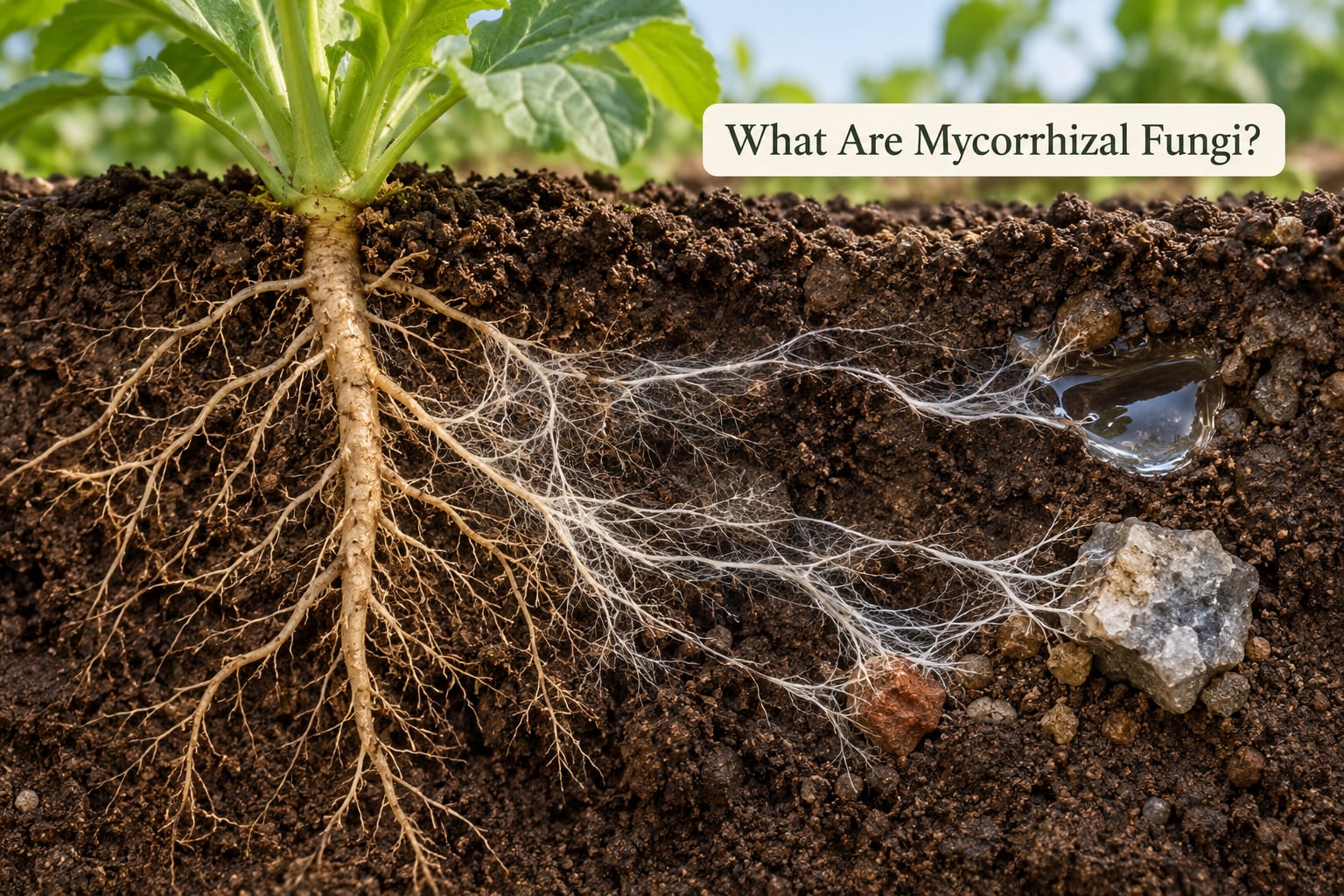
What Are Mycorrhizal Fungi?
Mycorrhizal fungi are fungi whose hyphae grow directly against or inside plant root tissue, forming a symbiotic association called a mycorrhiza. The fungus gets fixed carbon from the plant, and the plant gains a much larger absorbing surface, better access to phosphorus and micronutrients, and improved access to water. Around 85 to 90 per cent of plant species do this naturally, which makes it closer to a default condition than an unusual trait.
They are not the same thing as mushroom compost
The word fungus covers a lot of very different organisms, and the confusion is the single most common source of bad gardening advice. Three groups matter here, and they do completely different jobs.
Mycorrhizal fungi partner with living roots. Most are microscopic, living inside root cells or sheathing them, and they work quietly underground where you will never see them.
Decomposers break down dead organic matter: leaf litter, spent compost, woody debris. They release nutrients into the soil rather than fetching them for a living plant.
Pathogens are the fungi you are trying to avoid: damping-off moulds, mildews, rusts, wilts. They attack plants rather than feed on the trade.
The mushrooms that appear in a bed are often just the fruiting bodies of decomposers or of a mycorrhizal species whose host tree is nearby. A mushroom is a reproductive structure, not the working part of the partnership.
How Do Mycorrhizal Fungi Help Plants?
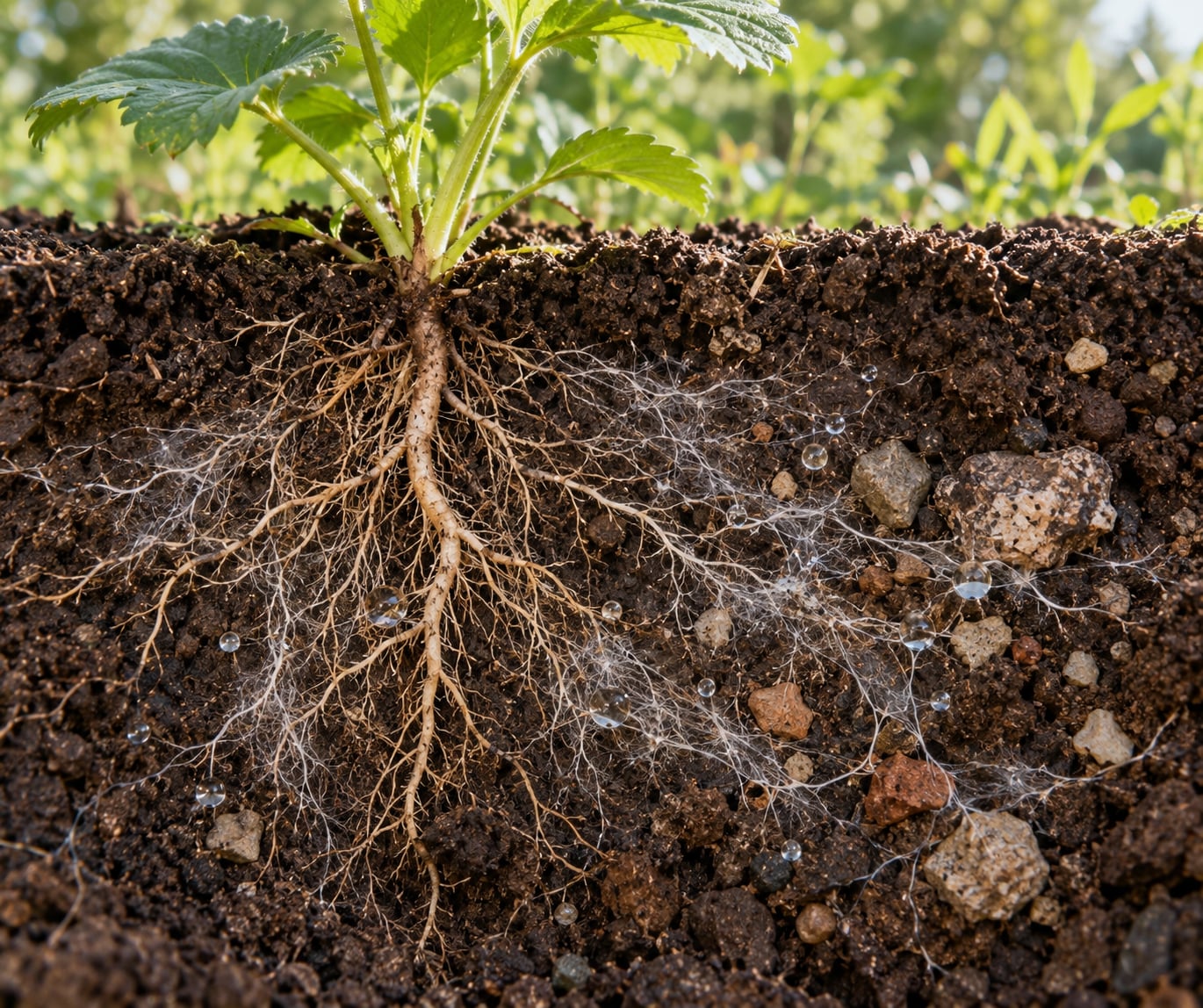
The fungus acts as a root extension made of thread. Root hairs are short and fine, so a plant’s absorbing surface is limited to the soil immediately around each root. Fungal hyphae, sometimes thinner than a root hair by a factor of fifty, push much further into small pores and into soil particles the roots physically cannot enter.
Effective absorbing surface can increase by anywhere from ten to a thousand times, depending on the host, the fungus and the soil. In a fertile bed with plenty of moisture, the advantage is modest. In compacted, cold, droughty or nutrient-poor soil, it is substantial.
| What the plant gives the fungus | What the fungus gives the plant |
|---|---|
| Sugars from photosynthesis, transferred into root cells | Phosphorus released from particles the roots cannot reach |
| Carbon, sometimes a meaningful share of the plant’s total | Zinc, copper, iron and other micronutrients pulled from tight soil bonds |
| Root surface and protected habitat inside the cortex | Water from fine pores during dry spells |
| Signals and lipids in some plant families | Suppression of some soil-borne pathogens through competition and induced resistance |
| Nothing for fungi that parasitise plants rather than partner with them | Aggregation of soil particles, improving porosity and water infiltration over time |
One thing worth stating plainly, because marketing rarely does: mycorrhizal fungi are not nitrogen fixers. They improve the delivery of what is already in the soil. If nitrogen is genuinely absent, the partnership cannot conjure it.
Nor is the benefit automatic. In a fertile bed, plants fertilised regularly often show little or no response to colonisation. The effect depends on the plant, the fungal species, the soil texture, moisture and how the plant is fed.
Which Plants Commonly Form Mycorrhizal Relationships?
Gardeners talk about two main types, and the difference matters because they suit different hosts. Most of what you grow is in the first group.
| Feature | Arbuscular mycorrhiza (AMF) | Ectomycorrhiza (ECM) |
|---|---|---|
| Where the fungus sits | Inside root cells, forming tree-like arbuscules | Between root cells, under a sheathing mantle with a Hartig net between them |
| Typical garden hosts | Most vegetables, fruit trees, roses, legumes, grapevines, cereals, cucurbits, onions, asparagus | Oaks, beeches, birches, maples, conifers, hazel, sweet chestnut, blueberries and rhododendrons in some soils |
| Partner type | Mostly facultative for the plant | Often obligate for the tree in nutrient-poor forest soil |
| Gardener relevance | This is the association you are feeding in a vegetable bed | Mostly relevant under established trees and shrubs, especially acid beds |
The practical split is between obligate and facultative mycorrhizal plants. An obligate mycorrhizal plant, such as most oaks and many ericaceous shrubs on poor soils, performs poorly without a fungal partner. A facultative plant, which includes most garden vegetables, can grow either way and forms the partnership when conditions make it worthwhile.
Plants that generally do not benefit
Some familiar groups are largely outside the partnership, or gain little from it. If these dominate your bed, that partly explains why added inoculants do little.
The Brassicaceae, which covers cabbage, kale, broccoli, radish and the rest of the cabbage family, are usually listed as non-mycorrhizal or only weakly associated. Pea and bean family members form their own nitrogen-fixing partnership, so they have less incentive to invest in a fungal one.
Proteaceae, carnivorous plants and members of the Ericaceae such as rhododendrons and blueberries behave differently. Many of them depend on ericoid mycorrhiza with their own specialised fungi rather than the common AMF partnership, so a general-purpose inoculant is the wrong tool. Some lupins are also reported as poor hosts.
What Does Mycorrhizal Fungi Explained for Gardeners Mean in Practice?
Knowing the biology changes a handful of ordinary decisions. The two that matter most are how you treat the soil and how you feed the plants.
Disturbing soil. Tillage severs hyphae, and the network takes seasons to rebuild. On a bed that is producing fine results, most gardeners gain nothing by turning it over each spring. On compacted or neglected ground, a single deliberate dig to break the pan, followed by years of no-dig management, is a reasonable trade.
Fertilising. Heavy routine nitrogen and phosphorus fertilisation can suppress root colonisation, because a well-fed plant has less reason to keep paying the fungus. This is the argument the fertiliser industry rarely puts in its own brochure. It does not mean you should stop feeding plants. It means you feed to the crop’s needs rather than blanketing the bed.
Here is the comparison most garden guides skip.
| Approach | What it actually does | Where it falls short |
|---|---|---|
| Mycorrhizal inoculant | Adds fungal spores or propagules to root zone soil | Often a single species for a soil community of hundreds; results in established soil are unpredictable |
| Synthetic fertiliser | Delivers soluble nutrients directly, quickly and predictably | Feeds plants only, feeds none of the soil biology, and leaches readily |
| Compost and organic matter | Feeds decomposers and the wider soil food web, holds moisture, improves structure | Slow, variable, and does not deliver a specific nutrient in a specific week |
| Living roots and diverse planting | Keeps fungal partners active and matched to the host in front of them | Takes planning and several seasons |
On watering, mycorrhizal hyphae do not replace correct irrigation. A fungus can move water a little further, but it cannot save a plant that has drowned. A plant wilting in wet soil is usually a root or drainage problem, and mycorrhizae will not fix it.
On expectations, a new tree planted into a fertile, well-structured bed rarely needs help. A tree planted into compacted subsoil beside a mature specimen has a much better case, because fungal inoculum from the older tree is likely present nearby.
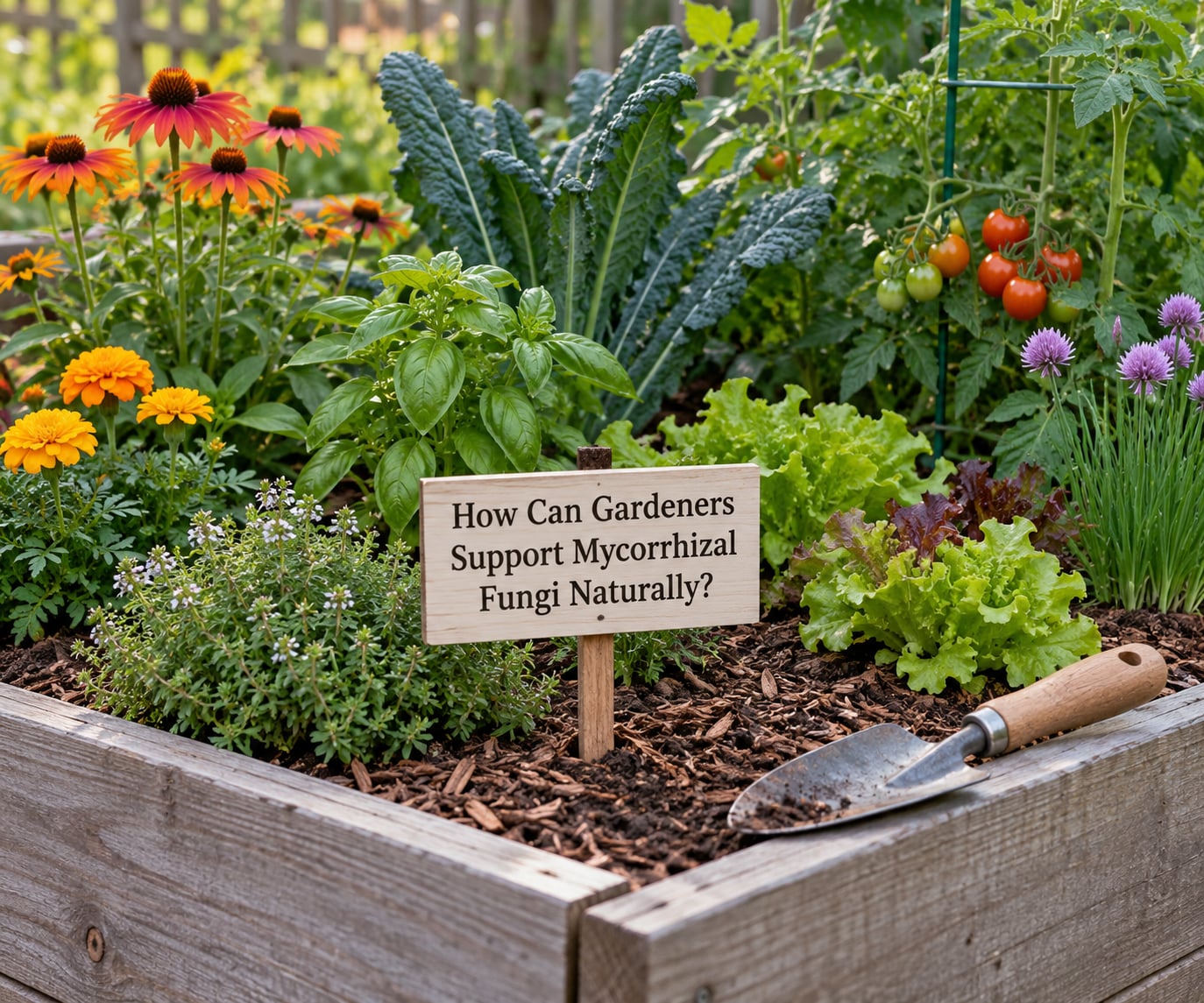
How Can Gardeners Support Mycorrhizal Fungi Naturally?
Most established garden soils already contain mycorrhizal fungi. Protecting what is there is cheaper, more reliable and more effective than adding anything, and it comes down to a handful of fairly unexciting practices.
Keep living roots in the ground for as much of the year as you can
A fungal partner with no host declines. Bare soil over winter, and empty beds between crops, both remove the food supply. Cover cropping, a mulch of leaf litter, or simply leaving roots in the ground rather than pulling them all out keeps the association alive across seasons.
Stop digging every year
Minimising disturbance preserves the network. Gardeners who treat a bed this way usually stop reaching for the fork once the structure is good. The first year is the expensive one; later years are maintenance.
Plant a mix rather than a monoculture
A wide range of host species supports a wider range of fungal partners, and a diverse bed is a more resilient one. Monoculture also gives pathogens a target-rich, root-dense zone, which is precisely the situation mycorrhizal fungi help disrupt.
Use organic matter as a mulch, not just a feed
Leaf mould and mature compost feed the whole food web and gradually improve aggregation. This is where decomposers and mycorrhizae cooperate, even though they are doing different jobs.
Feed plants, not the whole bed
Banded or targeted feeding leaves more of the soil unclaimed, and leaves root zones where fungi are useful. Heavy blanket applications of phosphorus and nitrogen are the ones to reconsider first.
Water sensibly
Both saturation and repeated drying damage the partnership. Consistent moisture matters more than dramatic irrigation, and well-structured soil with organic matter holds water longer in the first place.
Restrain the broad-spectrum pesticides
Fungicides in particular, and fumigants such as the soil treatments once used against nematodes, are destructive to symbiotic fungi. Broad-spectrum soil insecticides also do indirect damage to the food web. Spot treatments for a diagnosed problem are a different question from a preventive spray program.
One more deserves attention because it surprises people. Sorghum-Sudan green manure, sometimes recommended as a biofumigant, releases compounds that damage roots, and the damage extends to the fungal association along with the plant. It is not the gentle soil conditioner it is sometimes presented as.
Are Commercial Mycorrhizal Inoculants Worth It?
Sometimes, and far less often than the packaging suggests. The honest answer depends on which situation you are in.
The strongest argument against buying by default is a species-count problem. Soil communities contain hundreds of fungal species, and a commercial packet may contain one. Applying a single generalist species into soil that already supports a rich community can add very little, and the peer-reviewed record on field inoculation is genuinely mixed. Independent trial work reported by Gardens Illustrated, including a Which? Gardening trial of shop-bought products, found they sometimes work and often do not.
On the other hand, there are defensible cases. Sterile or near-sterile growing media, including peat-free seed-starting mixes, contain essentially no fungal partners. Very young seedlings have fine roots that may not have found a partner yet. Containers filled with fresh bought compost give you the same problem in miniature. And a new tree or shrub planted into subsoil scraped from a building site has almost no fungal history to draw on.
If you do buy, look for several named species rather than one, a stated propagule count, and a use case that matches your situation. Treat it as an experiment on one bed rather than a treatment of the whole garden, and change one thing at a time so you can tell what happened.
The free version: transfer soil from under a healthy tree
Foragers and ecologists have long moved forest soil inoculum between sites, and the technique works for a home garden for almost no cost.
First, find a healthy, mature tree with plenty of leaf litter beneath it and no history of chemical spraying. Take a small spadeful of soil from the top few centimetres, close to fine roots, away from the trunk.
Second, sieve or crumble it so it will mix. You want a light, even distribution rather than lumps.
Third, apply it at planting, directly onto the root zone of the new plant, before backfilling. Work it into the bottom and sides of the hole.
Fourth, cover it promptly and keep the planting moist until the plant is established, so the fungus is not exposed to drying sun.
Fifth, for a bed, mix a thin layer into the topsoil of one small section and compare it against an untreated section through a season. That comparison is the part most guides skip, and it is what tells you whether the transfer did anything.
Peer-reviewed work from forestry has long reported that forest soil inoculum works at around 0.2 per cent by volume, which is a reassuringly small amount.
What Signs Suggest a Mycorrhizal Problem?
Very few, and this is the honest answer. You cannot look at garden soil and conclude that mycorrhizal fungi are missing, and no home test reliably does it either.
Plant symptoms do not diagnose it. Stunted growth, yellowing between veins, purple leaves, wilting despite moisture and poor establishment after transplanting all look similar whether the cause is a missing fungal partner, a compacted pan, overwatering, root damage from slugs or larvae, or a nutrient lock-up from high pH.
What you can do is rule out the ordinary causes first. Check drainage, check pH, check whether the soil is actually dry below the surface, and check whether something has been eating the roots. If the bed drains freely, the pH suits the crop, watering is consistent and pests are absent, then fungal involvement becomes a more reasonable thing to think about.
One indirect signal is worth knowing. If a bed has never grown a mycorrhizal-associated plant, has been repeatedly fumigated or treated with a sterilised peat-based medium, and has only ever carried brassicas, the association may genuinely be thin. That is a reason to diversify the planting, not a reason to reach for a packet.
Seeing white mycelium on the surface of potting compost is normal and usually harmless, and it is not the same thing as mycorrhizal networks reaching the roots. Gardeners routinely assume it is a problem to treat. It generally is not.
How Does Mycorrhizal Science Connect with African Ethnomedicine?
It connects honestly, but narrowly, and the distinction is worth making because the two fields are often merged by people selling things.
Ethnobotany concerns the relationship between people and plants: which plants are used, for what, by whom, and with what preparation and practice. Soil microbiology concerns organisms that live on plant roots. The first is a record of human knowledge and the second is a biological mechanism. Neither implies the other.
Where they genuinely meet is that medicinal plants form mycorrhizal associations like any other plants, and the rhizosphere around a medicinal species affects the chemistry of the soil it grows in. Some work on medicinal and aromatic plants has looked at how mycorrhizal colonisation affects growth and secondary metabolites. That is a real research area, and it is also a place where a lot of speculation outruns the data.
Two cautions. First, mycorrhizal fungi are not medicinal products and there is no established clinical use for them. Second, traditional practices around soil, fertility and forest management in many African regions include forms of nutrient cycling and plant association that are conceptually adjacent to what modern soil science calls mycorrhizal ecology, though the frameworks are not the same and should not be presented as if they were.
For a site focused on medicinal plants, the useful takeaway is simple: the health of a medicinal plant starts with the soil it grows in, and the fungal community in that soil is part of that foundation.
Frequently Asked Questions
Can I see mycorrhizal fungi in my garden soil?
Not directly. Most mycorrhizal fungi live inside or around root cells and never produce visible structures. The mushrooms you see are usually decomposers or the fruiting bodies of a fungal species whose host tree is nearby. White mycelium on the surface of potting compost is a decomposer, not a mycorrhizal network. Lab staining of root samples is the only reliable way to confirm colonisation, which is why garden diagnoses stay speculative.
Are mycorrhizal fungi always present in garden soil?
Usually, in established ground. Because roughly 85 to 90 per cent of plant species form mycorrhizal associations, soil that has supported plants for more than a season usually contains plenty of fungal partners. The exceptions are recently disturbed or compacted sites, subsoil scraped from building work, and sterile growing media including peat-free seed compost, which contain very few.
Does planting a mycorrhizal plant guarantee better growth?
No. Benefits depend on the plant, the fungal species present, soil texture, moisture and how you feed the plant. In fertile, well-watered soil, a well-nourished plant may show no measurable gain at all. Colonisation helps most where conditions are difficult: compacted ground, poor or sandy soil, dry sites, and newly planted trees struggling to establish.
Do fertilizers stop mycorrhizal fungi from working?
They can suppress it. Plants that are heavily supplied with nitrogen and phosphorus have less reason to invest carbon in paying a fungal partner, and root colonisation often drops as fertiliser rates rise. This does not mean stopping feeding. It means targeting nutrients to what the crop needs rather than blanketing the whole bed, which leaves more soil where fungi are doing useful work.
Are organic fertilizers and compost better than mycorrhizal inoculants?
For most gardens, yes, because compost and organic matter improve the whole soil food web, water retention and structure, which supports the fungi already there. Inoculants can be worth testing in sterile or near-sterile media such as seed compost, or in new plantings on disturbed ground, but results in established soil are unpredictable and independent trials have often found they do little.
Conclusion
Mycorrhizal fungi explained for gardeners comes down to one practical principle: the partnership is already there in most soil, and it works best when you stop destroying it. The plants that benefit most are the ones you would describe as stressed, and the conditions that produce the partnership are the ones most gardeners spend money trying to correct chemically.
Start with the soil. Plant a wider mix of species than you did last year, stop turning the bed over every spring, mulch it, water consistently, feed the crop rather than the plot, and leave the broad-spectrum sprays in the cupboard. Only after that is it worth asking whether a purchased inoculant has anything useful left to add.