If you have been searching for ethnobotany degree programs and keep hitting the same wall, here is the plain version: ethnobotany is almost never the printed name of a bachelor’s degree in the United States. It is far more common as a minor, a concentration, a certificate, an occupational endorsement, or a graduate specialization that sits inside a larger degree such as botany, biology, anthropology, or environmental studies. A handful of places do award a degree you could call ethnobotany outright, mostly outside the US, so the field exists. The label just works differently than most students expect, and that mismatch is what this guide is for.
Once you understand how the credentials are actually structured, choosing one becomes much easier. You can match the type of credential to what you want to do afterwards, whether that is fieldwork with a tribal or community partner, a research career, a museum or conservation role, or a stronger foundation for pharmacognosy and public-health work on traditional medicines.
Table of Contents
- 1Ethnobotany Degree Programs Explained
- 2What Do You Learn in an Ethnobotany Program?
- 3How Is Ethnobotany Degree Programs Explained by Subject Level?
- 4What Kind of Fieldwork and Research Will You Do?
- 5Can Ethnobotany Lead to a Career?
- 6How Much Does an Ethnobotany Program Cost?
- 7How to Choose the Right Ethnobotany Degree
- 8Frequently Asked Questions
- 9Are ethnobotany degree programs available fully online?
- 10What high-school courses prepare you for an ethnobotany degree?
- 11Do you need a graduate degree to work in ethnobotany?
- 12Is ethnobotany a botany major or an anthropology major?
- 13Which degree is best for ethnobotanical research careers?
- 14Conclusion
Ethnobotany Degree Programs Explained
Ethnobotany is the scientific study of the relationships between people and plants: how humans use, name, classify, and manage plants for food, medicine, materials, ritual, and identity. Ethnobiology is the broader field that does the same for all living things, so plants are one part of its scope, alongside animals, fungi, and microbes. A student who wants to work on cultural relationships with plants has chosen ethnobotany. A student who wants fungi and foraging knowledge across organisms has chosen ethnobiology.
That distinction matters when you read a program page, because both words get used loosely. Economic botany asks how people use plants commercially. Ethnopharmacology looks at medicinal use through a pharmacological lens, usually including chemical analysis. Biocultural anthropology studies culture broadly, with plants as one possible thread. If a course listing mentions plants specifically, you are probably looking at ethnobotany. If it says “peoples, plants and animals,” it is likely ethnobiology.
There are four common academic homes for the subject. Botany departments own the plant science half, including taxonomy, ecology, and physiology. Anthropology departments own the people half, including interviews, linguistic work, and research ethics. Indigenous studies or Native American studies programs add cultural competence, sovereignty, and policy context. Environmental studies and conservation biology programs connect traditional knowledge to land management. Strong programs draw from more than one home at a time, and that mix is a better predictor of a good fit than the department name.
| Degree level | What you usually study | Typical length | Best for |
|---|---|---|---|
| Certificate or endorsement | Survey of ethnobotany, field methods, ethics | One term to one year, often stacked with another degree | Testing the field, or adding a credential to a job you already have |
| Bachelor’s with a minor or concentration | Full science or anthropology degree plus a block of ethnobotany courses | Four years | Working in natural resources, conservation, education, or a lab technician role |
| Bachelor’s in ethnobotany or ethnobiology | Integrated plant science, social science, and methods coursework | Three to four years, uncommon in the US | Students who want the subject named on their transcript from day one |
| Master’s specialization or thesis | Advanced methods, quantitative skills, original fieldwork | One to three years | Research careers, agency work, and teaching-adjacent roles |
| Doctoral program | Original research, teaching, dissertation, grant writing | Four to seven years | Leading studies, running a lab, or a faculty position |
One real example is worth naming here. The University of Alaska Fairbanks offers ethnobotany training as an occupational endorsement rather than a degree, drawing on botany, biochemistry, ecology, Indigenous studies, anthropology, and political ecology, and it can be delivered at a distance with optional field components. That credential type tells you something real about how institutions treat the subject: valuable enough to formalize, narrow enough to sit inside something larger.
I would also flag the word “endorsement” early, since it confuses almost everyone. In the Alaska usage, an occupational endorsement is a credential that recognises a specific body of skill, often built one course at a time alongside a degree, and it can be less expensive and less time-consuming than starting a new degree from scratch. Elsewhere a similar credential may be called a certificate, a microcredential, or a concentration. Check with the registrar, not just the department page, because the naming differs campus to campus.
What Do You Learn in an Ethnobotany Program?
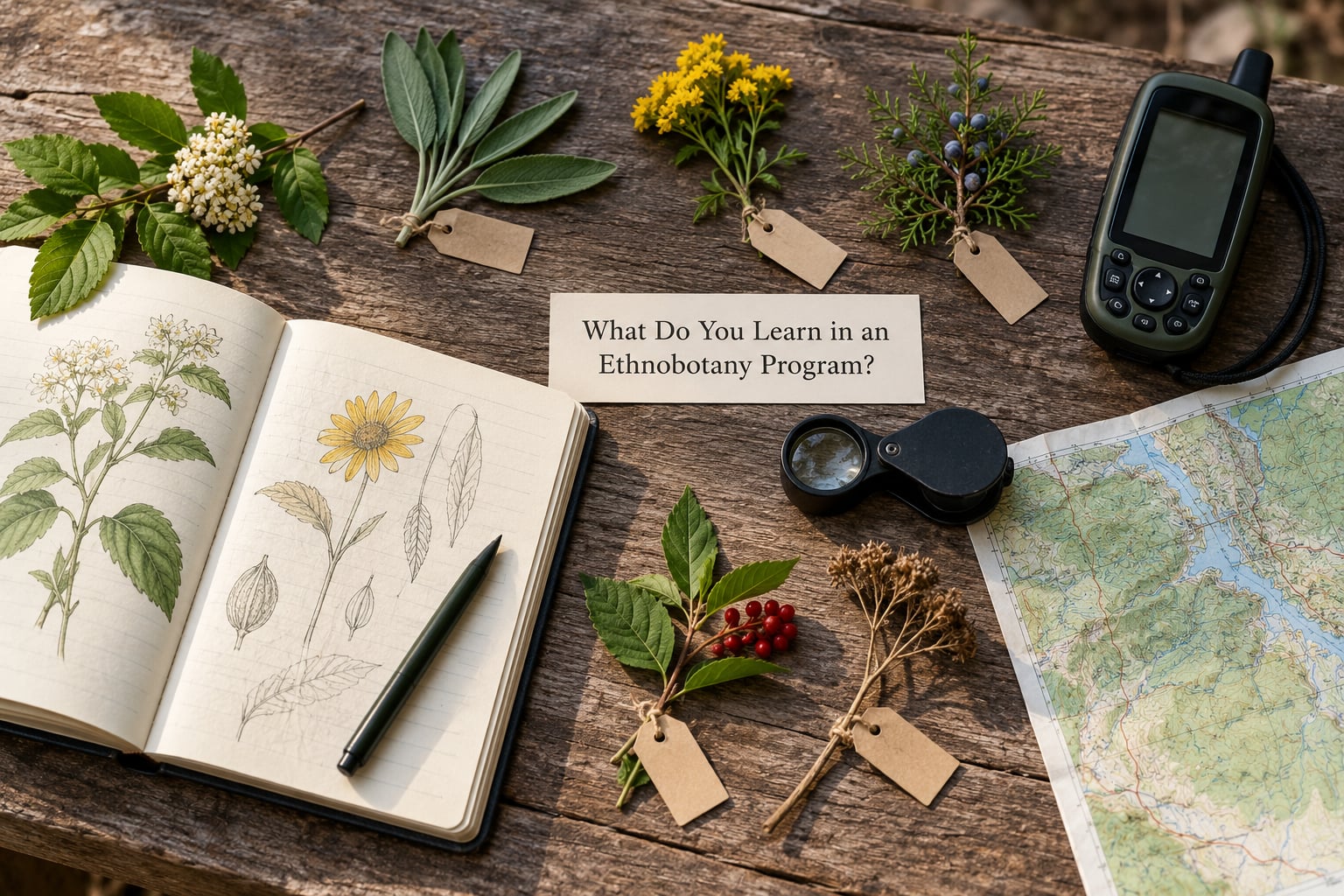
The curriculum is genuinely interdisciplinary, and that is the honest answer rather than a marketing line. Most programs require you to hold four skill areas at once, and no single one of them is optional if you want to do the work properly.
- Plant identification and taxonomy. Learning to identify species in the field, including the regional flora you will actually work in, and understanding why voucher specimens have to be collected and deposited properly.
- Ethnobotanical research methods. Semi-structured interviewing, participant observation, participant consent, survey design, habitat and GIS data, and quantitative analysis of what people reported.
- Cultural and historical context. How knowledge systems organise plants, how names change between languages, how colonialism disrupted plant knowledge, and how recording has historically gone wrong.
- Ecology, conservation, and natural resource management. Plant communities, disturbance, harvest pressure, and what sustainable use looks like on the ground.
- Pharmacology and chemistry basics. How compounds are identified and tested, and where the line between a documented traditional use and a clinically proven treatment sits.
- Ethics, statistics, and scientific communication. Institutional review of human-subject research, data sovereignty, plus the writing and presentation skills any working scientist needs.
That last cluster is where a lot of students underestimate the workload. Ethics review is not a formality bolted onto fieldwork; it shapes the project from the first conversation with a community partner. Statistics is not optional at the graduate level either, because the older literature in this field is now being re-analysed with modern quantitative tools and there is real work to do.
How Is Ethnobotany Degree Programs Explained by Subject Level?
Comparing ethnobotany degree programs by level is really a comparison of prerequisites, depth, and what each level opens. A certificate assumes little or no prior study, so it rewards curiosity with breadth. An undergraduate minor or concentration assumes you are already earning a degree and fits a few electives into a schedule you cannot easily bend. A standalone bachelor’s in ethnobotany is rarer, assumes a science foundation from the first year, and gives you the subject named on your diploma.
At the graduate level, a master’s is where most ethnobotanists become practitioners: you run your own fieldwork, learn grant writing, and produce a thesis that becomes a credential in its own right. A doctorate is for people who intend to lead studies, teach, or hold a research-specialist position, and it is the level that makes you competitive as a principal investigator.
The practical question is not which level is best but which level matches the work. Field and agency roles usually open at the bachelor’s level. Independent research roles generally expect a master’s. Leading studies and academic positions expect a doctorate. A reader asking how the field is explained by level should also know that credential names differ internationally, and that European and several other national systems award master’s degrees where the US awards a bachelor’s.
What Kind of Fieldwork and Research Will You Do?
Fieldwork is the part of the degree that people describe afterward as both exhausting and the reason they stayed. In an interview-based project you spend weeks, sometimes months, learning a language well enough to ask about plants without leading the witness, then recording who said what, in which language, and under what permission.
Alongside interviews, most programs expect plant collection and voucher specimen work. You collect a specimen with the knowledge holder present, press it, and deposit it in an herbarium so that anyone can verify the identification later. Without that deposited specimen, a plant report is not reproducible, which is why the boring logistics matter so much. You will also likely help run an ethnobotanical survey, record habitat and GPS data for each collection, and do seasonal repeat visits because a use reported in the dry season may not appear in the wet one.
Laboratory work depends on where the program sits. Programs with pharmacognosy or chemistry partners will have you extracting compounds, running chromatography, or preparing specimens for analysis. Programs with strong herbarium collections will have you mounting, curating, and doing taxonomic verification with a specialist, because a misidentified voucher specimen quietly corrupts an entire study.
Community-based research changes the shape of all of it. Instead of collecting data about a community, you design the questions with the community, and some data may never leave the community at all. Free prior informed consent is the baseline, and it has to be sought again for anything a partner considers sensitive. The Nagoya Protocol on access and benefit-sharing, which sits under the Convention on Biological Diversity, has made access to traditional knowledge associated with genetic resources a formal negotiation rather than an assumption. Indigenous data sovereignty frameworks push further, asking who controls the record and who gets to say so later.
Good programs teach this as content, with real coursework and real review. That is worth a lot to employers and to community partners, and it is the single fastest way to tell whether a program takes the field seriously or treats culture as fieldwork decoration.
Can Ethnobotany Lead to a Career?
Yes, but not in the way most people picture. Standalone roles titled “ethnobotanist” are uncommon, and anyone who promises you a straight line from a credential to a specific job title is overselling it. What actually happens is that ethnobotany graduates hold hybrid roles where the plant knowledge, the field method, and the cultural fluency are what distinguish them. Surveying employment data carefully is worth more here than enthusiasm, because the students who get good outcomes tend to be the ones who planned a second skill alongside the first.
- Academic research. University and institute positions, usually requiring a doctorate, sometimes starting as a postdoctoral or research associate role on a grant-funded project.
- Government and tribal agencies. Natural resource management, subsistence support, cultural resource management, and heritage programs at federal, state, and tribal levels. Bachelor’s degrees are the usual entry point, and field experience counts.
- Conservation and restoration. Working with communities on restoration, sustainable harvest agreements, and biocultural diversity monitoring, usually with a conservation biology background alongside ethnobotany.
- Botanical gardens, herbaria, and museums. Public education, collections management, interpretation, and living collections work, where a science degree plus ethnobotany coursework is a real asset.
- Pharmaceutical and natural product research. Pharmacognosy, quality control, botanical drug discovery, and traditional medicine research, usually with a chemistry or pharmaceutical sciences component. These roles lean heavily on laboratory skill.
- Public health, nutrition, and herbal practice research. Studying traditional medicines and food systems as they relate to community health, increasingly including African and global traditional-medicine contexts.
- Nonprofits, NGOs, and consulting. Biocultural diversity programmes, international development work, sustainable harvest certification, and grant-funded community projects.
One more note on scope. An ethnobotany degree teaches you to document traditional uses; it does not qualify anyone to treat a medical condition. Our own site’s coverage of African traditional medicines is educational and cultural, and readers should consult a doctor or pharmacist about personal health decisions, warning signs, and anything they intend to take. A professional pathway built on that boundary is also a more credible one.
How Much Does an Ethnobotany Program Cost?
There is no single price for ethnobotany degree programs, because most students pay a tuition published by a larger institution and then add the ethnobotany-specific expenses on top. A minor usually adds nothing beyond per-credit course fees. A certificate or occupational endorsement can be built course by course, which makes it the cheapest way in. A field-based master’s can be the most expensive option once travel, housing, and equipment are counted. These are typical US patterns that vary by institution, residency status, and program length, and every figure changes over time, so read the institution’s own published cost pages rather than trusting a number here.
| Cost element | What it covers | What moves it up or down |
|---|---|---|
| Application fees | Undergraduate, transfer, or graduate application | Usually waived or reduced at many public institutions; fee waivers are common |
| Undergraduate tuition | The degree you are already paying for | Public versus private, in-state versus out-of-state, and whether ethnobotany courses sit inside the standard tuition band |
| Graduate tuition | Thesis or doctoral coursework | Assistantships, fellowships, and whether the degree is research-based or coursework-only |
| Field course and travel | Travel to a field site, lodging, meals, local transport | Distance to the site, season, group size, and how much the program subsidizes |
| Equipment and materials | Hand lenses, field notebooks, cameras, GPS units, pressing supplies, safety gear | Often partly subsidized by the department; some items are reusable across a whole program |
| Lab and analysis costs | Chemicals, consumables, sequencing or extraction fees | Only relevant if the curriculum includes lab-based methods |
| Books and memberships | Required texts, society dues, conference fees | Society student memberships are usually modest and often worth it |
Funding exists, which students often discover too late. Assistantships cover tuition and a stipend at most US research universities. Outside that, the Society for Ethnobotany and the Society for Economic Botany both run student awards, and the Richard Evans Schultes Research Award helps defray field costs for student members of the Society for Ethnobotany. National Science Foundation and agency funding also create paid research-assistant slots, which are the best possible entry point because you learn the field while being paid to do it. Start the funding search before you need it, because the first award you win is usually small.
How to Choose the Right Ethnobotany Degree
Work through these in order. The order matters, because students often fall for a program’s brochure before checking whether it teaches the thing they came for.
- Confirm the credential type before anything else. Ask the registrar what the credential is, how many credits it takes, whether it appears on a transcript, and whether it stacks with another degree. This one conversation eliminates most confusion.
- Check that field methods are actually taught. Look for a course list containing interviewing technique, plant collection, and voucher specimen methods. A program with only overview lectures is not going to get you fieldwork-ready.
- Look for ethics and sovereignty coursework. Not one lecture dropped into a methods class, but a named course with review-board procedures attached. Ask how many times their students have had proposals reviewed.
- Ask about herbarium and lab access. Can you handle specimens? Is there a collection on campus? Who verifies identifications, and are they botanists?
- Match the regional focus to your interest. Programs with a strong local flora teach you plants you can actually work with. Arctic, tropical, arid, and highland programs each have very different field realities.
- Investigate community partnerships properly. Ask which partners, how long the relationships have lasted, who holds the data, and whether students are welcome in community meetings or only on the research schedule.
- Weigh delivery mode honestly. Distance delivery works well for the coursework half of an endorsement. It cannot replace a season of field seasons, and anyone telling you otherwise is selling something.
- Compare total cost against funding. A pricier program with funded assistantships can cost less than a cheap one that pays nothing, and field travel is usually the line item students forget.
- Ask where graduates ended up. Not enrolment numbers, actual placements, and how long it took. If nobody tracks this, ask what alumni are doing now.
- Test advisor fit early. One email exchange before applying tells you more than a program brochure will.
If your university has nothing at all, the self-directed route still works: major in botany or biology, add anthropology courses, join a local herbarium or native plant society, take a field methods course elsewhere, and build a relationship with a researcher who already works with communities. That is how the classic botanist-to-ethnobotany pivot happens, and it is a slower route, but it is a real one.
Frequently Asked Questions
Are ethnobotany degree programs available fully online?
Partly. Distance delivery works well for coursework, and the University of Alaska Fairbanks delivers its ethnobotany occupational endorsement without requiring on-campus attendance, with optional field components. What cannot move online is the hands-on half: plant identification under pressure, collecting and pressing specimens, and sitting with community knowledge holders. If you cannot do fieldwork near your home, plan on summer field courses or a study placement elsewhere.
What high-school courses prepare you for an ethnobotany degree?
Biology, chemistry, and any available ecology or environmental science give you the foundation, and a statistics course matters more than most students expect because the field is increasingly quantitative. Language study is a real advantage, since interviews often happen in a language other than English. Field skills matter too: a natural history club, a garden job, birding, hunting, or a summer job outdoors teaches you to observe carefully before a degree teaches you the vocabulary.
Do you need a graduate degree to work in ethnobotany?
Not for most roles. Agency, conservation, botanical garden, and museum work usually opens at the bachelor’s level when paired with an ethnobotany minor or endorsement and real field experience. A master’s is what most people need for independent research positions, and a doctorate is the requirement for leading studies and academic posts. If you are unsure, an undergraduate research assistantship will tell you more about your own fit than another year of deciding.
Is ethnobotany a botany major or an anthropology major?
Either, and both, depending on where it sits. Programs anchored in botany lead with plant science, taxonomy, and ecology, then add social science methods. Programs anchored in anthropology lead with cultural analysis, interviews, and linguistics. Ethnobiology programs tend to be broader, covering animals, fungi, and plants together. The best ones borrow heavily from both. Read the required-course list rather than the department name, since the department tells you where a program is filed, not what it teaches.
Which degree is best for ethnobotanical research careers?
A master’s is the practical floor for independent ethnobotanical research, and a doctorate is what qualifies you to lead studies, supervise others, and hold an academic position. The bachelor’s matters as preparation: plant identification, statistics, and methods. For students comparing ethnobotany degree programs, pick the level that matches the research you want to be running in five years, then build toward it one funded research experience at a time.
Conclusion
Ethnobotany is a real and growing field with a naming problem, not an availability problem. Before you compare programs, decide whether you need a named degree, a minor inside a science or anthropology major, a short endorsement to test the field, or a graduate specialization, then work through the ten checks above in order.
Start with the institution, not a ranking page. Ask the registrar what the credential is, ask a current student what fieldwork actually looks like, and ask a community partner whether the program has earned trust. Whatever you decide, treat traditional plant knowledge as cultural and scientific material rather than a substitute for medical care, and bring any personal health question to a doctor or pharmacist.