
To tell a good research study from a weak one, ignore how impressive the results sound and check whether the design, comparison and analysis can support the claim being made. Read the abstract, then the methods, then the results, and treat funding, uncertainty and bias as part of the finding rather than footnotes. This is about judging published scientific research, not revision for an exam.
A confident headline tells you almost nothing. A study in a respectable journal can still use the wrong design for its question, measure the wrong thing, or report a difference so small it would not change anyone’s life. The habit that separates one reader from another is a fixed order of checks, applied the same way every time.
It takes about ten minutes to triage a paper and thirty more to read it properly. If you are reading research on plants, herbs or traditional remedies, allow longer, because those studies carry their own specific problems that we cover at the end.
Table of Contents
- 1What You Need
- 2Step-by-Step: How to Tell a Good Study From a Weak One
- 3Start With the Research Question
- 4Check Whether the Design Fits the Claim
- 5Look for a Fair Comparison
- 6Examine the Evidence and Analysis
- 7Treat Results as a Range, Not a Promise
- 8Look for Bias, Errors, and Selective Reporting
- 9Common Mistakes
- 10Frequently Asked Questions
- 11What are the characteristics of a good study?
- 12What are the 5 criteria for evaluating a research paper?
- 13What are the 5 key elements of peer review?
- 14Does peer review mean a study is good?
- 15Is 30 respondents enough for a survey in research?
- 16What are the 5 C’s in research?
- 17Conclusion
What You Need

You need eight things before a verdict is possible, and all of them appear in a standard paper. Pulling them out first turns appraisal from an impression into a checklist.
- The research question. What exactly are they trying to find out?
- The study design. Survey, laboratory experiment, clinical trial, field observation, or a review of other studies.
- The population and sample. Who took part, how many, and how were they chosen?
- The comparison. What were the participants or samples measured against?
- The outcome measures. What was measured, with which instrument, and is it a reasonable proxy for what matters?
- The analysis. How the numbers were handled, including missing data and any subgroups.
- The funding and conflicts. Who paid, who designed the study, and who wrote it up?
- The paper itself, not the summary. The abstract, the full text, or the protocol registered before the study began.
The last one matters most. Press releases, blog posts and social threads routinely drop the caveats that were in the paper. If all you have is a headline, your judgement is about the writer, not the science.
Step-by-Step: How to Tell a Good Study From a Weak One
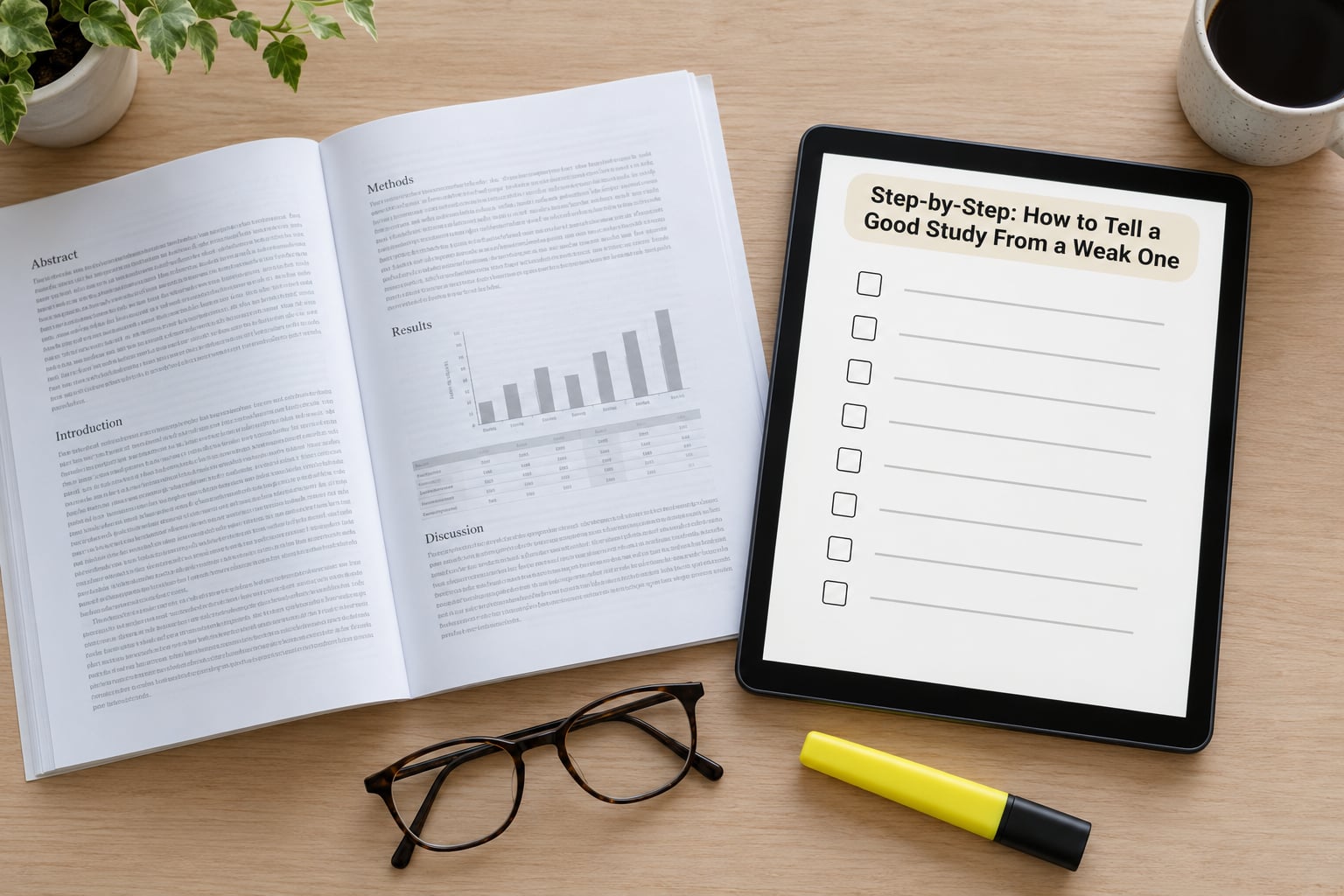
Work through these six stops in order. Each stop has one question to answer, and the answer at any stop can end the appraisal early, which is a feature rather than a failure.
Start With the Research Question
A study can only answer the question it actually asked. Many weak papers are not dishonest work, they are simply a descriptive study wearing a causal costume. “People who drink this tea report fewer headaches” describes a group. “The tea reduces headaches” claims a cause, and only a design that controls for other differences can support it.
Write the question in one sentence in your own words. If the paper’s own conclusion claims more than that sentence allows, the mismatch is your first finding.
Check Whether the Design Fits the Claim
The design sets the ceiling on the conclusion. A survey records what people say and cannot show what caused it. A laboratory study can control conditions tightly but often measures something narrow and artificial. A randomised controlled trial, where assignment to treatment or placebo is left to chance, is the strongest design for testing whether a treatment works.
Field studies in ethnobotany sit somewhere else. They record how a plant is used, by whom, and with what reported effect. That is genuine evidence about practice and culture, and it is not a substitute for a trial of safety or efficacy. Reading either one as the other is the most common misjudgement outside mainstream science.
Look for a Fair Comparison
A comparison only counts if the groups were similar before the intervention began. Check how people were recruited, whether groups were assigned by chance, what was excluded, and whether the two groups differed on age, illness severity, diet or something else that could produce the result on its own.
Read the baseline table before the results table. When the treatment group started sicker, any later difference may have been there from the beginning.
Examine the Evidence and Analysis
When you want to know how to tell a good study from a weak one, this is the section that decides it. Sample size is justified by the question and the analysis planned, not by a round number, so a small study is not automatically bad and a large one is not automatically sound. Ask whether the measurement was reliable, whether people dropped out and whether that was handled, and whether the statistics matched the study type.
Two red flags stand out here. Dropping participants from one group only, with no explanation, breaks the comparison. Choosing an outcome after seeing the data turns a test of a hypothesis into a search for a result.
Treat Results as a Range, Not a Promise
A p-value below 0.05 means the result is unlikely to have appeared by chance alone. It does not mean the effect is large, important, or certain. Thousands of people would need the same benefit for the finding to matter in practice.
Ask for two numbers: how big the effect was, and how wide the range of plausible values was. A confidence interval is that range, and the standard stands at 95%. “Between 3 and 18 percent better” is a very different message from “19 percent better”, even when both carry p below 0.05. Confidence intervals wide enough to include no benefit at all are a sign of imprecision, not a subtle positive.
Also check who was studied. Results from one group, one region or one clinic may not transfer to you, and subgroup findings in a small study are usually hypotheses for the next study, not findings.
Look for Bias, Errors, and Selective Reporting
Risk of bias means the chance that a systematic flaw in design, conduct, analysis or reporting pushed the result in one direction. Randomisation, blinding to treatment assignment, and hiding who was allocated where all reduce it. None remove it entirely.
Then run the verification checks. Has the paper been retracted or corrected? Search the title on PubMed and check the journal in a reputable index, because predatory outlets charge authors and skip peer review entirely. Look for a registered protocol or a pre-specified analysis plan, which makes selective reporting harder. Read the funding statement and the author conflicts section as data, not as fine print.
Finally, ask what the study cannot tell you. Good authors state this themselves, and a paper that claims its findings apply to everyone regardless of dose, preparation or population is overreaching.
Common Mistakes
Most bad judgements come from substituting a shortcut for the check.
- Treating publication as proof. Peer review filters out some poor work, but it does not check whether data were fabricated, whether the design was appropriate, or whether the conclusion outruns the analysis. Fix: appraise the method, not the masthead.
- Reading correlation as cause. Fix: look for randomisation or a design that handles confounding. If it is absent, say association.
- Stopping at the abstract. The abstract is written to be accurate and persuasive, which are different goals. Fix: read methods and results before the conclusion.
- Worshipping sample size. A huge observational sample cannot rescue a design that cannot separate cause from coincidence. Fix: ask whether the number was justified by a power calculation or a stated analysis.
- Treating agreement as truth. Several small studies repeating the same flawed method agree perfectly and are still wrong. Fix: weigh quality before counting.
- Treating tradition or scepticism as evidence. A remedy used for centuries is not proof, and dismissing it because it is traditional is not a counter-argument. Fix: ask for the same evidence from both camps and grade the body of work, often with a low certainty rating because trials are rare.
- Ignoring the stopping rule. Fix: decide in advance how many studies you need before a conclusion is defensible, otherwise you will stop when the reading feels sufficient.
Frequently Asked Questions
What are the characteristics of a good study?
A strong study has five visible features: a clear research question, a design that matches it, a fair comparison group, methods detailed enough to repeat, and results reported with the size of the effect and its uncertainty. Add two more: funding and conflicts disclosed, and limitations stated by the authors. A paper can have a prestigious journal name and still fail most of these.
What are the 5 criteria for evaluating a research paper?
Borrow the five source-evaluation criteria and point them at the paper. Currency: is it recent enough to matter, and has it been corrected? Relevance: does it address the question you actually have? Authority: who ran it, in what field, in a legitimate journal? Accuracy: are the methods, data and analysis inspectable? Purpose: is it disclosed as research, and who benefits from the conclusion?
What are the 5 key elements of peer review?
Peer reviewers are typically asked to check five things: originality, methodological soundness, the significance of the work, clarity of the writing, and ethical compliance with consent and approval. What it does not check is whether the data are real, whether the design suits the question, whether the analysis was pre-specified, or whether the conclusion is spun beyond the results.
Does peer review mean a study is good?
No. Peer review is a filter, not a certificate. Reviewers work from a short submission, often without the raw data, sometimes with limited subject expertise and little time, and they vary in rigour. Publication tells you that some expert did not spot a fatal flaw. Judging the design, comparison and analysis yourself is still the reader’s job.
Is 30 respondents enough for a survey in research?
There is no number that is always enough. Thirty is far too small to estimate how common something is across a population, and fine for descriptive work inside one clinic or classroom. The real question is what the study claims: if it makes population-level claims, the sample has to support them. Look for a stated justification rather than accepting a round figure.
What are the 5 C’s in research?
There is no single fixed set, which is why answers to this one disagree. One common version stands for clear, concrete, complete, concise and correct, and another for criteria such as credibility, relevance and rigour. Treat any acronym as a memory aid rather than a method. The appraisal questions in this guide are what actually change a verdict.
Conclusion
Knowing how to tell a good study from a weak one takes about ten minutes of structured reading, and it is the same sequence every time. Identify the actual claim, check whether the design can support it, inspect the comparison and the sample, demand the effect size and the uncertainty around it, and read the funding and bias sections as evidence rather than boilerplate.
Start with the abstract and the conclusion, then spend your real attention on the methods. When you are weighing something herbal or traditional, hold the same standard and expect a lower certainty rating, because most of that evidence is observational, field-based or pre-trial. And when the claim is about your own health, bring the paper to a doctor or pharmacist rather than acting on it alone.