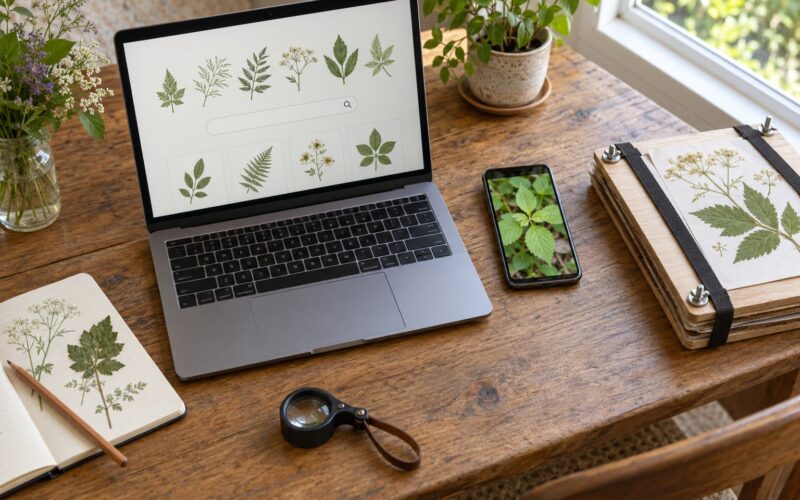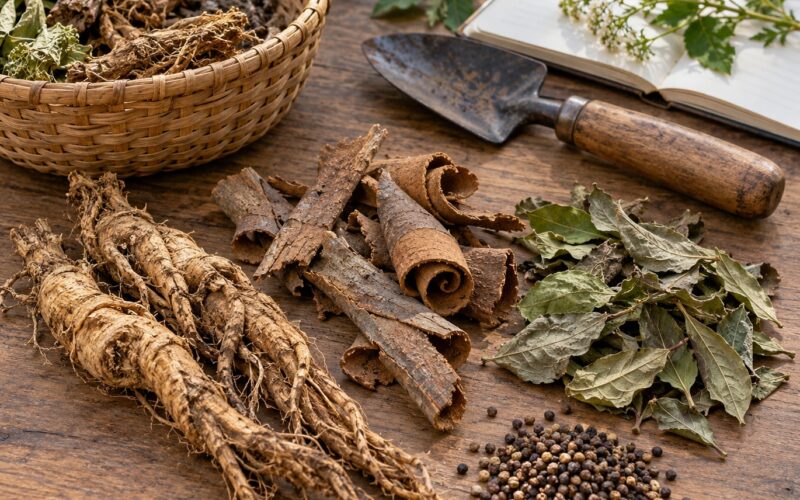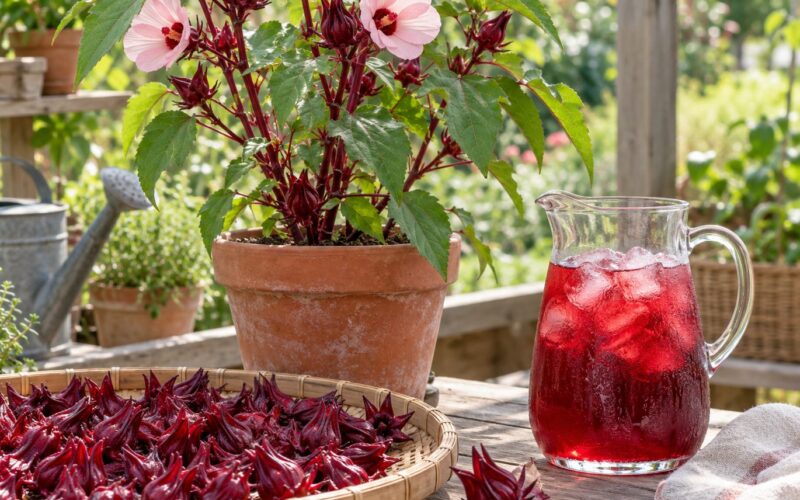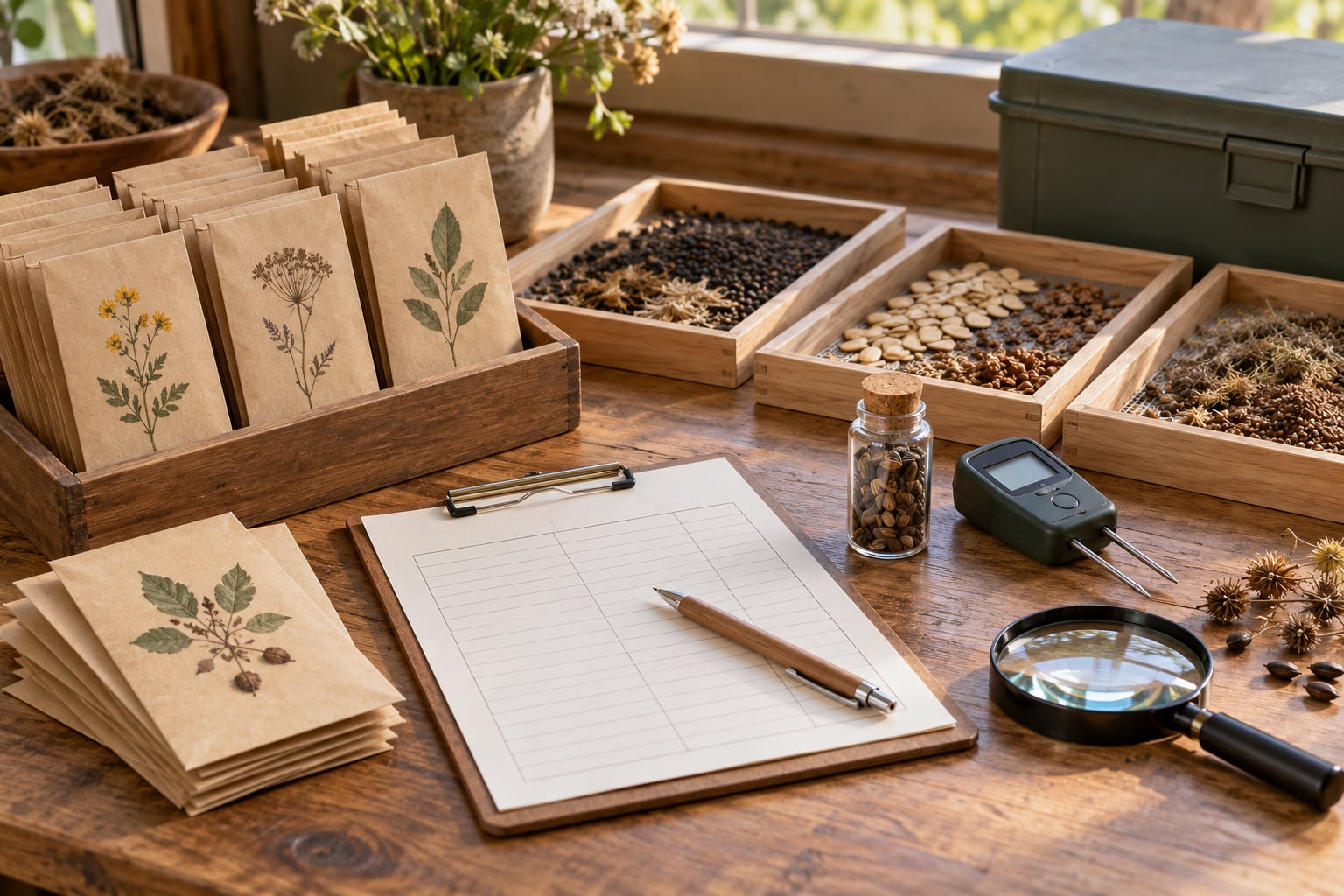
A seed bank collects plant seeds, records where each lot came from, and stores it cold and dry so the genetic material survives long after the plant has vanished from its habitat. For medicinal species, that stored seed is a backup against overharvesting, habitat loss and climate pressure. It is not a replacement for protecting habitat, and it cannot preserve the knowledge of how a plant is prepared or used.
Seed banks and medicinal plant conservation are often treated as the same thing. They overlap, but they answer different questions. A seed bank protects genetic diversity. Conservation in the wild protects the plant, its pollinators and the people who live with it, and a lot of the practical work happens in communities rather than in freezers.
This guide covers how seed banking works, the storage behaviour that decides whether a species can be banked at all, what makes a collection scientifically useful, and the ethical ground around collecting medicinal germplasm. One note before we start: documentation of traditional use is not the same as clinical evidence of a medical effect. If you are considering any herbal preparation as a treatment, talk to a doctor or pharmacist first, especially alongside prescribed medicines.
Table of Contents
- 1Seed Banks and Medicinal Plant Conservation: How They Work
- 2Why Preserve African Medicinal Plant Diversity?
- 3What Happens During a Seed-Bank Collection Process?
- 41. Planning and permits
- 52. Field collection
- 63. Documentation and accessioning
- 74. Cleaning and drying
- 85. Storage and freezing
- 96. Viability testing and regeneration
- 107. Distribution
- 11What is the difference between orthodox and recalcitrant seed?
- 12What is James’s Rule in seed storage?
- 13How long do stored seeds stay viable?
- 14What Makes a Medicinal Plant Seed Collection Useful?
- 15Why Are Living Collections and Community Conservation Needed?
- 16Why Seed Banks and Medicinal Plant Conservation Matter in Africa
- 17How Can Seed Banks Support Research Without Exploiting Traditional Knowledge?
- 18Prior informed consent
- 19Access and benefit sharing
- 20Respect for intellectual property and custodianship
- 21Collaboration rather than extraction
- 22What Are the Main Limits of Seed Banking for Medicinal Plants?
- 23How Can Readers Support Plant Conservation Effectively?
- 24Frequently Asked Questions
- 25Can seed banks preserve all medicinal plants?
- 26How long do seeds usually remain viable in a seed bank?
- 27Does storing a medicinal plant seed protect its traditional healing knowledge?
- 28How can researchers request medicinal plant germplasm?
- 29Are traditional uses of African medicinal plants proof that they treat disease?
- 30Conclusion
Seed Banks and Medicinal Plant Conservation: How They Work
Ex situ conservation means keeping a species outside its natural habitat, in a controlled facility. Seed banks are the most common form of it because dry seed is cheap to store, takes up very little room and stays genetically stable for long periods. Botanic gardens, arboreta and field genebanks are other forms of the same idea, holding living plants instead.
In situ conservation means protecting the species where it grows. That includes protected areas, community conservation areas, sustainable harvesting rules and restoration of degraded harvest landscapes. In situ work keeps ecological relationships intact, which banking cannot do.
Three terms do most of the work in this field. Germplasm means the genetic material of a plant, and a seed bank holds it in seed form. An accession is one collection of seed from a defined source, given a unique number so it can be tracked. Viability is whether that seed will still germinate, and because viability falls over time, every bank tests it on a schedule rather than trusting a storage date.
Desiccation tolerance is the trait that decides everything else. A seed that survives being dried to around 8 percent moisture content can be frozen and stored for decades. A seed that dies when dried cannot be frozen at all, and needs a completely different storage approach. Most temperate herbs, vegetables and grain crops behave the first way. Many tropical trees, palms and mangroves behave the second.
So a working conservation strategy uses both approaches together. A bank keeps a sample of genetic material safe, while in situ work keeps enough plants growing, and being used, to stay adapted and available.
Why Preserve African Medicinal Plant Diversity?
There are four overlapping reasons, and they are stronger together than separately.
Ecological. African medicinal plants are not only useful plants. Many grow in habitat that is already fragmented, and losing a species for a herbal trade removes a whole plant community along with it. Wild medicinal harvest adds pressure on top of agricultural expansion, fuelwood cutting and grazing.
Scientific. A species that has disappeared cannot be studied. Drug screening, phytochemistry, taxonomy and ecological work all need living material, and much of the world’s tropical plant diversity has never been studied by scientists at all. Stored seed is how a researcher gets material without taking it out of the wild.
Cultural. Preparation matters as much as the species. Which part is used, whether it is fresh or dried, what it is combined with, and who is allowed to teach the method are all part of the plant’s value. None of that fits in a freezer drawer.
Economic. Medicinal plant trade supports real incomes, and conservation that ignores livelihoods gets resisted. A conservation area that makes harvesting predictable and legal is easier to defend than a ban.
One caution here. An ethnobotanical record tells you what a plant has been used for and by whom. That is valuable evidence for research priorities and cultural documentation, and it is not evidence that a preparation treats a disease. That claim needs controlled clinical work, which for most African medicinal species has not been done.
What Happens During a Seed-Bank Collection Process?
Here is the sequence a seed lot actually moves through, from a field trip to a request from a researcher.
1. Planning and permits
The team decides which species and populations to collect, which may need collection permits, export permits and access agreements in the country of origin. Legal collection without permission is still theft of genetic resources, conservation intent or not.
2. Field collection
Seed is gathered from a defined population, ideally spread across enough mother plants that the lot does not represent one unusual individual. Collectors note that they are taking a minority of what is available and leaving the population able to recover.
3. Documentation and accessioning
Each lot gets its accession number and a passport record: species, locality, coordinates, altitude, habitat, soil, collection date, collector name and the associated traditional use and preparation notes. This is the part most likely to be done badly, and it is the part that decides whether the seed is ever usable.
4. Cleaning and drying
Seed is cleaned of debris and dried to a safe moisture content. Orthodox seed is usually dried in a controlled chamber rather than on a windowsill, because drying speed and humidity control how much lifespan you keep. Drying too slowly or too warm can kill the embryo before it ever reaches the freezer.
5. Storage and freezing
Packed and sealed, the seed goes into long-term storage at around minus 18 to minus 20 degrees Celsius. Many banks keep a duplicate somewhere else, and the Svalbard Global Seed Vault in Norway acts as a backstop of last resort for accessions deposited from other banks.
6. Viability testing and regeneration
A sample of each lot is germinated on a schedule. If results drop, the bank grows the accession out, harvests fresh seed and returns it to storage. Where seed is scarce, seed amplification multiplies it, though one recorded project grew a single remaining population of a rare annual to produce more than 90,000 seeds.
7. Distribution
Material goes to researchers, restoration projects and farmers, subject to the access and benefit-sharing terms agreed at collection. Distribution is the step that turns a stored asset into something people can actually use.
What is the difference between orthodox and recalcitrant seed?
Orthodox seed tolerates drying and freezing and stays viable for decades under good storage. Recalcitrant seed is killed by drying, so it must be kept moist and fresh and is usually stored as a living plant in a field genebank or as tissue in vitro. Intermediate species fall between the two and often need species-specific handling.
The practical difference is stark. An orthodox medicinal herb such as most Artemisia material, or common garden mints, can sit in a freezer for years and still be sown. Many tropical medicinal trees cannot.
| Seed type | Can it be dried? | Can it be frozen? | Typical storage method | Medicinal examples |
|---|---|---|---|---|
| Orthodox | Yes, to roughly 8 percent moisture | Yes, around minus 18 to minus 20 degrees Celsius | Sealed dry storage in a genebank | Most herbs and mints, many Artemisia, Sutherlandia frutescens, Pelargonium sidoides |
| Intermediate | Partly, with care | Often, with species-specific protocols | Drier or shorter-term storage, sometimes field collections | Many tropical forest trees, some Boswellia material |
| Recalcitrant | No, drying kills the embryo | No | Field genebank, in vitro tissue culture, or cryopreservation | Azadirachta indica (neem), Adansonia digitata (baobab), Warburgia salutaris, palms, mangroves, avocado-type trees |
Recalcitrant seeds are the ones that surprise people. A beginner who stores every plant seed the same way will lose a tropical tree lot within months and then have to re-collect from an already-thinned population. For those species, a field genebank, tissue culture or cryopreservation is the realistic route, and each needs its own budget and skills.
What is James’s Rule in seed storage?
James’s Rule states that for every 1 percent reduction in seed moisture content, and every 5 degree Celsius reduction in storage temperature, seed lifespan roughly doubles. That is why a moisture-tight container matters more than a cold room, and why home storage with damp envelopes loses seed quickly.
How long do stored seeds stay viable?
There is no single answer, which is why nobody should quote a date. Properly dried and frozen orthodox seed often remains viable for decades and sometimes far longer, while seed kept in paper envelopes on a shelf can fail within a season or two. The only reliable answer is a germination test on a sample from the actual lot.
What Makes a Medicinal Plant Seed Collection Useful?
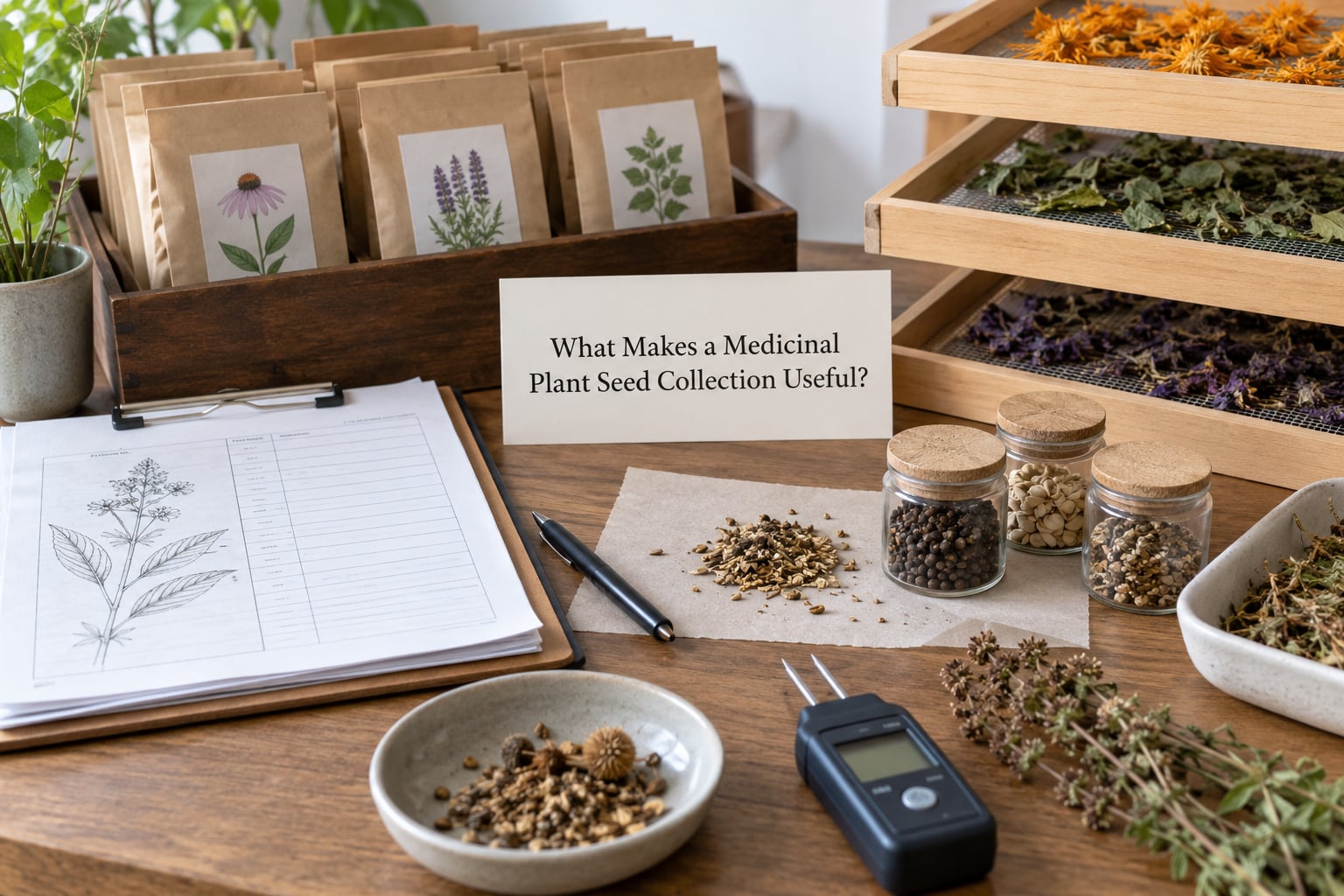
A seed lot that cannot be traced is a curiosity, not a resource. The value sits in the record, and these are the fields that carry it.
- Correct identification. Species name backed by a herbarium voucher specimen. Medicinal material is frequently traded and collected under the wrong name, and misidentified lots quietly pollute research.
- Provenance. Which country, region and population the seed came from, with coordinates or at least a locality description.
- Habitat and ecology. Soil, altitude, rainfall, associated species, and whether it grew in forest edge, grassland, rocky slope or farmland margin.
- Collection date and method. Because chemistry changes with season and stage of ripeness.
- Population size. How many individuals the seed came from, and whether they were spread across the population. Seed from a handful of plants narrows the genetics without anyone noticing.
- Associated traditional knowledge. Which community uses the plant, which part, preparation method, and consent for recording it.
- Quality control. Germination test results, seed count, purity and any disease screening.
Two small national examples show how specific this can get. Lithuania’s Plant Gene Bank stores seeds of 184 accessions covering 38 medicinal and aromatic species in long-term storage, run across three institutions. In India, Medicinal Plant Conservation Areas in Arunachal Pradesh protect Himalayan yew populations, where taxol from the bark was once harvested under pressure that pushed the species towards local extirpation.
National genebanks at Kew and elsewhere hold far larger collections. The scale difference is useful context: a country or region-level bank is where medicinal species coverage tends to be thinnest, since collecting priorities usually follow crop wild relatives and forestry species first.
Why Are Living Collections and Community Conservation Needed?
Some species simply cannot be banked. Recalcitrant tropical trees die in storage, so a field genebank, an in vitro collection or a cryopreservation lab has to hold them instead, which costs far more per species than a freezer does. Species propagated clonally, such as named cultivars of Aloe or certain elite medicinal selections, lose the genetic spread a seed lot would carry. Others lose viability in months regardless of technique.
Then there is the ecological argument. A seed in a freezer has no pollinator, no mycorrhizal partner, no seed disperser and no relationship with the surrounding community of plants. Conservation programmes in the United States have found that restoring a rare species into isolation is not enough, because its performance depends on the abundant matrix species around it. You need the habitat, not only the seed.
Community conservation covers what neither bank nor fence captures. A healer who knows which populations are healthy, when to harvest and how to prepare a remedy holds living knowledge that no accession record can replace. Community seed banks typically work in three areas: conserving local biodiversity, improving access to diverse planting material, and strengthening local seed-system knowledge.
Two demands recur in community seed system discussions. First, how many accessions and how many mother plants you need, because one seed from one plant quietly strips out diversity. Second, whether the material ever comes back to the community that supplied it.
Why Seed Banks and Medicinal Plant Conservation Matter in Africa
Seed banks and medicinal plant conservation carry particular weight in African landscapes for practical reasons. Many of the continent’s medicinal species are wild-harvested from habitats that are shrinking under agriculture, fuelwood demand and settlement. Where a species is also culturally important, local pressure to conserve it is often higher than pressure to conserve a crop wild relative.
Climate pressures compound this. Range shifts mean a seed lot collected in one district may, in a generation, need to be planted somewhere else. Having stored diversity makes that possible without collecting again from the wild.
Research access matters just as much. Researchers screening African plants for bioactive compounds frequently cannot obtain authenticated material, which biases results and slows the work. Regional genebank networks, linked to national collections and to botanical gardens, would reduce that friction.
Food and health sovereignty ride along here too. A region that can grow, store and breed its own medicinal and food plants has more control over prices and supply than one that imports both.
And there is a legitimate frustration running through all of it: material has historically moved outward into international collections with little returned to the villages it came from. Regional facilities, shared curation standards and clear benefit-sharing terms are the fix, not a footnote.
How Can Seed Banks Support Research Without Exploiting Traditional Knowledge?
This is where most guidance is thinnest, and where practitioners most want clearer rules. Four commitments do most of the work.
Prior informed consent
Consent is asked before collection, not after. It means the people sharing knowledge understand what it will be used for, where it will be stored, who will receive the material, and that they can decline or withdraw.
Access and benefit sharing
The Nagoya Protocol to the Convention on Biological Diversity sets the framework: collecting genetic resources or documenting traditional knowledge associated with them requires agreement on fair, equitable sharing of benefits. Some countries have their own legislation, which can be stricter, and that national law applies.
Respect for intellectual property and custodianship
Who legally owns a preparation method taught by one healer is contested and jurisdiction-dependent. Institutions get this wrong by assuming that once a knowledge is written down it is free to use. Documenting a practice is not the same as owning it, and naming the community as the knowledge holder costs nothing.
Collaboration rather than extraction
Useful models put practitioners and communities into the role of collaborators and rights-holders rather than informants. Where a community wants its own collection, a facility or training, or a share of any commercial outcome, that should appear in the agreement up front.
Practically, a small number of documents does most of the work: a material transfer agreement, a biocultural protocol attached to each accession, and a record of consent for each recorded use. A collection without those is legally fragile and scientifically weaker.
What Are the Main Limits of Seed Banking for Medicinal Plants?
Anyone selling conservation should say this part out loud.
Genetic narrowing. An accession collected from too few plants, or from one unusual individual, can reduce the diversity the species had. Small populations collected repeatedly from the same few individuals make it worse.
Misidentification. A large share of traded medicinal material is under the wrong name. A bank that skips voucher specimens stores something, but not reliably something identifiable.
Weak viability records. Seed lots that are stored for years without germination testing are an assumption, not a resource. Bad records make a collection useless precisely when someone needs it.
Funding and staffing. A freezer, a drying chamber, glassware and a trained technician are ongoing costs. Facilities with short-term project money often lose the ability to test and regenerate, and the collection quietly dies on the shelf.
Restricted access. Material behind a request form, a fee or an institutional agreement is inaccessible to community members, who often cannot fill in the paperwork.
Missing ecological context. A seed lot records a place on a map. It does not record the community of species, the pollinators or the harvest practices that let the plant survive.
The substitution risk. The biggest failure mode is treating storage as a reason to stop protecting habitat. Seed banks are insurance. Insuring a house and letting it burn down is not conservation.
National schemes such as Lithuania’s combining ex situ storage with in situ methods, and community schemes such as community seed banks, both point the same way: no single tool covers the job.
How Can Readers Support Plant Conservation Effectively?
Most of the useful actions here are unglamorous.
Support a credible genebank or botanical garden rather than a general plant appeal. Look for a collection with published accession data, current viability testing and named partners in the countries of origin.
Buy medicinal material from suppliers who grow what they sell. Cultivated supply takes pressure off wild populations outright, and where a supplier harvests from the wild, ask whether they rotate sites and leave enough behind.
Do not collect medicinal plants from the wild for personal use, and never uproot a plant to take root bark or a whole rhizome. Where collection is legal and permitted, take mature material, from a minority of the population, and rotate sites.
Learn the conservation issues where you live. Which species are locally harvested, whether harvest is licensed, and who the community group is, are all findable.
Finally, read traditional-use claims carefully. A statement that a plant has been used for a symptom is ethnobotanical documentation. A claim that it treats a disease is a health claim, and it deserves the same scepticism you would apply to anything sold as medicine. Nothing here replaces advice from a doctor or pharmacist.
Frequently Asked Questions
Can seed banks preserve all medicinal plants?
No. Species with recalcitrant seeds, such as neem, baobab and many palms, are killed by drying and cannot be frozen, so they need field genebanks, tissue culture or cryopreservation. Plants propagated only clonally and species with short seed viability also fall outside ordinary seed banking. That is why botanical gardens, in situ conservation areas and community collections are needed alongside every seed bank.
How long do seeds usually remain viable in a seed bank?
It depends entirely on the species and the storage conditions. Properly dried orthodox seed held frozen at around minus 18 to minus 20 degrees Celsius can stay viable for decades, sometimes far longer. Seed kept in paper envelopes in a warm, humid room may fail within a season. James’s Rule explains why: each 1 percent drop in moisture and each 5 degree Celsius drop roughly doubles lifespan. Always test a sample rather than trusting a date.
Does storing a medicinal plant seed protect its traditional healing knowledge?
No. Seed stores genetic material, not knowledge. Which plant part is used, whether it is fresh or dried, what it is combined with and who is allowed to teach the method are cultural information that a seed lot cannot carry. Protecting that knowledge needs documentation with consent, community agreements and benefit sharing, ideally attached to the accession as a formal record of who shared it.
How can researchers request medicinal plant germplasm?
Contact the national plant genetic resources genebank or a regional repository first, since they hold passport data and can supply authenticated material with correct handling instructions. Expect a material transfer agreement and possibly an access and benefit-sharing fee. If the species is wild-collected and associated with traditional knowledge, the Nagoya Protocol means prior informed consent and agreed benefit-sharing terms are required before material leaves the country.
Are traditional uses of African medicinal plants proof that they treat disease?
No. Traditional-use records are valuable ethnobotanical evidence of cultural importance and long use, and they help researchers set priorities. They do not demonstrate that a preparation is safe or effective. Claims about treating a disease need controlled pharmacological and clinical work, which most African medicinal species have not had. If you are considering a herbal preparation as treatment, speak to a doctor or pharmacist, especially alongside prescribed medicines.
Conclusion
Seed banks and medicinal plant conservation work as one part of a wider system. Stored seed protects genetic diversity cheaply and keeps options open for research, cultivation and restoration. It does not protect habitat, pollinators, or the preparation knowledge held by healers and communities, and for recalcitrant species it is not even the right container.
If you want to do something concrete, start with the people already doing the work: your national plant genetic resources genebank, a regional collection, a botanical garden, or a community seed system in your own area. Ask what they hold, who can access it, and what goes back to the communities that supplied it. That is where the gaps are, and it is where help is useful.