The history of the global herbal trade is the long-distance movement of medicinal and aromatic plants, dried roots, bark, seeds, gums and prepared extracts between regions and cultures. It runs from Chinese and Egyptian materia medica through Silk Road and Indian Ocean caravans, colonial botanical transfer programmes, and today’s industrial supply of dried herbs and standardised extracts.
Six eras explain almost everything you see in that trade today:
- Ancient origins — written materia medica in China, Egypt, India and Greece, alongside early exchange of aromatic plants.
- The Silk Road and the spice routes — overland and maritime corridors built around pepper, cinnamon, cloves, nutmeg, resins and dyes.
- Medieval transmission — Arabic and Persian scholarship consolidating and extending Greek plant knowledge, then European monastic and apothecary practice.
- Printing and botanical naming — herbals that became trade documents, then Linnaean taxonomy giving every plant a stable name.
- Colonial botany — plantations, botanical gardens, forced cultivation and the extraction of indigenous plant knowledge without benefit sharing.
- The modern market — chemical standardisation, supplement and cosmetic demand, international regulation and a supply chain now measured in billions of dollars a year.
Table of Contents
- 1What Is the History of the Global Herbal Trade?
- 2The main products and regions that carried the trade
- 3How did herbs become international trade goods?
- 4Why plant products travelled before medicine was standardised
- 5Which trade routes shaped the earliest herbal commerce?
- 6Overland corridors
- 7Maritime corridors
- 8What changed during the ancient and medieval spice trade?
- 9How did African medicinal plants enter wider commercial networks?
- 10How did colonialism reshape the global herbal trade?
- 11What drove the nineteenth- and twentieth-century expansion of herbal commodities?
- 12The decline of plant material in the official pharmacopeia
- 13How is the modern global herbal trade regulated?
- 14What are the main forces changing the herbal trade today?
- 15The plants that dominate the world herb market today
- 16A Timeline of the Global Herbal Trade
- 17Frequently Asked Questions
- 18What are the main trade routes for herbs and spices?
- 19Why were spices so valuable in the medieval period?
- 20Are herbs the same thing as spices?
- 21How did colonialism change the herbal trade?
- 22Which country became most famous for the spice trade?
- 23What is the Nagoya Protocol and how does it affect the herbal trade?
- 24Conclusion
What Is the History of the Global Herbal Trade?
The global herbal trade is the exchange of medicinal and aromatic plant materials, and the knowledge needed to grow, identify and use them, across regions. It covers raw dried herbs, seeds, barks, roots, gums and resins, but also prepared products: oils, tinctures, standardised extracts and formulated remedies.
It overlaps with the spice trade without being the same thing. Spices were mostly valued for flavour, aroma, preservation and ritual use, and the famous spice commodities, pepper, cinnamon, cloves and nutmeg, are only a slice of what moved. Herbs moved for medicine, dyeing, perfumery, food preservation, tanning, incense and feed.
The main products and regions that carried the trade
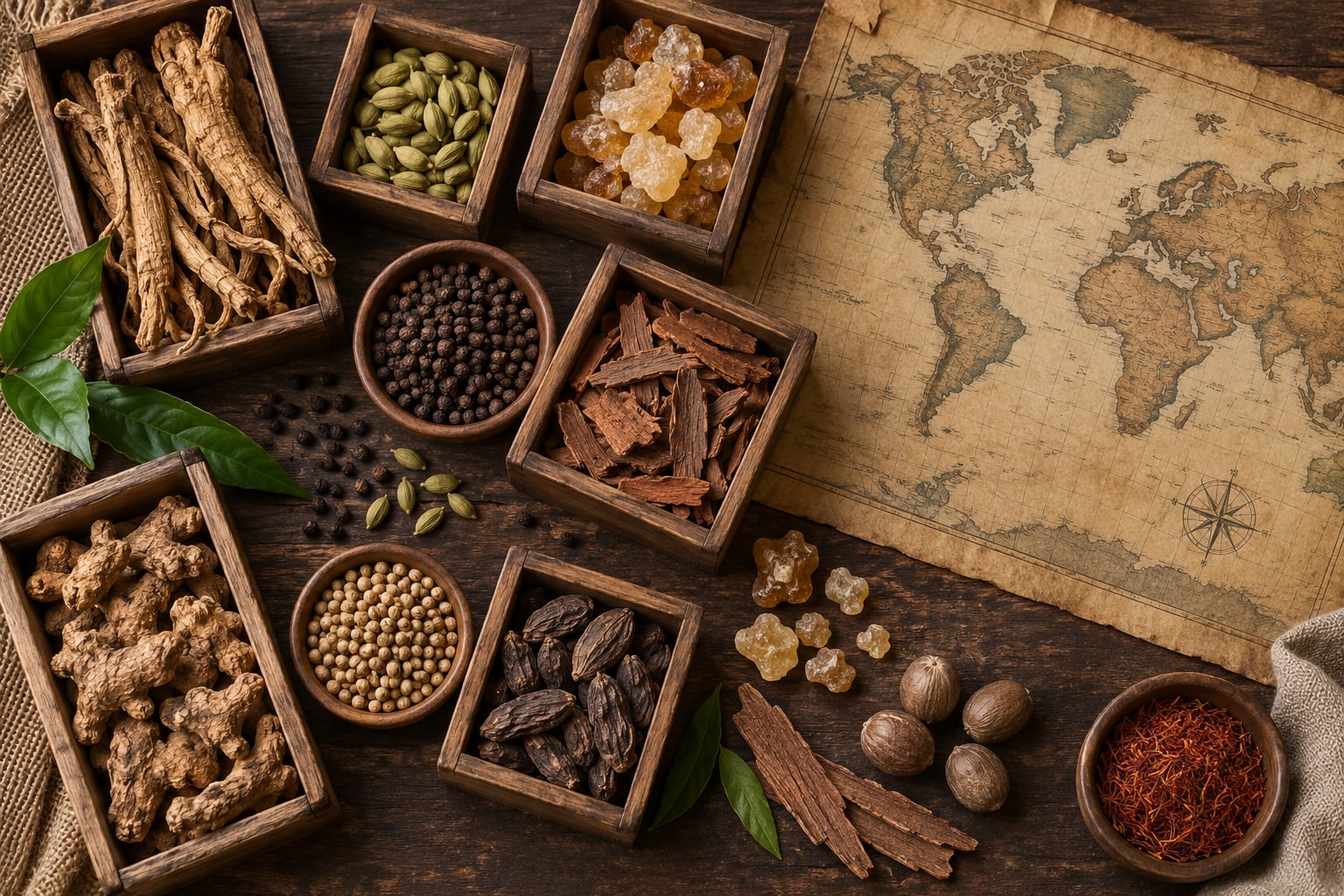
Plant commodities fell into a handful of classes that stayed remarkably stable for centuries. Aromatics and spices came from South and Southeast Asia and the Moluccas. Resins and gums, frankincense, myrrh, gum arabic and benzoin, came from the Horn of Africa, Arabia and India. Medicinal barks and roots, cinchona, sassafras, ipecacuanha and sarsaparilla, moved out of the Andes, Central America and the Caribbean. Dyes and tanning materials came from India, the Mediterranean and later the American tropics.
The main regions are the Indian Ocean rim, the Mediterranean and Saharan corridors, Atlantic Europe and its plantations, East and Southeast Asia, West and Central Africa, and Latin America. Each supplied different materials, and each sat at a different point on the chain between wild or cultivated harvest and the consumer.
Why the topic matters: it explains how plants reached populations thousands of kilometres from where they grow, who profited from moving them, and why today’s debates over adulteration, wild-harvest pressure and benefit sharing sound the way they do.
How did herbs become international trade goods?
Plants became trade goods for practical reasons long before anyone wrote a pharmacopoeia. A dried root keeps for months when a fresh plant does not. A resin stays stable in heat and damp. A bark that is worthless as food can be worth a season’s labour as a dye, a medicine or a perfume base.
Why plant products travelled before medicine was standardised
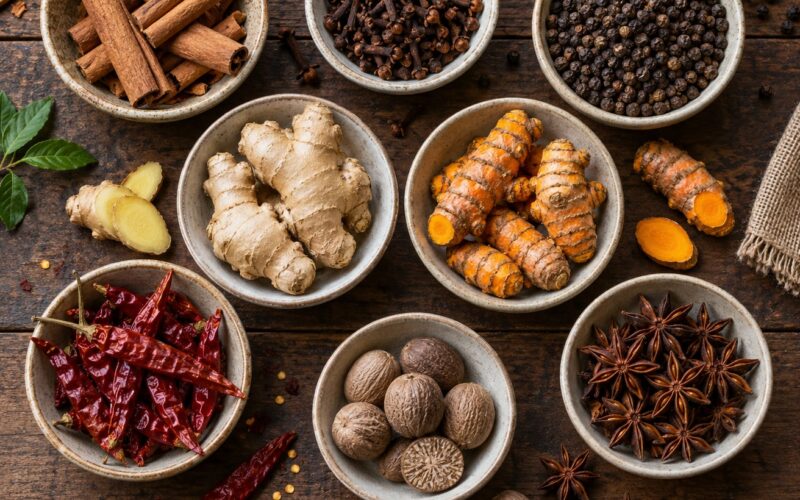
Six product classes carried the early trade. Aromatics, pepper, cardamom, cloves and nutmeg, added flavour and slowed spoilage, so they paid for themselves in the kitchen as well as the apothecary. Medicinal simples, gums, barks, roots and seeds, were prescribed by weight and preparation with little standardisation, so traders sold reliable origin and freshness rather than a guaranteed active content. Resins and incenses, frankincense, myrrh, benzoin and labdanum, burned as offerings and used in perfume, and were lightweight and high-value. Dyes and tanning materials, madder, indigo, myrobalan and catechu, were urban manufacturing inputs. Perfume oils and balms, myrrh, rose water and attar of roses, followed elite demand across courts and caravans. Ritual and psychoactive plants, frankincense, coca, tobacco, opium and cannabis, crossed regions with worship and habit attached.
Preservation is the quiet reason behind most of this. Salt, sugar, drying and resinous aromatics were the four preservation technologies of the premodern kitchen, and every one of them is a plant product that travelled.
Which trade routes shaped the earliest herbal commerce?
Exchange was rarely direct between producer and buyer. Goods usually changed hands at several entrepots, each layer adding risk, tax and knowledge, which is why the same bark or root could be re-labelled three times before reaching a consumer.
Reading the history of the global herbal trade through its corridors makes one point clear: the routes were built for high-value, low-weight goods and for information as much as for cargo.
Overland corridors
The Silk Roads linked China, Central Asia, Persia, the Levant and the Mediterranean, carrying silk, paper, lacquer, tea, rhubarb, frankincense, precious stones and spices. The incense roads of Arabia and the Horn of Africa ran frankincense and myrrh north to Mediterranean ports and east to India. Trans-Saharan caravan trade carried gold, salt, gum arabic and khat between West Africa and North Africa. Central Asian routes moved rhubarb and medicinal gums into Persia and Ottoman markets.
Maritime corridors
The Indian Ocean monsoon system tied East Africa, Arabia, India and Southeast Asia into one network: dhows and lateen sails left with one monsoon and returned with the other. The South China Sea carried cloves, nutmeg, mace and camphor toward Malacca, which sat astride the Straits. Cape routes around Africa from the fifteenth century shifted European purchases from Levantine and Venetian brokers to Lisbon, then Amsterdam. The Manila galleon ran silver, porcelain and spices from Asia to Veracruz and American silver back to Manila. Atlantic plantation routes carried sugar, tobacco, cacao, indigo, sassafras and cinchona to European ports.
| Corridor | Plant goods | Main hubs | Peak period |
|---|---|---|---|
| Silk Roads | Tea, rhubarb, gums, aromatics, medicinal roots | Chang’an, Kashgar, Samarkand, Bukhara, Rayy, Aleppo | c. 200 BCE to 1400 CE |
| Indian Ocean monsoon network | Pepper, cloves exported, cotton, tamarind, teak, gum arabic | Aden, Mogadishu, Malindi, Calicut, Goa, Malacca | c. 200 CE to 1600 |
| Southern Silk Road sea lanes | Cloves, nutmeg, mace, camphor, benzoin | Malacca, Aceh, Tidore, Guangzhou | c. 700 to 1700 |
| Trans-Saharan caravan | Gum arabic, khat, shea, salt, gold | Timbuktu, Kano, Agadez, Ghadames | c. 800 to 1900 |
| Incense and resin roads | Frankincense, myrrh, balsam | Shabwa, Sumhuram, Aden, Petra, Gaza | c. 1000 BCE to 1400 CE |
| Cape route to Asia | Pepper, cloves, cinnamon, drugs, dyes | Lisbon, Cape Town, Goa, Malacca | 1498 to 1700 |
| Atlantic plantation and mule route | Sassafras, ipecacuanha, cinchona, indigo, cacao | Cartagena, Havana, Veracruz, Bristol, Amsterdam | 1600 to 1850 |
| Manila galleon | Spices, medicinal woods, porcelain | Manila, Acapulco, Veracruz | 1565 to 1815 |
What changed during the ancient and medieval spice trade?
The spice trade grew because aromatic plants solved three problems at once. They preserved food in a world without refrigeration, they made bland staples palatable, and they carried medicinal and aromatic value, especially for camphor, cloves and nutmeg as drugs as well as condiments. On top of that, spices were taxed hard and imported from far away, which kept them scarce, which kept them valuable.
Pepper from the Malabar Coast supplied Europe, the Middle East and North Africa for roughly fifteen centuries. Cinnamon reached the Mediterranean from Sri Lanka and India through Arab and Venetian hands. Cloves and nutmeg moved from the Moluccas, the Banda Islands, across two seas to reach European markets, passing through Venice in its role as the great European entrepot of the fourteenth and fifteenth centuries before Lisbon and Amsterdam took over.
Saffron, the stigmas of Crocus sativus, was the most expensive of them by weight and moved from Iran and Kashmir through Persia and the Ottoman world to Europe. Frankincense and myrrh, resins tapped from Boswellia and Commiphora trees in the Horn of Africa, ran the incense roads to temple and church markets and then into perfumery and pharmacology.
Two things changed the map. Cumulative geographic knowledge, produced by Arab, Chinese, Greek and later Portuguese pilots, made voyages repeatable. And shipping capacity, from lateen-rigged dhows to multi-deck carracks and Dutch fluyts, cut freight cost per tonne sharply enough that spices stopped being luxuries reserved for courts.
Written records ran alongside commerce. Dioscorides’ De Materia Medica in the first century CE described hundreds of plants with their gathering sites and uses, and remained the reference for European apothecaries for well over a millennium. The Canon of Medicine compiled by the physician Ibn Sina, or Avicenna, in the eleventh century, organised Arabic, Persian and Greek materia medica into a systematic framework that later shaped both Unani medicine and European teaching. Monastic infirmaries kept physic gardens where herbs grew for the sick, and apothecaries in Italian and German cities stocked both locally grown simples and imported drugs.
How did African medicinal plants enter wider commercial networks?
African plants were early participants in long-distance trade, usually as raw materials for industries elsewhere rather than as finished medicines. Gum arabic tapped from Acacia senegal in the Sahel shipped from West African ports into European printing, textiles, confectionery and pharmacy. Frankincense and myrrh from Somalia, Ethiopia and southern Arabia fed incense, perfume and embalming trades spanning three continents. Shea butter and shea kernels moved from West and Central Africa into European soap and cosmetic manufacture. Khat from Ethiopia, Kenya and Somalia travelled the Horn of Africa as a daily stimulant, and in the twentieth century generated its own export economies and diplomatic disputes.
Three points are worth keeping straight when writing this history. First, most African plant exports were industrial raw materials, not packaged remedies, so a trade record showing sacks of gum says little about how local healers used the tree. Second, regional trade was older and larger than the export trade: kola nuts, shea, moringa and medicinal barks moved across the Sahara, the Sahel and the coast long before European buyers arrived. Third, forest and savannah products such as wild forest medicines, honey and gum arabic were often gathered opportunistically rather than cultivated, which made supply elastic and hard to regulate.
What did not travel was the documentation. Much African plant knowledge was oral, held by healers and families, and it left little written record that a later archive could catalogue. That asymmetry is one reason African contributions sit lower in most accounts of the global herbal trade than their economic weight would suggest.
How did colonialism reshape the global herbal trade?
Colonial rule turned plants into state-controlled commodities, and it did so on three fronts at once: production, science and knowledge.
On plantations, colonial administrations forced cash crops and medicinal plants into monoculture, with land, labour and yield managed for export rather than local use. Indentured and coerced labour moved people to those plantations. In British India, cinchona was moved from the Andes to Kew and then to Java in a bid to break the Andean monopoly on quinine bark. Conversely, rubber, cinchona, sarsaparilla, sassafras, ipecacuanha and cacao were carried from the Americas into Asian and African colonial economies.
Botanical gardens were the working infrastructure. Gardens at Kew, Calcutta, Peradeniya, Buitenzorg and elsewhere received seeds and specimens from colonies, grew them, and shipped both living material and dried herbarium material back to metropolitan laboratories. They were built for imperial advantage, yet they produced the botanical science of the modern world, and the plant records they created still back modern identification work.
Indigenous knowledge was the raw material of that science. Local healers’ knowledge of which plant treated which complaint was recorded, classified and patented by colonial institutions, with credit and compensation rarely flowing back. Convincing cases include rubber, chaulmoogra oil for leprosy, and the documentation that turned cinchona and ipecacuanha into pharmaceutical commodities. Those cases pushed the international benefit-sharing debate that eventually produced the Convention on Biological Diversity in 1992 and the Nagoya Protocol on Access and Benefit-Sharing, adopted in 2010 and in force since 2014.
The trade also shifted geography. Once voyages could bypass the Levantine brokers and sail around Africa or across the Atlantic, the profit centre moved from Alexandria and Venice to Lisbon, then Amsterdam and London, and the producing regions were pushed further into plantation monoculture rather than diversified local economies.
What drove the nineteenth- and twentieth-century expansion of herbal commodities?
Nineteenth-century industry turned herbs into measured inputs. Chemistry isolated active constituents such as morphine from opium, quinine from cinchona and caffeine from coffee, and pharmacy began buying botanical raw material by assay rather than by reputation. Standardised extracts, fluid extracts and later high-performance liquid chromatography fingerprinting let manufacturers guarantee a dose from a variable plant.
Patent medicines turned that into volume. Bottled preparations, pills and elixirs shipped through colonial and domestic retail networks, and firms built global brands on a few species. Cinchona, senna, cascara, ipecacuanha and sarsaparilla became industrial ingredients. Agricultural chemistry, refrigeration and rail and steamship freight cut spoilage and cost, and wartime supply pressure pushed governments to secure sources of quinine, opium substitutes and gaultheria oil.
The decline of plant material in the official pharmacopeia
Plant material lost official ground fast even as consumer demand held. Crude plant extracts were roughly 40 percent of official United States Pharmacopeia preparations in 1916, around 9 percent by 1950, and about 1 percent by 1990. The Flexner Report of 1910 reshaped medical education around laboratory science, antibiotics from the 1940s onwards supplied cheap and reliable substitutes, and synthetic chemistry gave formulators compounds no plant could supply at scale.
The twentieth century then rebuilt demand through new channels rather than through pharmacies. Food supplements, cosmetic botanicals, traditional medicine reforms and, later, e-commerce made raw dried herbs and standardised extracts international consumer products. Published estimates put herbal medicine use near 60 percent in most countries and between 70 and 80 percent in China, India, Africa and Germany, which keeps demand high even where prescription authority moved to chemistry.
How is the modern global herbal trade regulated?
Regulation today runs through four separate systems at once, and the difference matters more than most buyers realise. Food use, cosmetic use, traditional use and medicinal use each carry different rules for the same jar of dried leaves.
Botanical identification is the first gate. Trade names vary by country and by clinic, and a substitution error between closely related species can turn a standard preparation into an unrelated one. Quality testing then checks identity, potency, moisture, microbial load, pesticide residues, heavy metals and adulteration with cheaper lookalike material, often against a pharmacopoeial monograph. Protected species matter commercially as well as ecologically: international wildlife trade rules restrict unsourced collection of threatened plants, and buyers increasingly ask for collection permits and chain-of-custody documentation.
Customs classification decides whether a plant is a food, a pharmaceutical, a spice or a controlled substance, and that single decision sets duty, documentation and market access. Labelling rules differ again, with the United States treating most botanical products as dietary supplements under the 1994 supplement framework, and the European Union running a traditional herbal registration route based on traditional use alongside the stricter marketing-authorisation route.
| Milestone | Year | Effect on the herbal trade |
|---|---|---|
| Convention on International Trade in Endangered Species | 1973 | Restricts international trade in threatened plant species and their products |
| WHO good manufacturing practice for herbal medicines | 2003 | Sets common manufacturing, documentation and quality expectations |
| WHO global strategy on traditional medicine | 2003 | Puts traditional medicine into health policy and regulation frameworks |
| EU traditional herbal registration | 2004, applied from 2015 | Creates a national listing route based on traditional use |
| Dietary Supplement Health and Education Act | 1994 | US framework that keeps most botanical products on the supplement market |
| Convention on Biological Diversity | 1992 | Sets national sovereignty over genetic resources |
| Nagoya Protocol on benefit sharing | Adopted 2010, in force 2014 | Requires fair terms for use of indigenous and local knowledge |
Harmonisation is still incomplete. A Chinese pharmacopoeia monograph, an Ayurvedic pharmacopoeial standard and a European monograph for the same species can specify different markers and limits, which means exporters often build to the strictest standard they can reach.
What are the main forces changing the herbal trade today?
Supply pressure is the first one. Wild collection of slow-growing species, including ginseng, arnica and some gentians, takes longer than the plants need to recover, and quotas and CITES listings now sit on the same species that international buyers want most. Climate change moves growing zones, shortens harvest windows and raises the failure rate for a crop that buyers expect on schedule.
Adulteration and misidentification run the other way, as substitution with cheaper plant material, undisclosed pharmaceutical additives and false certificate-of-analysis documents circulate through the same supply chains. Third-party testing and traceability records are becoming entry conditions rather than advantages.
Cultivation is the structural response. Many traded species are now farmed rather than wild harvested, which makes volumes predictable but reduces genetic variety if a narrow set of clones dominates. Fair-trade and regenerative-harvesting schemes exist but cover a small share of tonnage. Biopiracy and benefit sharing are the political edge of all this: the Nagoya Protocol asks access to genetic resources and associated knowledge to come with fair terms, and enforcement varies widely.
And demand keeps moving. Cosmetics, functional foods and supplements pull in botanical extracts, direct-to-consumer e-commerce shortens the chain from grower to buyer, and a buyer in Europe or North America can now order a single origin lot that a pharmacy counter would never have stocked.
The plants that dominate the world herb market today
Published reviews of world herb trade repeatedly name the same short list of species. These are the plants that carry the most traded volume, and each has a distinct path into commerce.
| Species | Common name | Main growing region | Principal trade form |
|---|---|---|---|
| Panax ginseng | Asian ginseng | China, Korea | Dried root, sliced, priced by age |
| Curcuma longa | Turmeric | India, Southeast Asia | Rhizome, dried and powdered, oleoresin |
| Zingiber officinale | Ginger | India, China, Southeast Asia | Dried rhizome, oil, oleoresin |
| Glycyrrhiza glabra | Liquorice root | Central Asia, Mediterranean | Dried root and root extract |
| Allium sativum | Garlic | China, Central Asia, Mediterranean | Dried bulb, aged extract, oil |
| Ginkgo biloba | Ginkgo | Cultivated in China and Japan | Leaf extract, standardised |
| Echinacea | Purple coneflower | North America, cultivated in Europe | Dried root and leaf, aerial parts |
| Hypericum perforatum | St John’s wort | Europe, cultivated worldwide | Dried herb, standardised extract |
| Silybum marianum | Milk thistle | Mediterranean, Eastern Europe | Seed extract, silymarin standardised |
| Rhodiola rosea | Roseroot, arctic root | Arctic and alpine Eurasia | Root extract |
Published market estimates put the global herbal medicine market at roughly 165 billion US dollars, growing toward 350 billion by the end of the decade. Those figures cover finished herbal products rather than raw dried herb tonnage, and the two are not the same trade.
A Timeline of the Global Herbal Trade
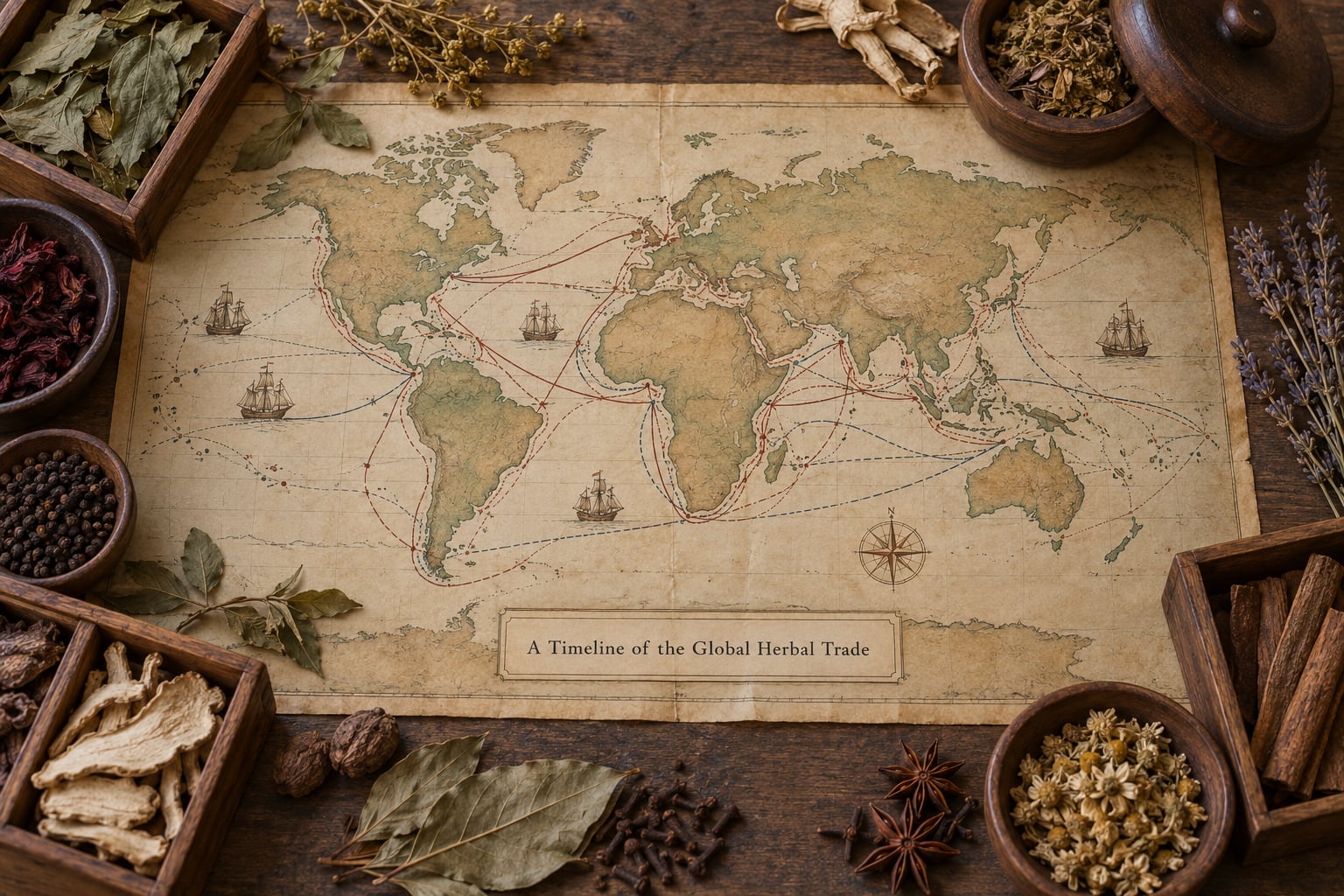
Date ranges below are approximate, because evidence and terminology vary by region and commodity. A single plant’s journey rarely has one clean starting point.
| Period | Regions | Representative materials | Key development |
|---|---|---|---|
| c. 2800 BCE (attributed) | China | Root and flower drugs | Shen Nung’s Pen Ts’ao, China’s first materia medica |
| c. 1600 to 1550 BCE | Egypt | Senna, caraway, honey, oils | Edwin Smith and Ebers papyri list remedies and ingredients |
| c. 1000 to 500 BCE | India, China | Spices, resins, tonics | Atharvaveda and early Ayurvedic drug lists |
| c. 1000 BCE onward | Horn of Africa, Arabia | Frankincense, myrrh | Incense roads link temple and port markets |
| c. 500 BCE to 100 CE | Greece, Rome, Egypt | Senna, pepper, dyes, perfumes | Hippocratic corpus and Alexandrian pharmacy |
| c. 70 CE | Mediterranean | Hundreds of described species | Dioscorides’ De Materia Medica |
| c. 200 to 1000 | Indian Ocean, Red Sea | Pepper, cloves, cinnamon, gum arabic | Monsoon shipping connects East Africa, India and Southeast Asia |
| 1025 | Baghdad, Persia | Organised materia medica | Avicenna’s Canon of Medicine |
| 1400 to 1500 | Mediterranean, Alexandria | Pepper, spices, drugs | Venice as Europe’s chief spice entrepot |
| 1485 | Germany | Illustrated plant remedies | Gart der Gesundheit, an early printed herbal |
| 1498 to 1600 | Atlantic, Indian Ocean | Spices, drugs, dyes | Cape route to Asia bypasses Levantine brokers |
| 1535 to 1600 | Europe, Americas | Sassafras, ipecacuanha, guaiacum | Trans-Atlantic exchange of New World plants |
| 1649 | England | Common-market simples | Culpeper’s English Physician, read widely by the public |
| 1753 | Europe | All plant commodities | Linnaean binomial nomenclature gives stable names for trade |
| 1800 to 1870 | Andes, Java, India, Africa | Cinchona, rubber, ipecacuanha, sarsaparilla | Plantations, botanical gardens, cinchona transplant to Java |
| 1859 to 1916 | Europe, United States | Fluid extracts, patent medicines | Standardised extracts and industrial pharmacy displace bulk simples |
| 1910 | United States | All medicinal plants | Flexner Report shifts medical education to laboratory science |
| 1916 to 1990 | United States | Crude plant extracts | Share of official USP preparations falls from about 40 percent to about 1 percent |
| 1940s to 1970s | Global | Antibiotics, synthetic drugs | Pharmaceutical era reshapes how herbs are traded and used |
| 1992 to 2014 | Global | Genetic resources and associated knowledge | Convention on Biological Diversity and Nagoya Protocol set benefit-sharing rules |
| 2000s to present | Global | Supplements, cosmetics, standardised extracts | Regulated herbal market and e-commerce supply chains expand |
Frequently Asked Questions
What are the main trade routes for herbs and spices?
The main corridors were the Silk Roads across Central Asia, the Indian Ocean monsoon network linking East Africa, Arabia, India and Southeast Asia, the South China Sea lanes through Malacca, the trans-Saharan caravans carrying gum arabic and khat, the Cape route around Africa from 1498, and Atlantic plantation routes running from the Americas to European ports. Each corridor added layers of brokers before goods reached a buyer.
Why were spices so valuable in the medieval period?
Three reasons: spices preserved food without salt or ice, they made bland staples such as salted meat and stale bread palatable, and many carried medicinal value as aromatic drugs. They were also taxed heavily and imported from distant growing regions, which kept supply scarce. Scarcity, preservation and pharmaceutical use together explain why pepper and cloves moved in bulk across continents.
Are herbs the same thing as spices?
No. Spices came mainly from aromatic plants and were valued for flavour, aroma, preservation and ritual use, with pepper, cinnamon, cloves, nutmeg and saffron as the classic examples. Herbs were gathered for medicine, dyes, perfumes and gums, including senna, cinchona, frankincense, myrrh and gum arabic. The categories overlap, since cloves and saffron were used as drugs too.
How did colonialism change the herbal trade?
Colonial governments pushed cash and medicinal crops into monoculture plantations with coerced labour, moved seeds between continents, and used botanical gardens as trade infrastructure. They also recorded, patented and commercialised indigenous plant knowledge, often without returning credit or benefit. The same period gave us the modern pharmaceutical plants, including rubber and cinchona, and left the argument about access and benefit sharing still unresolved.
Which country became most famous for the spice trade?
Venice was the great European entrepot through the fourteenth and fifteenth centuries, buying pepper through Levantine brokers. After the Cape route opened in 1498, Portugal took over, and the Dutch East India Company later controlled cloves and nutmeg from the Moluccas through Malacca. Production today sits largely in India, Indonesia, Vietnam, Madagascar and China, while trading hubs include Singapore, Dubai and Rotterdam.
What is the Nagoya Protocol and how does it affect the herbal trade?
The Nagoya Protocol is a treaty on access and benefit sharing, adopted in 2010 and in force since 2014. It requires that using genetic resources or associated indigenous and local knowledge, including traditional herbal knowledge, needs prior informed consent and mutually agreed terms. For traders it means documented sourcing, collection permits and traceability, and for traditional knowledge holders it means a claim to compensation that earlier collection systems ignored.
Conclusion
If you only read one part of this history, read the routes and the colonial section. Together they explain why the plants you buy were grown where they were, why their names vary so much between countries, and why questions about wild-harvest limits, adulteration and benefit sharing dominate the trade now.
Start with the timeline table for the shape of the whole story, then use the corridor table to trace a single material, such as frankincense or cinchona, from source region to end market. That end market part is where today’s labelling rules, pharmacopoeial monographs and supplement frameworks finally come into the picture.