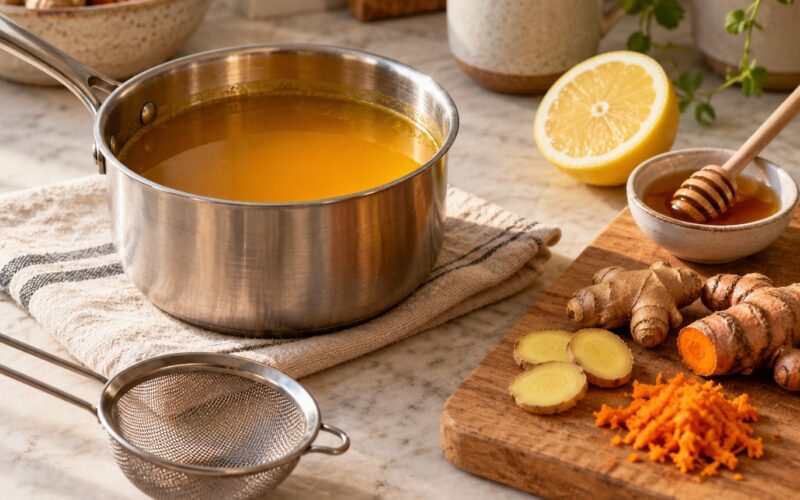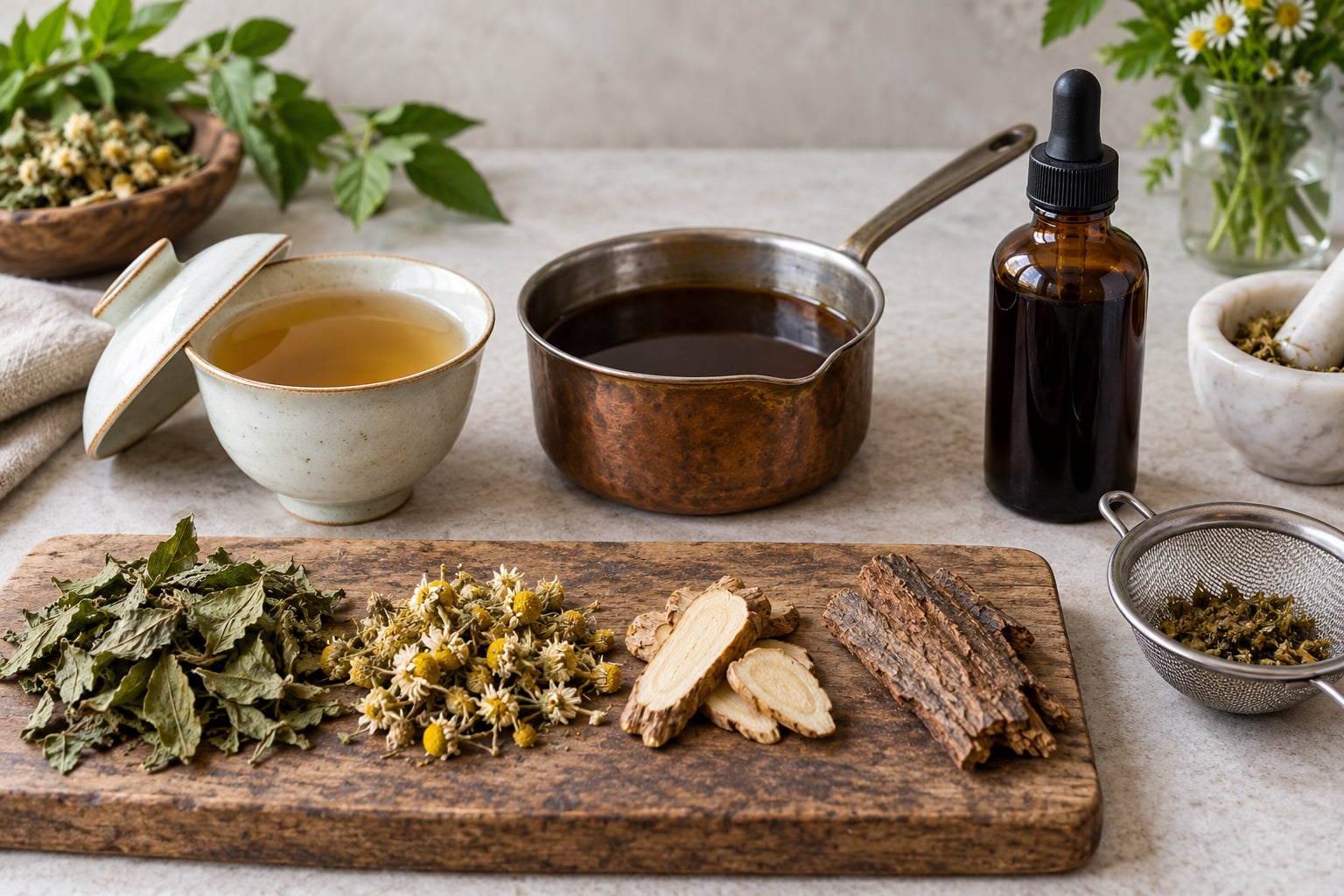
The difference between infusion, decoction and tincture comes down to two variables: the solvent and the heat. An infusion pours hot water over delicate plant parts and steeps them briefly. A decoction simmers tough roots, bark or seeds in water. A tincture extracts plant material in alcohol, which concentrates it and keeps it far longer.
Most confusion on this topic is a vocabulary problem, not a technique problem. The word “infusion” gets used loosely for anything liquid that comes out of a plant, which makes two very different processes look identical. Experienced preparers keep making the same correction: a tincture is by definition an alcoholic extract, and if the solvent is water or glycerin, it has a different name.
This guide compares the three methods by process, plant part, strength, storage and safety. It is written for students, researchers and curious home preparators, and it treats every preparation here as a traditional craft rather than a treatment plan. Nothing below is medical advice.
Table of Contents
- 1Difference Between Infusion, Decoction and Tincture at a Glance
- 2What Is an Infusion?
- 3What Is a Decoction?
- 4What Is a Tincture?
- 5How the Three Preparations Differ
- 6What the Difference Between Infusion, Decoction and Tincture Means in Practice
- 7Infusion vs Decoction: Hot Water or Simmered Water?
- 8Infusion vs Tincture: Water or Alcohol Extraction?
- 9Decoction vs Tincture: Simmered Water or Concentrated Extract?
- 10Which Should You Choose?
- 11Safety, Storage and Quality Considerations
- 12Frequently Asked Questions
- 13Is an infusion stronger than a decoction?
- 14Can a tincture be alcohol-free?
- 15What plant parts are best suited to decoctions?
- 16How long do homemade herbal preparations keep?
- 17What alcohol percentage is best for tinctures?
- 18Is a tincture better than a cup of herbal tea?
- 19Conclusion: Start by Identifying the Preparation
Difference Between Infusion, Decoction and Tincture at a Glance
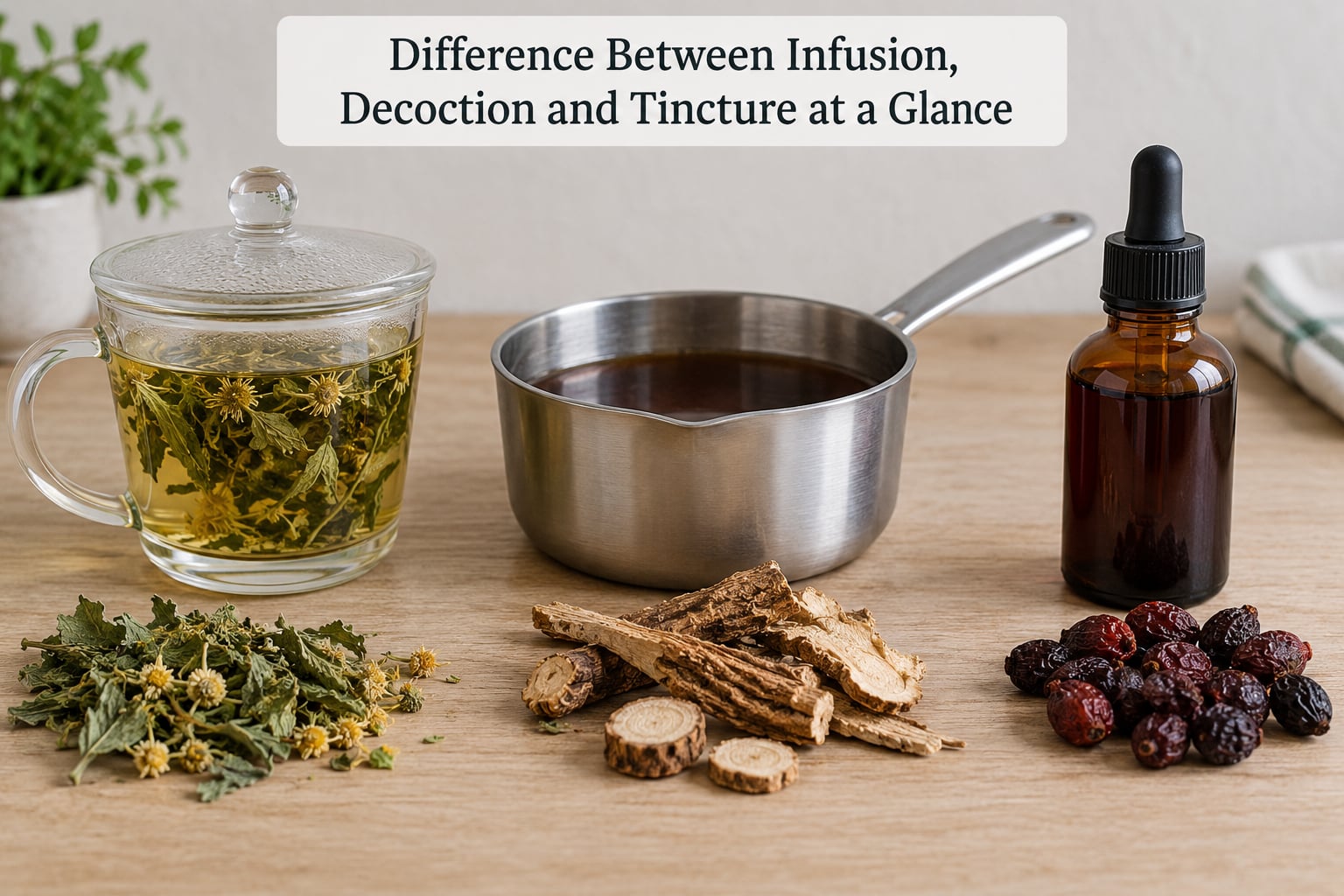
Here is the short version: an infusion uses hot water and short heat, a decoction uses simmering water and long heat, and a tincture uses alcohol and no heat at all. The table below sets them side by side.
| Criterion | Infusion | Decoction | Tincture |
|---|---|---|---|
| Basic definition | Plant material steeped in hot water, then strained | Plant material simmered directly in water until the liquid concentrates | Plant material extracted into alcohol over days or weeks |
| Solvent (menstruum) | Water | Water | Alcohol, usually ethanol at 40 to 60 percent |
| Best plant parts | Leaves, flowers, buds, soft fruit, tender stems | Roots, bark, seeds, hard stems, twigs, rhizomes | Almost any part, including resins, roots and bark |
| Heat | Hot water, typically just off boiling, no sustained boil | Bring to a boil, then simmer | None; room temperature or cool |
| Time | 5 to 20 minutes | 10 to 60 minutes or longer | 2 to 6 weeks of maceration |
| Finished texture | Clear to cloudy water, thin, served as a drink | Dark, fuller-bodied liquid, sometimes reduced | Deeply coloured, viscous, oily-looking liquid |
| Relative strength | Lightest | Medium to strong | Most concentrated |
| Dose volume | A cup or two | A cup, often reduced to a smaller serving | Dropperfuls or teaspoons |
| Shelf life | 1 to 2 days refrigerated | 3 to 5 days refrigerated | Several years in a sealed amber bottle |
| Practical fit | A daily cup for tender material | Extracting dense material that water alone cannot pull apart | Portable, concentrated, long-term storage |
What Is an Infusion?
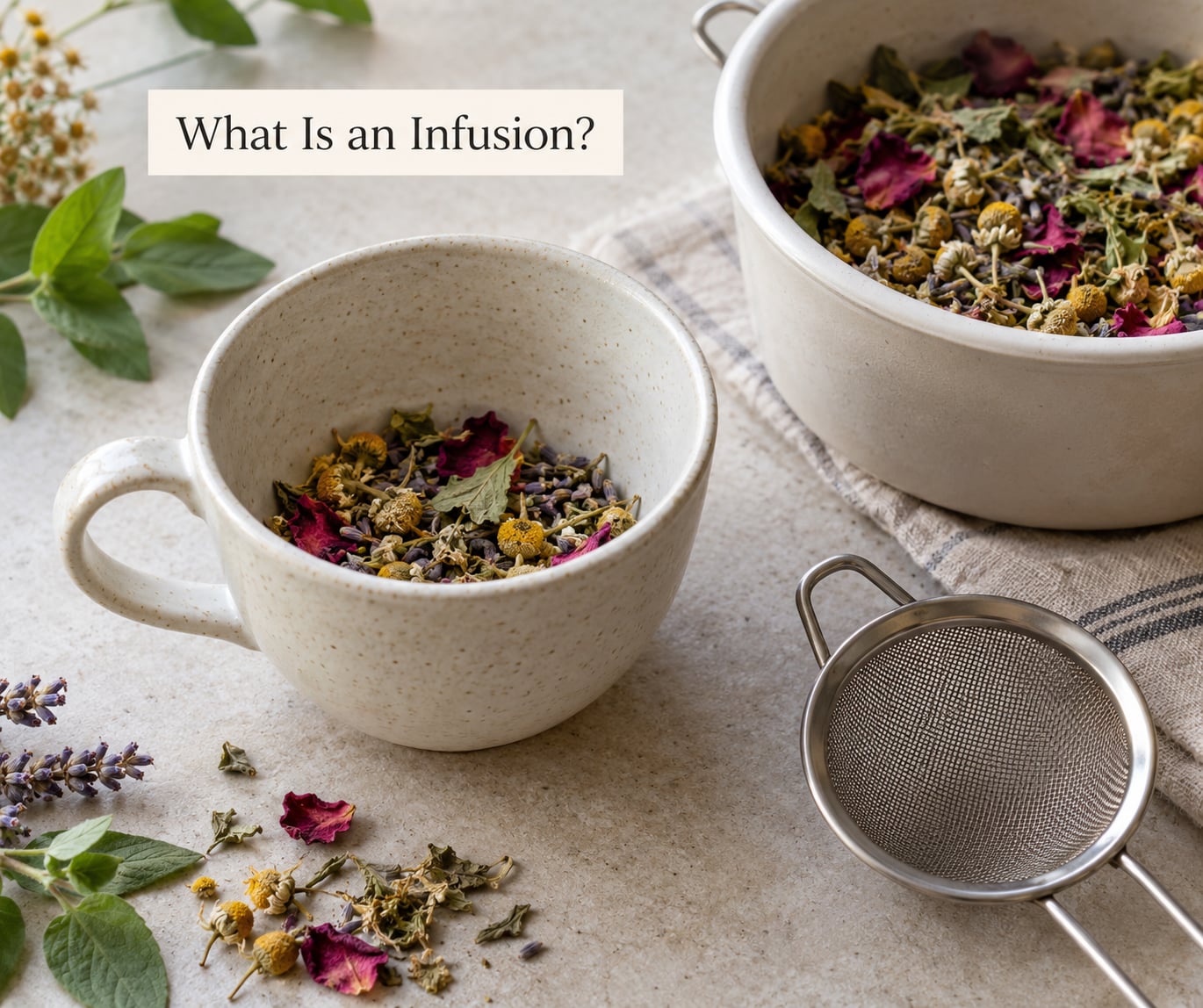
An infusion uses hot water to draw compounds out of delicate plant material, and it is the fastest and gentlest of the three methods. You pour the water over the plant, keep the vessel covered so volatile oils do not evaporate, let it stand for a few minutes, then strain. That is the whole process.
The material should be tender enough to give up its constituents quickly. Leaves, flowers, buds, soft fruit and young green stems are the usual candidates, and chamomile, peppermint, lemon balm, hibiscus and mallow are the classic examples.
Covering matters more than most beginners expect. Chamomile, peppermint and lavender carry aromatic oils that rise as steam and escape into the room if the pot is uncovered. A lid or a plate on top keeps them in the cup where you can taste them.
Water quality also changes the result. Hard water dulls an herbal cup, and some minerals interfere with extraction, so filtered water is a sensible default if your tap water has a strong taste or a lot of limescale.
Infusions are the weakest of the three by concentration, and that is usually fine. They are meant to be drunk, not measured by the dropper, and they work best as a daily habit rather than a concentrated dose. A second steep of the same material usually gets weaker rather than stronger, so pouring the spent leaves away is normal.
What Is a Decoction?
A decoction simmers tough plant material in water, using sustained heat to break down woody tissue and pull out constituents that a short steep cannot reach. The finished liquid is darker, heavier in the mouth and more concentrated than an infusion.
Roots, bark, seeds, rhizomes and hard stems are the standard materials. Ginger, licorice root, cinnamon bark, valerian and oak bark are familiar examples, and so are many of the root and bark preparations used across African, South Asian, Chinese and European herbal traditions, where the simmered liquid is often drunk as a cooled cup or eaten as a broth-like preparation.
The usual sequence starts cold. You put the plant material and the water in the pot together, bring it to a boil, then drop the heat to a steady simmer for anything from 10 minutes to an hour depending on how dense the material is. Starting cold extracts more evenly than throwing boiling water over a root and walking away.
Many traditional decoctions are strained and then boiled down further, sometimes to a third or a quarter of the starting volume, to get a small, dark, syrupy serving. That reduction is where a decoction pulls ahead of an infusion in strength, and it is also where it is easiest to go too far.
Extended simmering is not automatically better. Prolonged heat and a reduced volume can degrade volatile constituents and leave the result bitter, astringent or harsh. Pharmacopoeial and apothecary practice, which is where the formal definition of a decoction comes from, treats decoction as a standard pharmaceutical preparation with controlled proportions and times rather than an improvised one.
What Is a Tincture?
A tincture is a concentrated extract made by macerating plant material in alcohol, which acts as both solvent and preservative. No heat is used, and the mixture sits for weeks, shaken occasionally, before the solids are pressed out and the liquid is bottled.
The alcohol percentage is the part that matters most. Somewhere around 40 to 60 percent ethanol is the usual range, because that is high enough to pull resins, waxes and alkaloids yet low enough to keep some water-soluble constituents in the mix too. Fresh material generally needs less alcohol than dried, since it already carries water.
Higher alcohol suits resinous and resin-heavy plants such as pine, myrrh and cannabis. Lower alcohol, closer to 25 to 40 percent, suits aromatic leaves where you want the volatile oils but not the alcohol burn. Using 100 percent alcohol simplifies the maths but can draw out fewer water-soluble constituents, so many herbalists dilute it back down with water.
Tinctures are labelled by ratio, written weight to volume. A 1:5 tincture uses one part plant material by weight to five parts solvent by volume, and the lower the numbers, the more concentrated the result.
| Ratio | What it means | Relative strength |
|---|---|---|
| 1:1 | Equal parts by weight and volume, often a standard extract | Strongest common ratio |
| 1:2 | Half as much solvent by volume as plant weight | Very strong, common for fresh material |
| 1:3 | A gentler version of 1:2 | Strong |
| 1:5 | The most common home and retail ratio | Standard |
| 1:10 | A lot of solvent relative to plant weight | Mild, good for dosing flexibility |
Because a tincture carries the plant in a small volume, it travels well and doses in drops, which is why most dispensary and traditional-practice preparations are made this way. It also keeps for years in a sealed, dark glass bottle, mostly because alcohol does not support microbial growth.
How the Three Preparations Differ
Each method varies on the same two axes, solvent and heat, and once you see that the choices become obvious. Water with brief heat gives you a light drink, water with sustained heat gives you a deeper extract from dense material, and alcohol without heat gives you a stable concentrate that pulls a different set of constituents.
That last point is worth pausing on. Alcohol and water do not extract the same things. Water reaches sugars, salts, gums, tannins and some alkaloids, while alcohol reaches resins, waxes, oils and lipophilic constituents that plain water leaves behind. This is the practical reason a tincture is not just a stronger tea.
What the Difference Between Infusion, Decoction and Tincture Means in Practice
Put simply, the plant part and the goal decide the method. A delicate leaf such as peppermint gets steeped, not boiled, because a hard simmer drives off the volatile oils you steeped it for. A hard root such as ginger gets simmered, not steeped, because a 15-minute steep in hot water barely touches it.
A portable concentrate is a different situation again. If you need something shelf-stable that doses in drops, alcohol extraction is the route, and there is no water-based shortcut that reaches the same concentration.
None of this proves that one preparation is more effective or safer than another. Method determines what you extract and how concentrated it is, not whether it works for you. That is a separate question that depends on the plant, the person and the situation.
Several related methods sit alongside these three, and mixing their names up is the most common source of confusion in online discussions.
| Method | Solvent | Typical use | Time |
|---|---|---|---|
| Maceration (cold infusion) | Water, no heat | Delicate material you do not want heated | 4 to 12 hours in the fridge |
| Glycerite | Vegetable glycerin and water | Alcohol-free option for children and people avoiding alcohol | 4 to 6 weeks |
| Vinegar extract | Apple cider vinegar | Mineral-rich or bitter material, short shelf life | 2 to 4 weeks |
| Oxymel | Vinegar and honey | A traditional sour-sweet solvent | 2 to 4 weeks |
| Infused oil | Carrier oil, usually olive | External use, salves and balms | 1 to 4 weeks, warm or at room temperature |
| Hydrosol | Water, distilled | A gentle aromatic water for external use | Distillation only |
A glycerite is not a tincture, even though shops often sell the two in similar bottles with similar names. Glycerin extracts tend to be weaker, which is why practitioners dose them more generously, and honey infusions are used as a whole-food alternative when alcohol is off the table.
Infusion vs Decoction: Hot Water or Simmered Water?
These two share a solvent and differ in heat, and that single variable changes the flavour, the colour and the plant parts you can use.
In temperature, an infusion gets water near boiling and then simply waits. A decoction gets a full boil followed by a controlled simmer, which is the only way to get deep extraction from woody material without it burning.
In plant material, the line is drawn at texture. Leaves, flowers and buds steep well and can lose their character quickly under hard heat. Roots, bark and seeds need the sustained simmer because their constituents sit inside dense tissue.
For flavour, an infusion stays light and aromatic. A decoction tastes fuller, often sweeter or more bitter, and reduction concentrates it further.
For colour, an infusion is usually pale to golden, while a decoction runs from amber to near-opaque brown.
In strength, a plain infusion is the lightest of all three preparations. A decoction, especially one reduced after straining, is several times more concentrated, which is why decoctions are traditionally taken in smaller servings.
In practice, an infusion is the sensible choice for a daily cup from tender material, while a decoction is the practical choice when your material is a root or a piece of bark and water has to do more work than a 15-minute steep allows.
Infusion vs Tincture: Water or Alcohol Extraction?
This is the comparison people most often get wrong, because both methods can come out of a jar and both can be made from the same leaves. The solvent decides what ends up in the liquid and how long it lasts.
In concentration, the tincture wins comfortably. A tincture holds a large amount of plant material in a small volume, while an infusion holds a small amount in a large volume. That is why doses are measured in dropperfuls for one and in cups for the other.
In what gets extracted, alcohol reaches resins, waxes, oils and some alkaloids that water leaves behind, and water reaches sugars, salts and tannins that a high-alcohol tincture pulls less efficiently. Neither is a complete answer on its own.
In portability and shelf life, the tincture is far ahead. It fits in a coat pocket, survives a trip and keeps for years in a sealed amber bottle, while an infusion is made to be drunk within a day or two.
For readers avoiding alcohol, this is the deciding factor. Pregnancy, recovery, religious practice, household sharing with children and personal preference all push toward a water infusion, a decoction, a glycerite or a dry root honey, and each has a different strength and shelf life that you should expect rather than assume.
Whichever you use, read the label rather than the front of the bottle. The solvent percentage and the ratio tell you far more than the product name does.
Decoction vs Tincture: Simmered Water or Concentrated Extract?
A decoction and a tincture are usually reached for on the same material, a root or a bark, but they end up as completely different products.
In process, a decoction applies heat to plant material sitting in water for minutes to an hour. A tincture puts the same material in alcohol at room temperature for weeks.
In consistency, a decoction is a thin water-based liquid with the solids strained out, sometimes reduced to a thicker syrup. A tincture is a coloured, oily-looking liquid that often leaves a residue on the glassware.
In strength, the tincture is generally the more concentrated and the more portable of the two, because it carries the plant in a fraction of the volume.
In storage, a decoction needs refrigeration and lasts days. A tincture keeps for years without refrigeration in a dark glass bottle, since the alcohol content alone prevents spoilage.
In convenience, the tincture wins on dosing and the decoction wins on transparency. You can see exactly what went into the pot, whereas a finished tincture needs a label to tell you what is in it at all.
In practice, the choice usually comes down to how long you need it to last and whether you can store alcohol in your home. A fresh batch of decoction suits an everyday drink, while a tincture suits a remedy you want to keep on hand for months.
Which Should You Choose?
Match the method to the plant part first, then to the goal, and the answer usually takes seconds.
Start with the material. Tender leaves, flowers and buds call for an infusion. Roots, bark, seeds and hard stems call for a decoction. Resinous material or anything you want to keep for months calls for a tincture.
Then consider the goal. A daily drink means an infusion. Extracting stubborn dense material means a decoction. Concentrated, portable, long-term storage means a tincture. Avoiding alcohol entirely means an infusion, a decoction, a glycerite or an oxymel, and you should accept a shorter shelf life or a weaker extract in exchange.
Then consider logistics. If you have no dark glass bottles, no way to shake a jar for six weeks and no safe place to store alcohol, a tincture is not the practical choice, whatever the theory says.
One more variable: taste. If you dislike a bitter simmered liquid, that is real information, and a shorter decoction or a tincture dosed in drops may suit you better than a cup you force down.
Whatever you pick, questions about a specific preparation for your own health belong with a doctor or a pharmacist. Preparers can talk about technique, not about whether something is right for your body.
Safety, Storage and Quality Considerations
Handling and storage mistakes cause more ruined preparations than any flaw in the method itself, and a handful of safety points apply to all three methods.
Identify your plant material correctly and keep it labelled. Wrong identification is a serious problem with dried roots and bark, since lookalike species exist. Buy from a supplier that gives a botanical name, not just a common name.
Use clean equipment and correct storage. Water-based preparations support microbial growth, so a fresh infusion or decoction needs refrigeration and should be poured out rather than returned to the pot. Tinctures and glycerites go in sealed amber glass, away from light and heat, with the label written on at the time of bottling.
Treat homemade preparations as unverified. Nobody has tested yours for potency, purity or contaminants, and a homemade preparation is not a substitute for a regulated product or a clinical treatment.
Check alcohol content before handing one to anyone else. A 60 percent tincture is a significant amount of ethanol in a few millilitres, and it matters for children, for pregnancy, for anyone avoiding alcohol for health, recovery or religious reasons, and for anyone taking medication that interacts with alcohol.
Watch for allergies and tolerances. A preparation is only as safe as your response to it, so a small test amount makes more sense than a full serving when you have never had the plant before.
Do not use any of these to treat serious symptoms, and do not replace prescribed medication with a homemade preparation. Persistent symptoms, high fever, chest pain, breathing difficulty or anything that gets worse rather than better needs a qualified clinician, not a pot on the stove.
| Preparation | Refrigerated | Room temperature, sealed and dark | Note |
|---|---|---|---|
| Fresh infusion | 1 to 2 days | Not recommended | Use within hours if left out |
| Decoction | 3 to 5 days | Not recommended | Freezing in portions extends it |
| Alcohol tincture | Not needed | Several years | Alcohol acts as the preservative |
| Glycerite | 1 year | 1 to 2 years | Weaker extract, shorter shelf life |
Figures on shelf life vary between sources because storage conditions change everything, so treat these as practical guidance for a home kitchen rather than as a published standard. When a preparation smells off, looks cloudy in a way it should not, or has been left warm for days, discard it.
Frequently Asked Questions
Is an infusion stronger than a decoction?
Not automatically. An infusion steeps delicate material in hot water for a short time, while a decoction simmers roots, bark or seeds long enough to extract from dense tissue. A reduced decoction is usually more concentrated, but strength depends on the plant, the water, the heat and the time rather than on the label. Preparation method also does not indicate whether a preparation is effective or safe.
Can a tincture be alcohol-free?
Not by strict definition. A tincture is by definition an alcoholic extract, and standard herbal terminology is clear about that. When the same extraction is done in vegetable glycerin, the result is called a glycerite, and it is usually weaker and keeps for less time. Some shops blur this deliberately, so check the ingredients rather than the product name.
What plant parts are best suited to decoctions?
Dense or woody material such as roots, bark, seeds, rhizomes and hard stems, because sustained simmering extracts from them far better than a short steep. You can decoct leaves, and plenty of traditional recipes do, but you usually lose the volatile oils that made them worth choosing. Plant identity still comes first, and a correctly identified part matters more than the method.
How long do homemade herbal preparations keep?
It depends on solvent, material, water content, sterility, container and storage. Fresh infusions last one to two days refrigerated and decoctions three to five days. A properly made alcoholic tincture keeps for years in a sealed dark bottle, while glycerites run one to two years. If a preparation smells off or shows unexpected cloudiness, discard it rather than tasting it.
What alcohol percentage is best for tinctures?
Around 40 to 60 percent ethanol suits most material, since it reaches resins, oils and some alkaloids while still holding water-soluble constituents. Higher alcohol, up to 90 percent or so, suits resinous plants, and lower alcohol near 25 to 40 percent suits aromatic leaves. Fresh material needs less alcohol than dried because it already contains water.
Is a tincture better than a cup of herbal tea?
Neither is better as such. A cup of infusion suits a daily habit and a transparent, drinkable format, while a tincture suits concentrated dosing, travel and long storage, and pulls constituents water cannot reach. The right choice depends on the plant part, your goal and whether you can store alcohol at home. For anything health-related, ask a doctor or pharmacist rather than deciding from a comparison alone.
Conclusion: Start by Identifying the Preparation
Identify the method before anything else. An infusion uses hot water and a short steep for delicate parts. A decoction simmers tough roots, bark or seeds in water for a deeper extract. A tincture uses alcohol as the extractant, with no heat, which is what makes it concentrated and shelf-stable.
Once you know which one you are holding, you can read its label honestly: the solvent, the ratio, the alcohol percentage and the storage instructions. If you plan to use any of them medicinally, talk to a doctor or pharmacist first, especially during pregnancy, for children, or alongside prescribed medication.