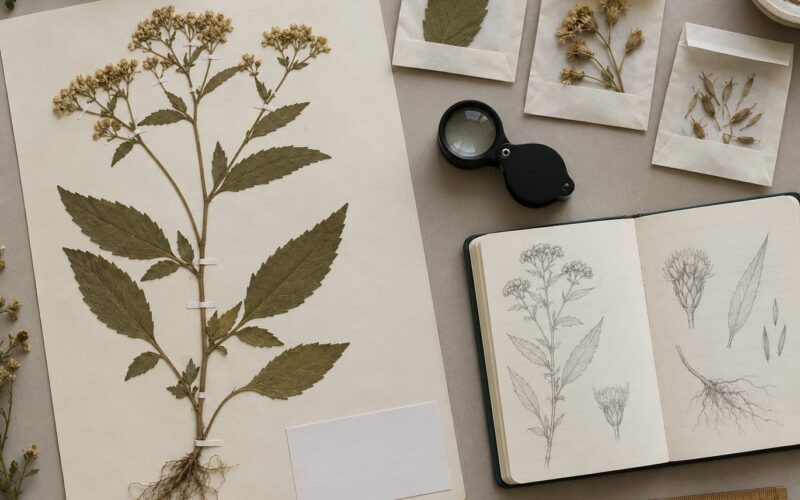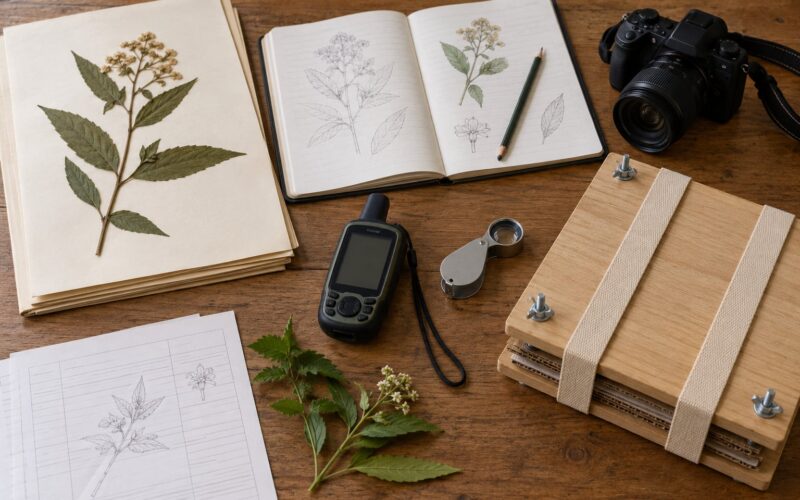
A herbarium is an organized, permanent collection of preserved plant specimens — usually pressed, dried and mounted on labelled sheets — kept so that plants can still be identified, compared and studied decades after they were collected. Understanding how herbaria are organized and used matters because a dried sheet with a complete label is proof that a particular plant grew at a particular place, on a particular date, under a particular name.
Most people meet herbaria for the first time in a university course, not in a shop. Once you see how the filing, labelling and cataloguing actually work, the idea stops being a dusty curiosity and starts looking like a research tool with rules.
Table of Contents
- 1What Is a Herbarium?
- 2How Herbaria Are Organized Physically
- 3How Plant Specimens Are Prepared
- 4How Herbaria Are Organized Scientifically
- 5What Information Does a Specimen Record Contain?
- 6How Are Herbaria Used in Research?
- 7How Do Herbaria Help Trace Medicinal Plants?
- 8How Herbaria Are Organized and Used in Ethnobotanical Studies
- 9How Are Herbaria Digitized and Searched?
- 10How Can You Find and Use a Herbarium?
- 11Frequently Asked Questions
- 12What does a herbarium actually store?
- 13Are herbarium specimens alive?
- 14Why do plant names change after a specimen is filed?
- 15How do you verify a medicinal plant record?
- 16Can a digital image replace the physical specimen?
- 17Conclusion: Start with the Specimen Record
What Is a Herbarium?
The word has Latin roots. Hortus siccus means dry garden, and the plural of herbarium is herbaria — the singular form simply drops the -a. Collections of dried specimens distributed in numbered sets to other institutions were called exsiccatae, and the term still appears in older literature and on some collection labels.
A herbarium is two things at once. It is a physical store of plant material, and it is a documented record, because each specimen carries a label recording who collected it, where, when and what it was called at the time. A beautiful pressed plant with no label data is a curiosity. A pressed plant with full data is evidence.
It helps to be clear about what a herbarium is not. A botanical garden grows living plants for display and research. A seed bank stores seeds under controlled conditions for restoration and breeding. A living plant collection keeps specimens growing in nursery beds so their genetics can be maintained. A herbarium holds none of those; it holds dried, filed, labelled records of plants that have been gathered from somewhere.
How Herbaria Are Organized Physically
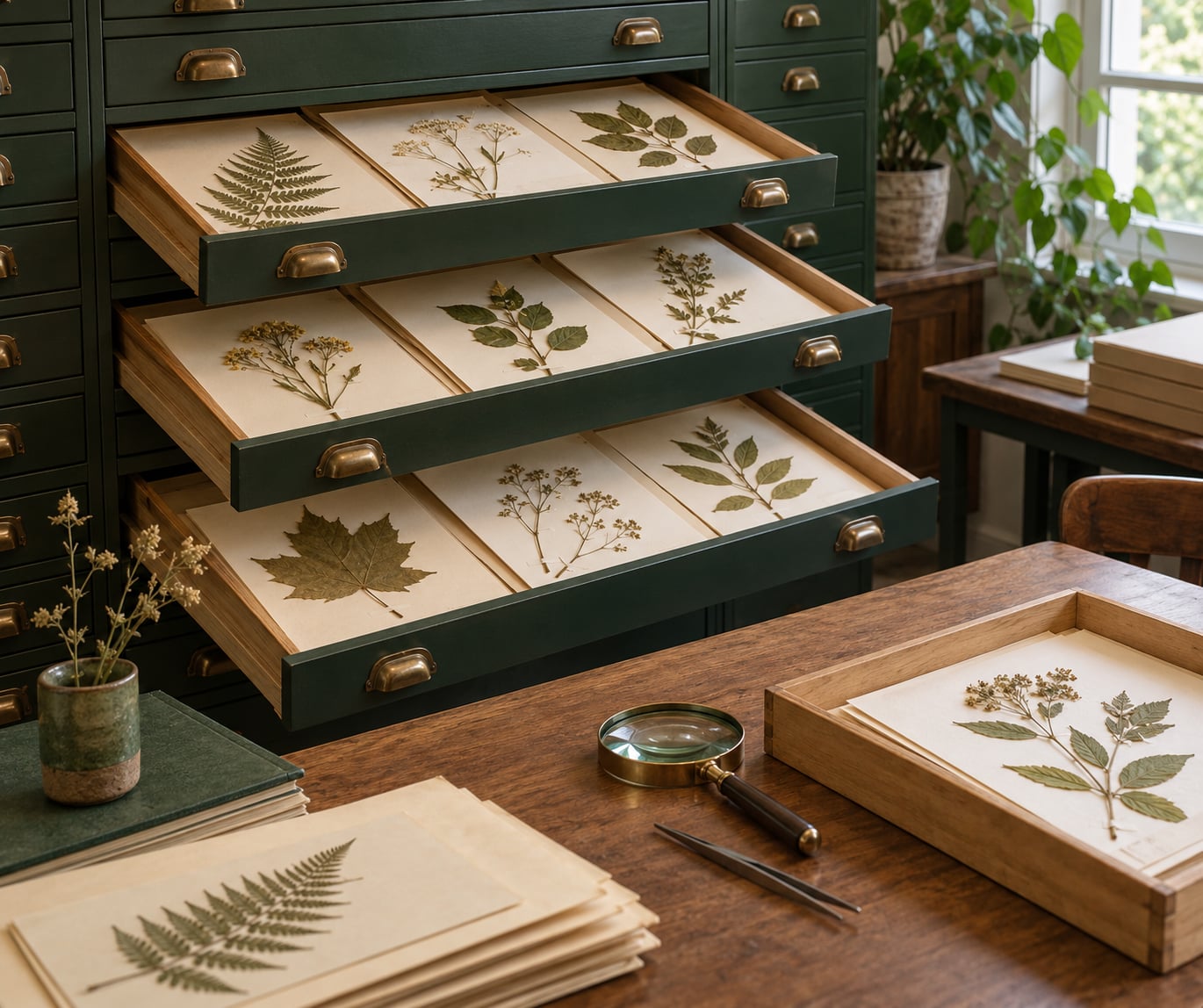
The physical arrangement follows one simple principle: everything must be findable in seconds and protected from light, humidity and insects. Compact shelving — dense metal cabinets on rails that roll together — is the standard unit, and each cabinet holds rows of shallow drawers or compartments.
Inside a drawer, the nesting runs genus folder, then species folder. Species folders are kept in genus folders, genus folders are grouped by family, and families follow the classification system the collection works in. Smaller material such as fruits, seeds, loose leaves or fragments may go into glassine packets or envelopes inside the species folder. Large items such as woody branches, oversized leaves or whole inflorescences get their own folder so nothing is folded to make it fit.
Every sheet carries a barcode that links it to a database record. Older collections without barcodes are usually barcoded during routine curating, and the barcode is what makes the sheet traceable when a database entry and a drawer disagree.
Storage conditions are unglamorous and non-negotiable. Specimens are kept dark, cool and dry, in cabinets that limit fire and water damage. Insect activity is the constant threat, so many collections freeze incoming material in sealed containers before it enters the cabinet, and some still use fumigation or chemical treatment on a schedule.
| Type of collection | What it holds | How it is stored |
|---|---|---|
| Herbarium | Pressed vascular plants, filed by family and species | Mounted on sheets in folders in compact cabinets |
| Fungarium | Fungi, lichens and slime moulds | Dried packets, often filed separately from plants |
| Xylarium | Wood samples and timber sections | Cut blocks or thin sections in numbered series |
| Hortorium | Living or dormant cultivated plant material | Field plots, glasshouses or seed storage |
| Seed collection | Seeds and reproductive material | Sealed, labelled containers under cool dry conditions |
How Plant Specimens Are Prepared
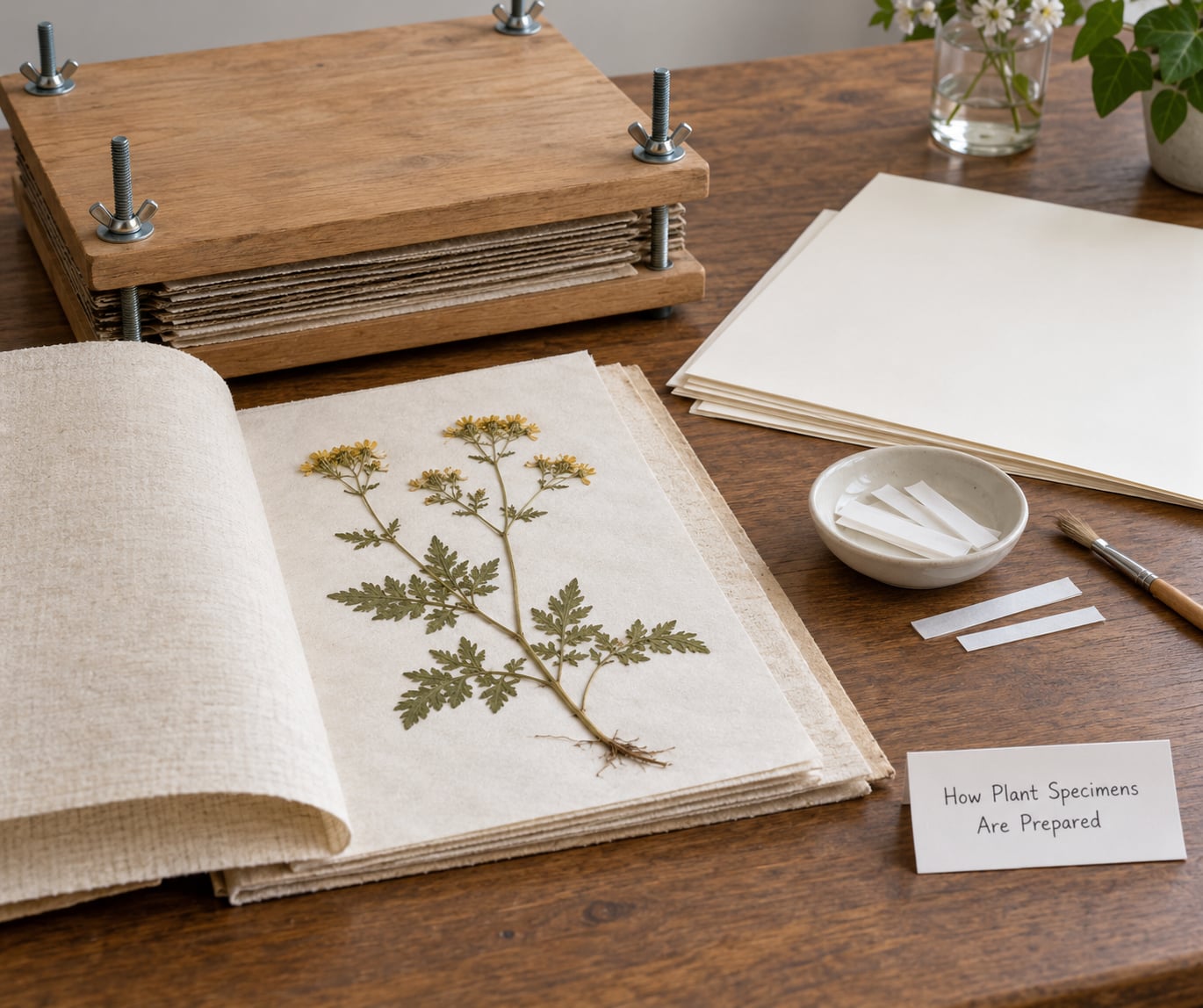
The pipeline is the same whether a collector works at a national institution or builds a small teaching set at home. Field material is collected with the appropriate permission, and a collector number is assigned to everything gathered on one day at one place. That number is the thread running through the whole process.
The material is pressed between ventilated sheets and blotters until dry, with weight and, if necessary, gentle heat to speed things up. Once dry, it is mounted on standard-sized herbarium sheets, roughly 41 by 29 centimetres, using archival glue strips, linen tape or a mount board, with the plant arranged so that the diagnostic features stay visible. Flowers, leaves, stem sections, fruits and seeds are all included when available, because a sheet missing flowers or fruit is often impossible to determine later.
Labels come next, followed by the determination label, which carries the current accepted name and the name of the person who identified it. Sheets are then accessioned, given a permanent number, barcoded and filed.
One caution about medicinal plants specifically: collection and preparation are not the same as ingestion. A pressed specimen documents identity, not safety, dosage or efficacy, and wild-collected material should never be handled bare-handed or tasted. Work through a herbarium or university botany department rather than improvising.
How Herbaria Are Organized Scientifically
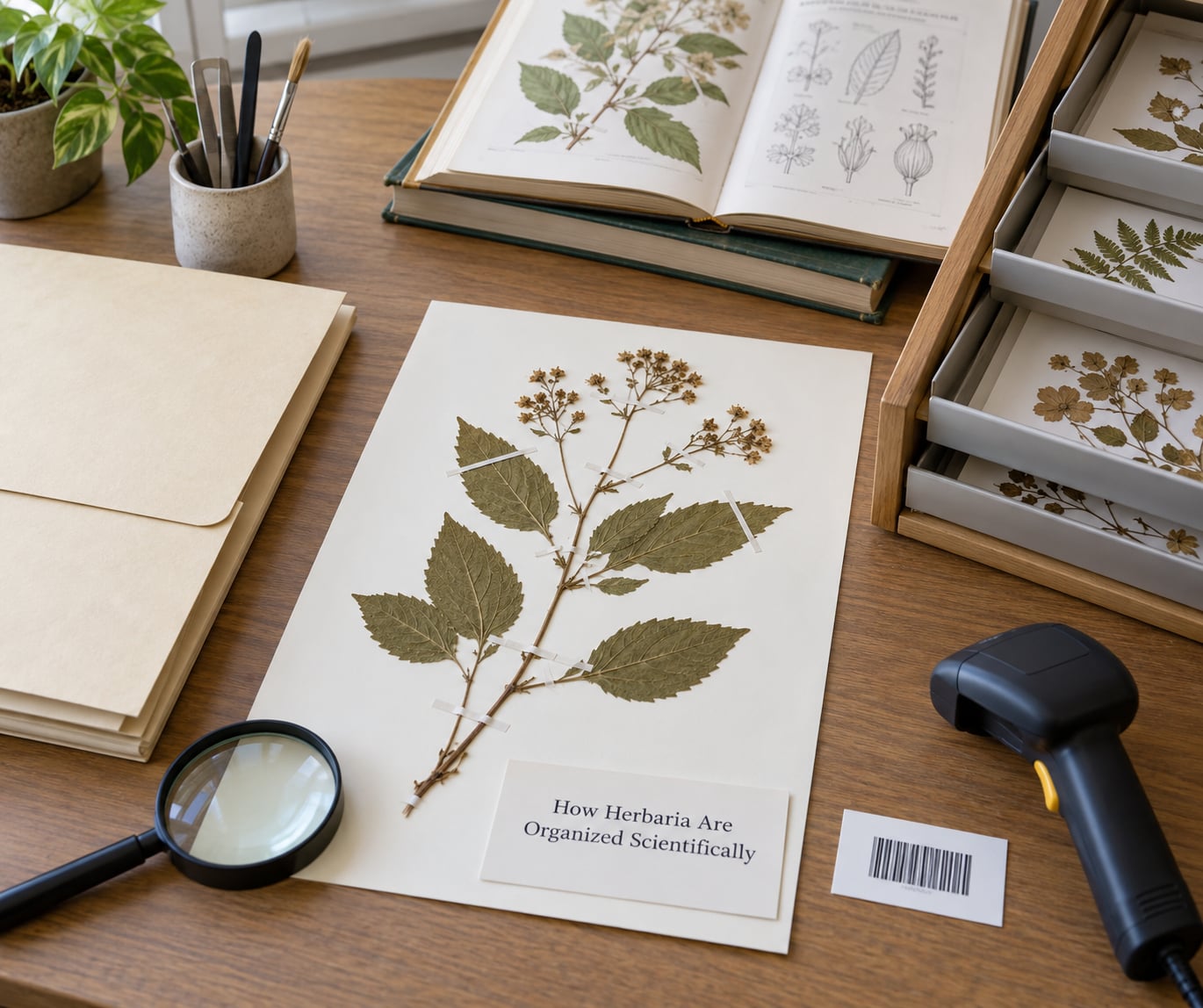
Filing by family and genus is the familiar scheme, but it is only the front door. The same specimen is cross-referenced in other ways, which is why a well-run collection can answer questions the shelf order cannot.
- Taxonomic arrangement places a sheet among its relatives, so a revision of a genus can be worked through as a set.
- Geographic arrangement exists in the separate regional herbaria, where specimens are filed by country, region or vegetation zone.
- Ecological arrangement groups material by habitat type, which matters for comparing plants from comparable sites.
- Chronological arrangement records when a specimen was gathered, allowing collections from 1900 and last year to be compared directly.
- Collection-based arrangement follows individual expeditions, so everything from one field trip stays together.
Institutional herbaria have their own identifiers in Index Herbariorum, the global directory of herbaria run by the New York Botanical Garden. Each holding has a short code, and every citation of a specimen names that code. It is the address system of the whole network.
What Information Does a Specimen Record Contain?
Reading a label is the most useful skill a lay reader can build, because the label is where the evidential value sits. Field by field, it carries the following.
- Collector and collector number — who gathered it and which of their numbers it is.
- Date — the day it was collected, which anchors phenology and season.
- Locality — village, district or mountain range, sometimes with coordinates.
- Altitude and habitat — elevation and the ecological setting, such as forest edge, riverbank or roadside.
- Field notes — habit, colour, smell, soil, associates and abundance as seen on the day.
- Vernacular names and uses — local plant names and how people reported using the plant.
- Determination history — who identified it, the name they applied, and any later annotations by other specialists.
- Accession data — the number the specimen received when it entered the collection.
- Images — digital photographs and, increasingly, scans of the sheet itself.
Those fields work together. A specimen labelled Aloe sp. from one unnamed locality is nearly useless. The same plant with a collector number, a date, coordinates, habitat notes and an identification confirmed by a named botanist can support a distribution record, a taxonomic revision and a report of traditional use at the same time.
How Are Herbaria Used in Research?
Curators describe their collections as reference libraries, and that is fairly literal. The main uses are these.
- Identification. Compare unknown material against specimens that were confirmed by a specialist.
- Nomenclature. Type specimens, the preserved material behind a published name, fix what a name refers to.
- Distribution and change. Historic and modern sheets from the same site show contraction, expansion or shifting flowering times.
- Variation. Sheets from many localities show how much a species changes across its range.
- Floras and field guides. Descriptions and distribution accounts are written from herbarium material, not from memory.
- Molecular work. DNA can be extracted from dried tissue, though older or heavily processed sheets may yield poor results.
- Conservation. Occurrence records feed the assessments that decide whether a species is protected.
- Training. Students learn to see diagnostic characters by comparing real specimens.
The limits matter as much as the uses. A dried sheet preserves shape, arrangement and often colour, but not texture, scent, taste or the chemistry of living tissue. Reviewers and curators are blunt about this: a herbarium tells you what a plant is and where it was, not what it does to the body.
How Do Herbaria Help Trace Medicinal Plants?
Traditional-use reports are often the first clue about a medicinal plant, and herbaria are where those reports get tested. When a researcher records a remedy, interviews a healer or healer-knowledge holder, or surveys a market stall, the plant involved is collected and pressed as a voucher specimen.
How Herbaria Are Organized and Used in Ethnobotanical Studies
A voucher specimen is the physical evidence that links a published claim to an actual plant. Without one, a report of “a bark used for cough” cannot be checked by anyone, ever. Voucher specimens follow the same accessioning, labelling and filing rules as any other material, but they carry the ethnobotanical field data: informant name or community where permission allows, the local name, the plant part used, the preparation, and the reported indication.
That link exposes real problems. A name may turn out to be a synonym, meaning two labels refer to one species. The plant sold in a market may not be the plant described in an older paper at all. Localities from historic collections may be lost or shifted, so a range map drawn from old labels can mislead. None of these failures is a scandal; they are exactly the kind of thing an organized, dated, georeferenced record is designed to catch.
Ethics matter here too. Collecting medicinal plants is not a free action. Research permits, prior informed consent and benefit-sharing under frameworks such as the Nagoya Protocol may apply, and communities should expect credit, copies of results and sometimes a share of any commercial return. A herbarium that accepts specimens without any of that is doing extraction, not collaboration.
How Are Herbaria Digitized and Searched?
Most large collections now run collection-management software and publish records online, which has changed who can use a herbarium. A researcher working in a capital city used to need a flight and a week of travel; now a database query returns records from thousands of institutions in seconds.
Four things make that work. Barcodes tie each sheet to one record. Georeferencing converts written localities into map points. Standardised metadata fields mean records from different institutions can be combined, and global aggregators such as GBIF pull those records into a single search. Image capture adds a scan or photograph of the sheet so the material can be examined without handling it.
What digitization does not do is replace the object. A photograph flattens the specimen, distorts colour and loses the three-dimensional structure of a seed, a flower bud or a piece of bark. Where a determination depends on texture, thickness or smell, someone still has to examine the physical sheet, which is why collections keep both the drawer and the database.
How Can You Find and Use a Herbarium?
For a student, researcher or anyone checking a plant name, the route is straightforward. Start with the herbarium at a university, museum or national botanical survey near you, and look up its code in Index Herbariorum to confirm it holds material from the region you care about.
Then search by scientific name and always search the synonyms, since records are filed under whatever name was current when they were accessioned. A plant described in a 1960s paper may sit in the drawer under a name that was since changed.
Record the full citation of anything you use: institution code, collection, accession or barcode number, collector, number and date. Contact herbarium staff before handling original material, and ask about loans, image requests and visiting arrangements rather than assuming access. And if your interest is medicinal, ask for the determination history rather than the photograph, because that is what confirms the identity behind a traditional-use claim.
Frequently Asked Questions
What does a herbarium actually store?
A herbarium stores preserved plant specimens, usually pressed, dried and mounted on labelled sheets about 41 by 29 centimetres. Each sheet carries a label recording the collector and number, date, locality, habitat, altitude and the scientific name. Related collections hold other material: fungi in a fungarium, wood samples in a xylarium, cultivated plants in a hortorium, and seeds in a seed collection.
Are herbarium specimens alive?
No. Herbarium material is dead, dried plant tissue kept as a permanent record. The plant’s structure, arrangement and often its colour survive, but scent, texture, taste and most chemistry do not. Living plants are kept separately in botanical gardens or living collections, and seeds are held in seed banks, because a dried sheet cannot do what growing material does.
Why do plant names change after a specimen is filed?
Botanical research keeps revising relationships between species, so an accepted name can be replaced by another or demoted to a synonym. The old sheet stays filed under the name that was current when it was accessioned, with the current name added as an annotation. That is why searching a database by synonym, and not only by the modern name, is the reliable way to retrieve material.
How do you verify a medicinal plant record?
Look for a voucher specimen tied to the report and check its determination history to see whether a named botanist confirmed the identification. Compare the recorded locality, habitat and plant part with what you actually have, and search under synonyms as well as the current name. A herbarium confirms identity and provenance; it cannot confirm medicinal effectiveness, dosage or safety.
Can a digital image replace the physical specimen?
No. Images answer identification and distribution questions very well and save handling of fragile sheets. They cannot show texture, thickness, internal structure or smell, so a determination based on those features still requires examination of the physical sheet. Most collections treat images and specimens as complements: the database for discovery, the cabinet for verification.
Conclusion: Start with the Specimen Record
Understanding how herbaria are organized and used comes down to one idea: a collection is only as good as its records. Cabinets, folders and barcodes are what make the material findable; labels, determinations and locality data are what make it trustworthy.
If you are checking a medicinal plant or a traditional-use claim, start by pinning down the correct scientific name, search the synonyms, and locate a specimen record with a full determination history. Confirm identity with the herbarium before drawing any conclusion about use, and never treat a collection record as evidence of safety or effectiveness.