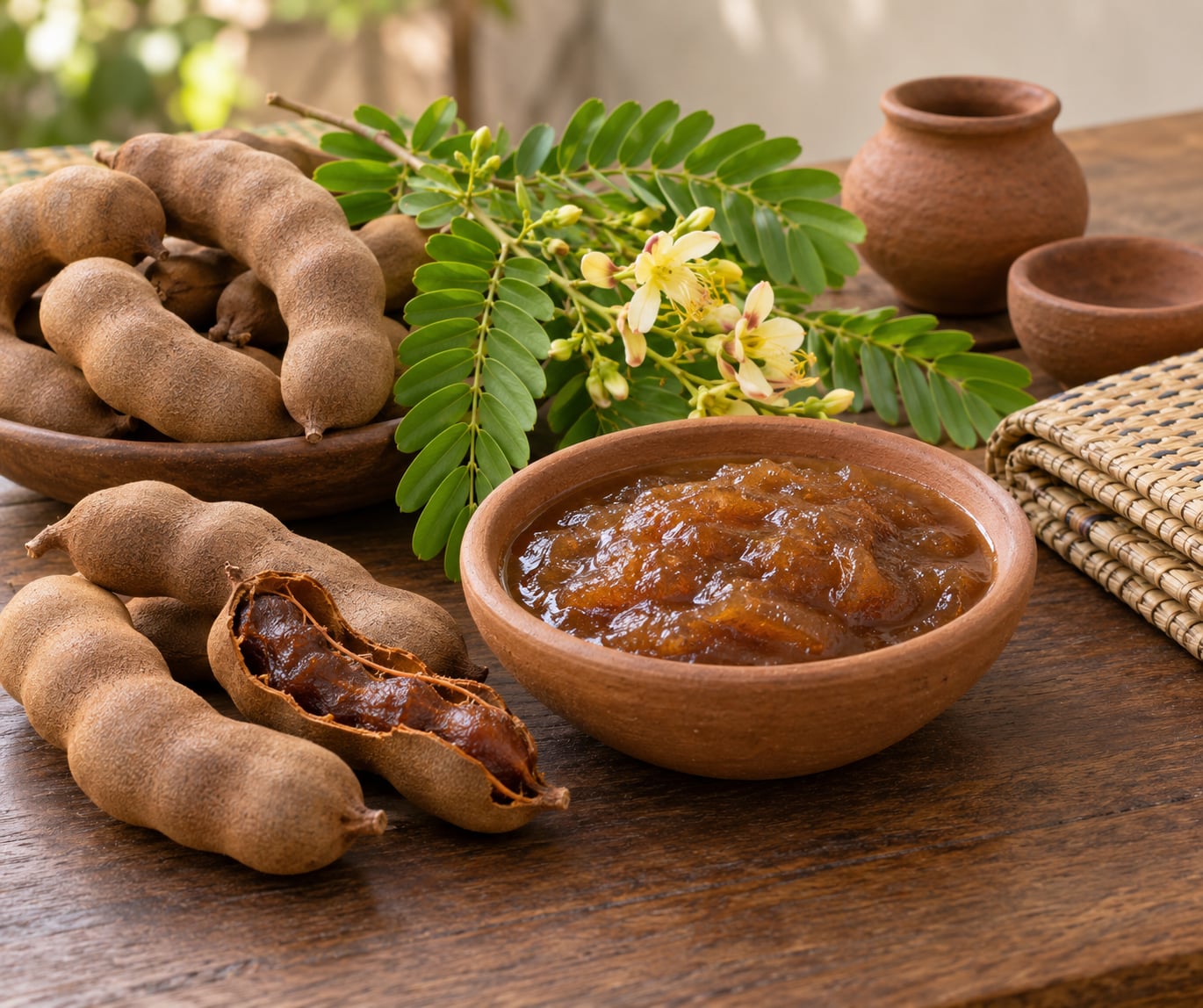
Tamarind is the fruit of Tamarindus indica L., a leguminous tropical tree that probably originated in the savannas of sub-Saharan Africa and reached South and Southeast Asia and the Caribbean through old Indian Ocean and Atlantic trade routes. The sticky pulp inside its brittle brown pod supplies sharp citrus-like acidity, and the pulp, seed, leaves and blossoms also sit inside food traditions and folk remedies in Africa, South Asia and Southeast Asia. This guide walks through both halves of tamarind uses in food and tradition, plus how to rehydrate it, how to store it and where caution is genuinely warranted.
The English word is a corrupted form of the Arabic tamr hindi, meaning Indian date. Swahili speakers call it ukwaju, and Tamil, Telugu, Malayalam and Kannada cooks each have their own word for it. If you have bought something called imli, puli, tangli or tamarindo, you have bought the same fruit.
Table of Contents
- 1What Is Tamarind, and Which Part Is Used?
- 2How Is Tamarind Used in Food?
- 3Tamarind Uses in Food and Tradition: Common Preparations
- 4How Do You Prepare Tamarind for Cooking?
- 5What Traditional Roles Does Tamarind Have?
- 6How Does Tamarind Taste, and When Is It Used?
- 7Is Tamarind Safe to Eat, and What Precautions Matter?
- 8How Should Tamarind Be Stored?
- 9Frequently Asked Questions
- 10What part of the tamarind plant is used in food?
- 11Can tamarind be eaten straight from the pod?
- 12Is tamarind good in curries, desserts, and drinks?
- 13Can tamarind pulp be frozen for later use?
- 14Are there traditional tamarind uses supported by reliable research?
- 15Can people with allergies or medicines eat tamarind?
- 16Where to Start
What Is Tamarind, and Which Part Is Used?
Almost every dish people mean when they talk about tamarind uses in food comes from one place: the pulp, which is the stringy, sticky mass that surrounds the seeds inside the pod. In fresh, mature fruit that pulp is firm and pale brown. In the dried pods sold for cooking, the shell becomes brittle, the pulp contracts into hard lumps and the flavour concentrates into something sharp, slightly floral and faintly molasses-like.
Different parts of the tree do different jobs, and plenty of tamarind advice skips the distinction, which is why descriptions of the plant so often end up vague.
| Part of the tree | What it looks like | How it is used |
|---|---|---|
| Pulp | Sticky brown strands and lumps inside the pod | The main souring agent in drinks, sauces, chutneys, curries, rice, sweets and pickles |
| Seeds | Hard, glossy, dark brown kernels | Roasted and ground into a flour used as a thickener and a protein-containing ingredient; also pressed for oil |
| Fresh leaves | Small paired leaflets on slender stems | Eaten raw in salads and slaws in parts of East Africa and Southeast Asia, and used in curries |
| Flowers and flower buds | Small pale yellow flowers with reddish streaks | Added to salads and soups, and used as a garnish |
| Pod shells and seed hulls | Brittle outer shell, reddish-brown seed coat | Tannin-rich material used in some places for dyeing and for treating skins and waters |
| Wood | Dense, hard timber | Carving, tool handles and furniture where the tree is cultivated |
That last row matters more than it sounds. Tamarind is a legume, related to beans and peas, and it behaves like one in the kitchen: the seed is the protein-bearing part, and the pulp is the acid-bearing part. Recipes that call for a pinch of tamarind in a cup of water want pulp, not seed.
How Is Tamarind Used in Food?
Tamarind functions as a souring agent first and a sweetener second, and those two jobs pull in opposite directions depending on the dish. Savoury cooking uses the sourness to balance salt, heat and fat. Sweet cooking uses the same sourness to stop a sugar-heavy preparation from tasting flat, the way lemon cuts the cloying edge of a caramel.
Pulp reaches a kitchen in several forms. Whole dried pods are the traditional form: you break the shell, soak it, and discard the seeds and fibre. Concentrate and paste are commercial forms that skip that work, and they vary enormously in strength, so a recipe written for one brand can taste flat or scalding with another. Tamarind powder or roasted seed flour does something different again, adding body and nuttiness rather than acidity.
Fresh leaves change the conversation. They are a vegetable, not a souring agent, with a milder, greener note that some cooks like precisely because it does not make a dish aggressively sour.
Tamarind Uses in Food and Tradition: Common Preparations
Almost every culinary use falls into one of a handful of families, and the family tells you what you are looking at on a menu.
- Drinks. Diluted pulp with water, sweetener and spice becomes agua de tamarindo in Mexico, sorrel-style drinks in the Caribbean, sherbets and panhas across India, and cooling drinks along the Swahili coast.
- Sauces and chutneys. Pounded pulp with chilli, ginger, roasted cumin, jaggery or salt forms the base of imli chutney, gongura and pachadi from Andhra kitchens, Thai nam prik, and Mexican and Central American tamarind salsas.
- Curries, gravies and soups. Tamarind is the sour backbone of sambar and rasam in South India, of countless Thai curries, of fish curries in Kerala and Bangladesh, and of kuku wa ukwaju, the Swahili chicken stew from the Kenyan coast.
- Rice and grains. Puliyogare and pulihora, the tamarind rice of South India, coat each grain in a thin sour glaze, and tamarind appears in seasoning pastes for rice across Southeast Asia.
- Meat marinades and glazes. The acid in tamarind tenderises meat while the sugars brown on the surface, which is why it turns up in barbecue glazes and Latin American adobos.
- Sweets and candies. Palmeta, the Mexican tamarind candy rolled in chilli and sugar, is the best-known example, alongside Indian jaggery-and-tamarind sweets and Thai dried-fruit sweets.
- Preserves and pickles. Because pulp is acidic and high in soluble fibre, it works as a souring element in chutney-style preserves and quick pickles.
- Seasoning pastes and seasoning blends. Ground with salt, chilli and spice, pulp forms the base of sambar powder, rasam powder and many Thai and Indonesian seasoning pastes.
Which form you should reach for depends on what the dish is doing. A drink wants a thin strained liquid; a curry wants a small spoonful of concentrated pulp; a candy wants thick paste.
How Do You Prepare Tamarind for Cooking?
The method is simple enough to do once a week and keep in the fridge. It is also the step people most often rush, and rushing is why home sambar turns out too sharp to eat.
- Break the pod. Use your fingers or the flat of a knife to snap the brittle shell along its seam and pull the pulp out.
- Pull off the seeds and fibre. The hard kernels and the sticky stringy strands around them are not worth eating in a soup or curry. Set them aside for seed flour.
- Soak in warm water. Cover the pulp with roughly three to five times its volume of water at around room temperature or just above, and leave it for two to four hours. Many cooks use hot water for speed, but boiling water cooks the aroma away and soaks up some of the fragrance.
- Squeeze and strain. Push the softened pulp through a sieve or a fine strainer, pressing hard to get the liquid, and let the fibre and seeds fall away. That liquid is your tamarind.
- Portion it. A rough guide is that one or two average pods give roughly a tablespoon of strained liquid, which is usually enough for a pot of curry for four. Adjust down if you are using concentrate.
The method itself is not in dispute, and the question almost every cook asks afterwards is how much is enough. The honest answer is that there is no fixed rule, because a tablespoon of homemade pulp and a tablespoon of a strong concentrate can be very different things. Add in thirds and taste.
If a dish is already too sour, you have more options than starting over. Add a little more liquid, a spoon of jaggery or sugar, a spoon of yoghurt or coconut milk, or a spoon of fat such as coconut oil or butter. If it tastes bitter rather than sour, the cause is usually seed fragments left in the pulp or over-soaking, and no amount of sugar fixes that properly.
What Traditional Roles Does Tamarind Have?
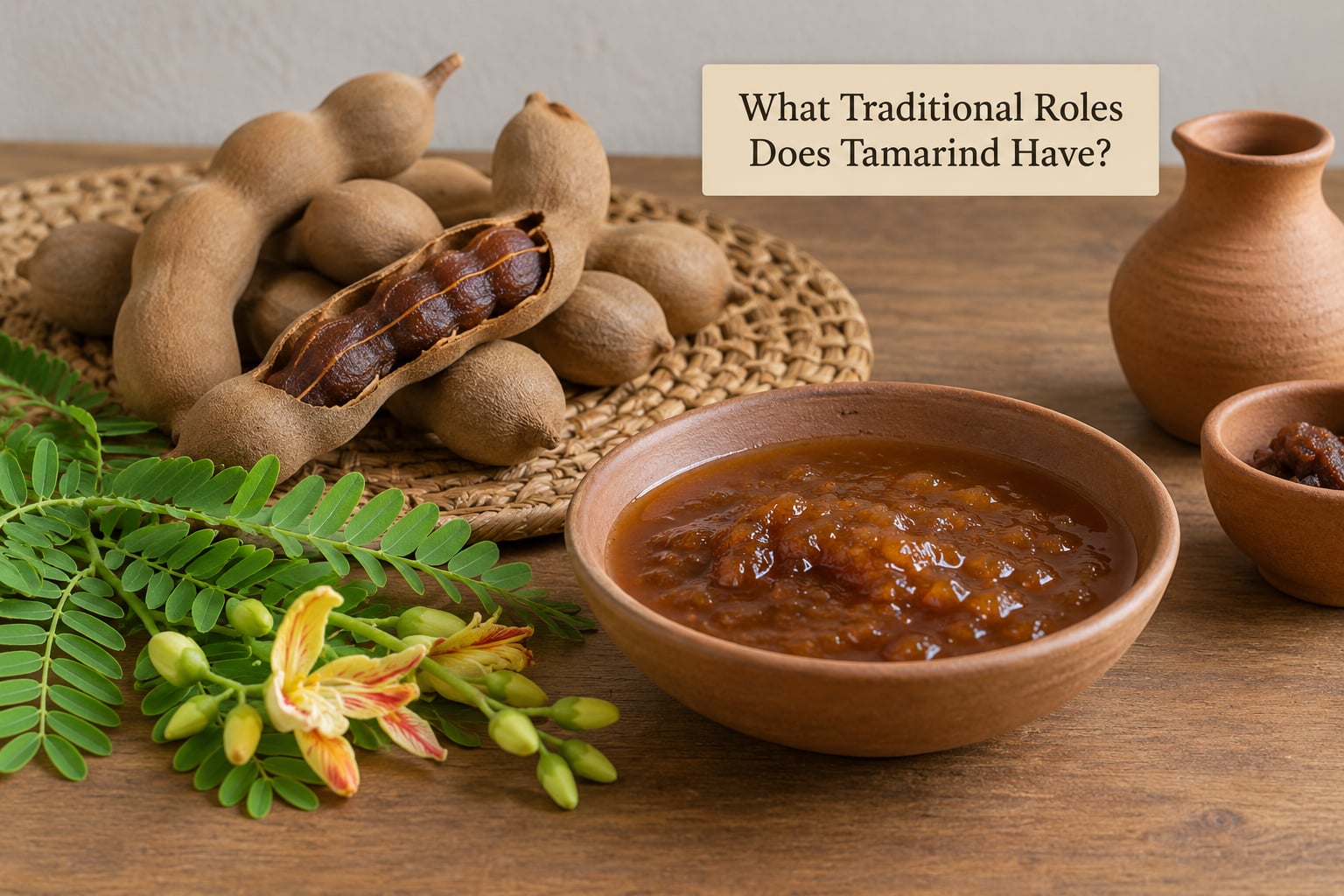
Meaning changes with place, community and source, so treat this section as a set of documented examples rather than a single unified tradition. The strongest documented pattern is hospitality and cooling refreshment: in many hot countries, a diluted tamarind drink is a street and household cooler, and the ritual of preparing it is itself a form of welcome.
In Ayurvedic practice tamarind is described as a rasayana, a preparation traditionally taken for general upkeep, and it is grouped with foods described as cooling. That is a statement about traditional classification, not a clinical finding. Modern laboratory work on Tamarindus indica extracts has looked at polyphenols, antioxidant capacity and metabolic markers in small studies, none of which is the same thing as an established treatment for a disease.
In parts of West and Central Africa, the pods and leaves appear in festival and household preparations, and the tree itself is sometimes marked as a respected living presence rather than being cut without thought. Ritual meanings vary a great deal from one community to the next, and generalisations about African, South Asian or Southeast Asian practice tend to flatten exactly the detail that makes it interesting.
Craft traditions run alongside the food ones. The tannin-rich pod shells and seed hulls have been used in various regions for dyeing and treating hides and waters, and the dense wood has been carved. The history behind all of it is a trade history: tamarind travelled from Africa through Indian Ocean and Arab routes as tamr hindi, Indian date, before reaching the Caribbean and Latin America in the colonial period.
How Does Tamarind Taste, and When Is It Used?
Ripe pulp tastes sour first, then sweet underneath, with a floral, almost apricot-like aroma that comes out when you warm it. The acidity comes largely from tartaric acid, which is also the acid that gives wine grapes and firm French lemons their sourness. Unlike citric acid, tartaric acid survives heat well, which is why a tamarind-based sauce keeps its bite after a long simmer.
Flavour changes as the fruit ripens. Fresh, just-mature pods give a lighter, more citrus-like sourness. Pods left on the tree or in storage develop a deeper, almost date-like sweetness and a stronger molasses note. That is why dried tamarind tastes more complex than fresh, and why a cook who has only ever used fresh pulp finds dried tamarind aggressive until they cut the quantity roughly in half.
Balance, not flavour, is the real technique. A little tamarind in a salty, fatty dish rounds the salt and cuts richness. Sugar and chilli both register as less sharp when tamarind is present. Smoke and char, as in tamarind-glazed grilled meat, get a bright edge beside them. And in sweet food, that same sharpness is what keeps jaggery, palmeta and tamarind caramel from turning into pure sugar.
Tamarind has no fixed place in a meal. It shows up in breakfast drinks, in a mid-afternoon cooler, at the end of a heavy meal, or in a candy carried home from a street stall.
Is Tamarind Safe to Eat, and What Precautions Matter?
For most people, ordinary culinary amounts of tamarind pulp are eaten safely around the world, and there is no established safe daily intake expressed as a gram amount. Points below are general information, not medical advice. If you have a medical condition, take medicines, or are pregnant, ask your doctor, pharmacist or a registered dietitian before using tamarind regularly or in concentrated form.
- Allergy. Tamarind belongs to the legume family. Anyone with a diagnosed allergy to legumes should treat tamarind as a possible allergen and discuss it with an allergist.
- Concentrated products. Paste and concentrate are far stronger than fresh pulp. Undiluted concentrate eaten by the spoonful is a genuinely large dose of tartaric acid and fibre, and it is not comparable to a spoonful of soaked pulp.
- Medicines. Tamarind may affect blood sugar and blood pressure, and its fibre and tannins can alter how some medicines are absorbed. Anyone on regular medication should ask a pharmacist before adding it to the diet in quantity. There is no trustworthy evidence that tamarind is a liver treatment, and anyone told otherwise should check with a clinician.
- Digestive symptoms. Large amounts can cause loosened stools and cramping, which is one reason it has a long history as a mild purgative. Persistent digestive symptoms need a doctor, not a dietary experiment.
- Identification. Unripe tamarind pulp is not a food preparation. The seeds are not meant to be eaten raw in a dish, and pods from a species that looks similar but is not tamarind should not be used.
- Spoilage. Concentrate and paste sold in jars should be stored as labelled and used within the stated period once opened. Discard anything with mould, an off or fermented smell, or an obviously wrong colour.
- Leaves and seeds. Fresh leaves are eaten as a vegetable in some traditions and are safe when properly identified and prepared. Tamarind seed has been reported as unharmed in some test settings while causing obstruction in others; treat swallowed whole seeds as a concern and seek medical advice if a child swallows several.
How Should Tamarind Be Stored?
Storage times vary with how dry the product is and how airtight the packaging is. Treat these as realistic home ranges rather than guarantees.
| Form | Fridge | Freezer | Notes |
|---|---|---|---|
| Whole dried pods | Not needed | Not needed | Airtight, dark, dry; keeps about a year to two and often well past that |
| Strained soaked pulp | 3 to 4 days | Up to 12 months | Portion into small cubes or ice-cube trays |
| Blended pulp or paste, homemade | 5 to 7 days | Up to 12 months | Freezes best in a thin layer |
| Store-bought concentrate or paste | Follow the label; a few weeks to months after opening | Generally acceptable but check the label | Tighten the lid and use a clean utensil each time |
| Roasted seed flour | Not needed | Not needed | Airtight, cool and dark; check for rancidity before use |
| Fresh leaves and flowers | 2 to 3 days in a damp cloth | Not well suited | Wash before use |
Signs that tamarind has gone off are mostly about smell and appearance: a sharp alcoholic or fermented scent instead of the familiar sour-fruity one, visible mould on paste or concentrate, or pulp that has gone slimy. Once a jar has been opened, a sniff and a small taste usually tell you more than a printed date.
If cooking raw meat, poultry or fish as part of a tamarind dish, follow standard food safety rules: 165 F for poultry, 160 F for ground meat, and 145 F for whole cuts and fish. A sour sauce is not a substitute for proper heating.
Frequently Asked Questions
What part of the tamarind plant is used in food?
The pulp is the part almost every recipe means, whether eaten as soaked pulp, paste or concentrate. Fresh leaves and flowers are also eaten as a vegetable in parts of East Africa and Southeast Asia. Seeds are generally removed from dishes but can be roasted and ground into a flour used as a thickener and a protein-containing ingredient.
Can tamarind be eaten straight from the pod?
You can, and many people do, but expect firm, intensely sour pulp wrapped in sticky fibres around hard seeds. Most people chew and swallow the pulp and spit out the seeds and stringy fibre. Fresh pulp is milder than dried; a dried pod is too hard to eat raw and needs soaking.
Is tamarind good in curries, desserts, and drinks?
All three. In curries it supplies the sour backbone for sambar, rasam, Thai gravies and fish curries. In desserts and sweets it cuts the cloying edge of sugar and caramel, as in palmeta or jaggery sweets. In drinks, diluted pulp with sweetener and spice becomes agua de tamarindo, sorrel-style cooler, sherbet or panha.
Can tamarind pulp be frozen for later use?
Yes, and it is the easiest way to keep a soaking session useful. Portion strained or blended pulp into small cubes or a thin flat layer so it freezes quickly, then bag it. Thaw one or two cubes in the pan; nothing needs to be cooked first. Keep soaked pulp in the fridge for only three to four days.
Are there traditional tamarind uses supported by reliable research?
Traditional use is well documented in Ayurveda and Unani practice, in African and Caribbean folk practice, and across many food traditions. Laboratory research on Tamarindus indica extracts examines polyphenols, antioxidant capacity and metabolic markers, but most studies are small and laboratory-based. That supports interest and safe culinary tradition, not a proven treatment for any disease.
Can people with allergies or medicines eat tamarind?
Ordinary culinary amounts are eaten safely by most people, but tamarind is a legume, so anyone with a legume allergy should discuss it with an allergist. It may affect blood sugar and blood pressure, and its fibre and tannins can change how some medicines are absorbed. If you take regular medication, ask your doctor or pharmacist first.
Where to Start
If you have never cooked with tamarind, buy a small bag of dried pods rather than a jar of concentrate. Soak two pods in warm water, strain it, and taste the liquid on its own so you learn how sharp it really is before it meets salt, chilli or jaggery. Once you can judge that by taste, every sauce, drink and sweet on this page becomes easy.