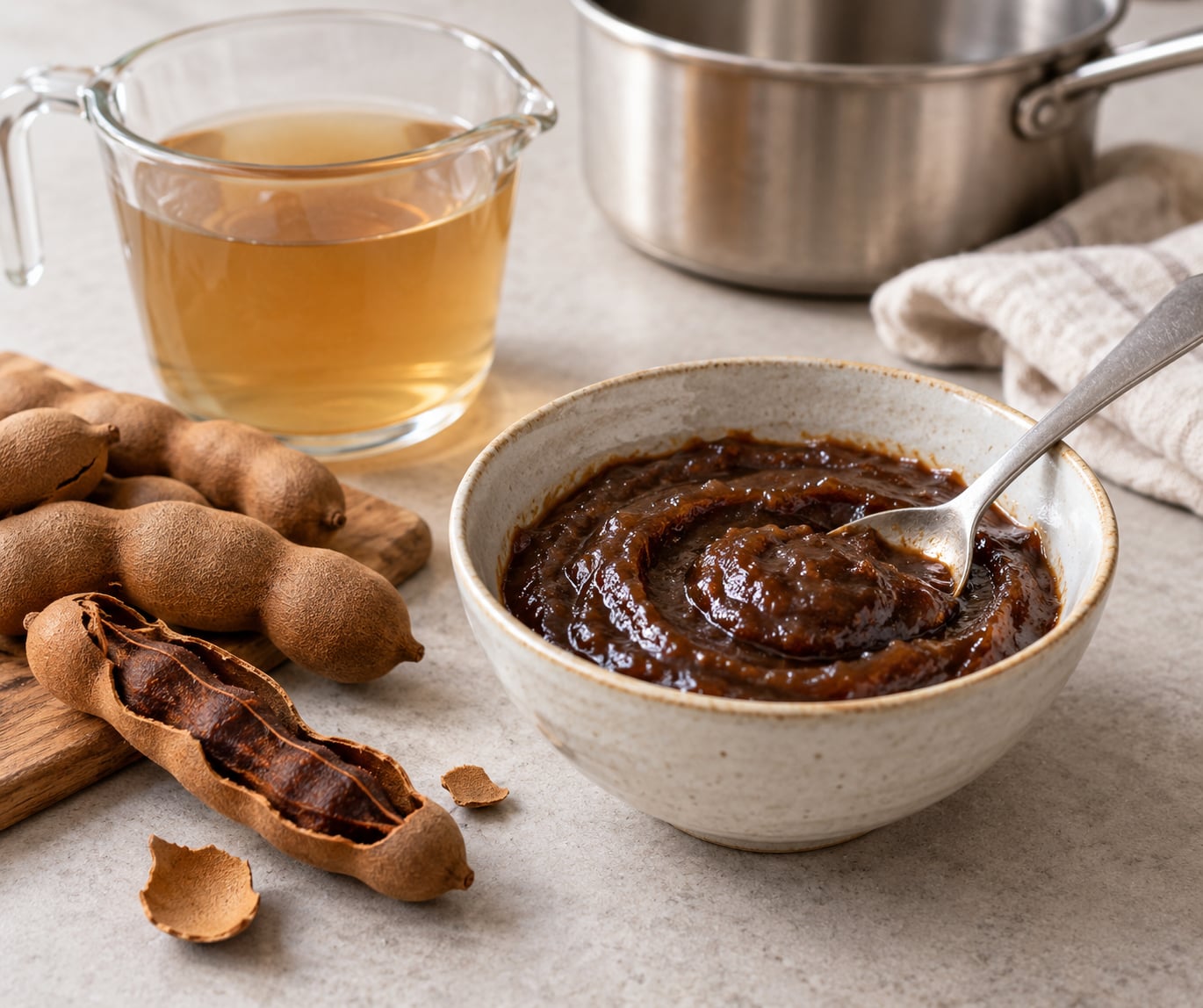
Knowing how to use tamarind paste comes down to dose and dilution: loosen a small amount in warm water, stir it into the dish early, then taste before you add more. Tamarind brings a sour, tangy, fruity depth that lemon juice or vinegar cannot, which is why it anchors Thai, Indian, Mexican and West African cooking.
Most cooks get it wrong the same way, by adding too much straight from the jar as a thick dark lump. The reason a spoon too much ruins a dish is simple. Tamarind’s sourness comes from tartaric acid, the same acid found in grapes, and jarred paste holds several times the acidity of fresh pulp. The fix takes about fifteen seconds of work and costs nothing: warm water, a spoon, and a taste before serving.
This guide covers what each form of tamarind actually is, how much to add to a given dish, which foods it pairs with, and how to keep an opened jar in good shape. No recipes to memorise, no special technique to master.
Table of Contents
- 1What You Need
- 2Tools and ingredients that help
- 3How to Use Tamarind Paste Step by Step
- 4Start with a small amount of tamarind paste
- 5Loosen the paste before adding it
- 6Balance the acidity
- 7How to use tamarind paste in familiar dishes
- 8How much tamarind paste to use
- 9Common Tamarind Paste Mistakes and Fixes
- 10The dish tastes far too sour
- 11The sauce is muddy, dark or thick
- 12The paste sits in dark streaks instead of blending
- 13The dish tastes bitter
- 14The sauce tastes clumpy or seed-bitten
- 15Everything tastes over-sweetened
- 16How to Store Tamarind Paste Safely
- 17Frequently Asked Questions
- 18How much tamarind paste should I use in a recipe?
- 19Do I need to soak or strain tamarind paste before using it?
- 20How can I make a tamarind sauce less sour?
- 21Can I use tamarind paste instead of tamarind juice?
- 22How long does tamarind paste last after opening?
- 23Is tamarind paste bitter, and how do I fix that?
- 24Conclusion
What You Need
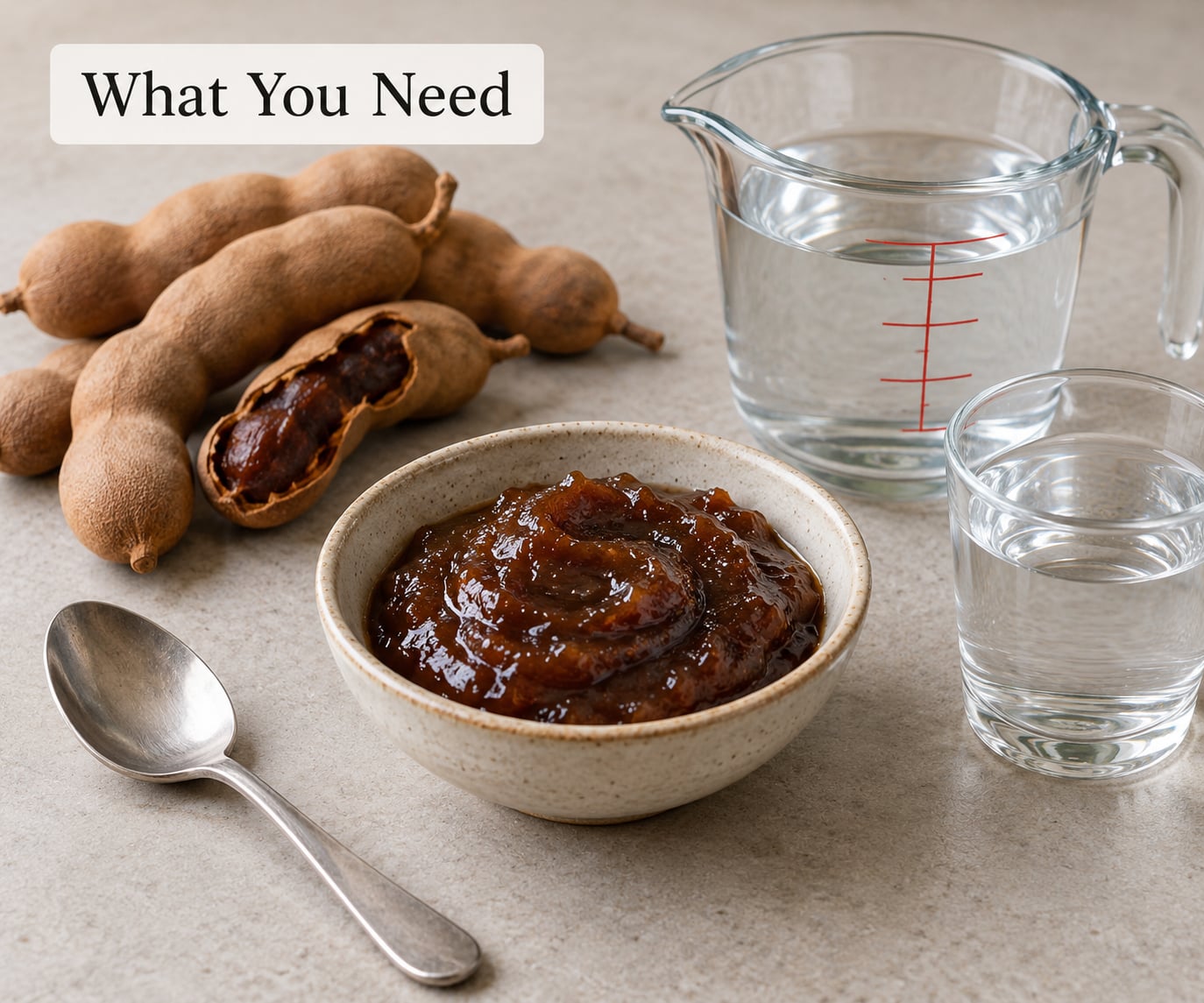
Before you measure anything, know which product is in front of you. Jarred paste, concentrate, pulp and block tamarind are the same fruit at very different strengths, and using them interchangeably is the single most common reason a tamarind dish goes wrong.
| Form | What it is | Water needed | Strength |
|---|---|---|---|
| Jarred paste | Strained pulp, ready to spoon | None, though 1 to 3 tsp warm water loosens it | Strong, 3 to 5 times fresh pulp |
| Concentrate | Cooked pulp reduced to a dark pourable liquid | About 1 tsp concentrate to 3 tbsp boiling water | Very strong, roughly 4 to 6 times jarred paste |
| Pulp | Pressed seed-free pulp, soft and moist | A splash to mash into a paste | Mild to medium |
| Block | Dried pulp pressed into a brittle slab | At least an hour in hot water | Mild once soaked, strongest aroma |
Home cooks posting on Reddit r/Cooking report that about 1 tsp of pure concentrate dissolved in 3 tbsp of boiling water gives them a workable paste-equivalent. Treat that as a starting point rather than gospel, since concentrate strength varies between brands.
Users on a Food Talk Central thread that has run since 2017 point out the same thing from the other direction: jarred paste is much thicker and darker than most newcomers expect, and the tube-style paste sold beside tomato paste and anchovy paste is the easiest format to work with because it comes out soft, clean and fruity rather than sticky and resinous.
Tools and ingredients that help
A small bowl, a fork or mini whisk, a teaspoon measure, a fine strainer and a saucepan cover almost every use. None of them are exotic, and none of them are optional if you want an even sauce.
- Warm water or broth for loosening paste before it hits heat.
- A pinch of salt to sharpen sweetness and lift the fruit notes.
- Honey, jaggery, sugar or soft dates to soften the sharp edge.
- Ginger, garlic, chilli and cumin for savoury dishes.
- A little fat such as oil, ghee or coconut oil to carry the aroma.
How to Use Tamarind Paste Step by Step
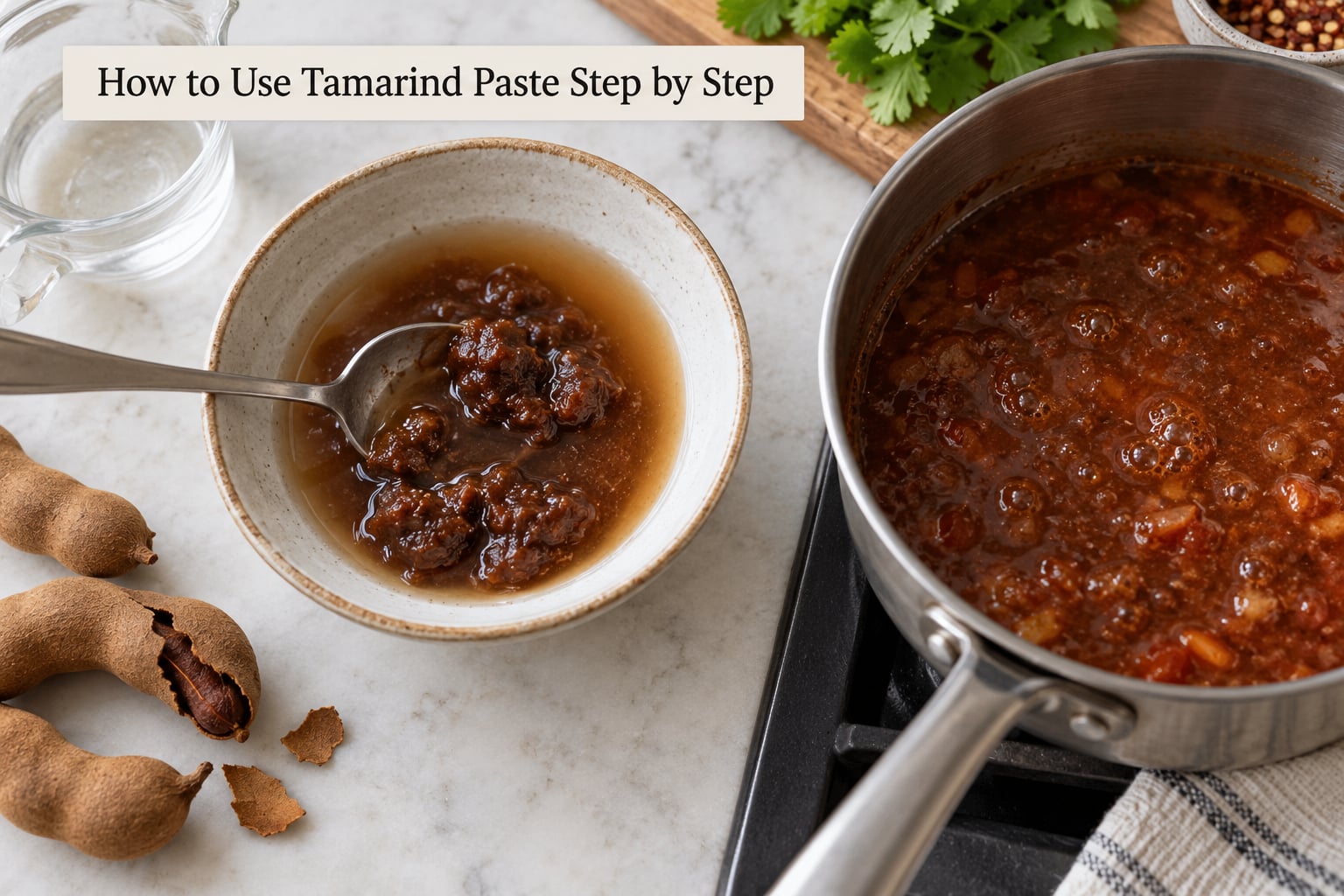
The core method is four moves: loosen, add a little, taste, adjust. Everything else on this page is a variation on that order, and once it feels automatic you can improvise with dishes that are not on any list.
Household tamarind cookery across the regions that use it follows a similar pattern of dilution and tasting, whether the cook is making pad thai in Bangkok, rasam in Tamil Nadu, or agua de tamarindo in Yucatán. The quantity is what changes from kitchen to kitchen, not the technique.
Start with a small amount of tamarind paste
Begin with half the dose you think you need, because tamarind’s flavour builds in layers that are hard to unwind once the pot is hot. You can always add more in the last few minutes of cooking, but you cannot remove acid from a finished sauce.
As a working rule for a dish serving four people, half a teaspoon of jarred paste is a sane opening point for a subtle savoury sauce, and a full teaspoon is a confident one. For a whole pot of soup or stew that serves six or more, start with a tablespoon and taste at the end rather than at the start.
Concentrate behaves differently and needs more restraint. Home cooks describe dissolving 2 tsp of concentrate in about half a cup of hot water and adding only a spoonful of that mixture, which works out to roughly a teaspoon of paste spread across a whole pot.
Loosen the paste before adding it
Tamarind paste that goes straight into a hot pan will not disperse. It sits in a dark streak, sticks to the base, and scorches before the rest of the sauce cooks. Two minutes of loosening prevents that entirely.
Put the measured paste in a small bowl, add warm water a teaspoon at a time, and work it with a fork until it runs off the spoon in a thin ribbon. Broth, coconut milk or even a splash of the sauce you are already making works in place of water, and adds more flavour than plain water does.
Cooking from a block is the slow version of the same step. Cover a broken-up slab with hot water, leave it about an hour, then press the softened pulp through a fine strainer to separate the seeds. Expect the strained liquid to be noticeably lighter and less sharp than jarred paste.
Once loosened, stir the tamarind into the dish at the point where you would add any other acidic ingredient, and give the pot a minute on low heat before tasting. The aroma becomes rounder as the acid cooks down.
Balance the acidity
Tamarind is not simply sour. It carries a fruity, almost date-like depth, which is why it can replace lemon without leaving a dish flat, and why cutting it with sweetness tends to make it taste more like tamarind rather than less.
- Add honey, jaggery or a soft chopped date to a savoury sauce when the sourness reads as sharp.
- Add salt rather than sugar when the dish reads as thin and weak rather than sour.
- Add fat, such as a spoon of oil or coconut milk, when the flavour feels thin and watery.
- Add ginger, garlic or roasted cumin when the sourness reads as harsh rather than bright.
- Add more liquid, broth or water, when the dish is simply too concentrated.
Taste with a clean spoon, rest for a minute, then taste again. Acidity builds faster than salt does, and a sauce that tastes balanced straight off the heat often tastes slightly flat after ten minutes of simmering.
How to use tamarind paste in familiar dishes
These pairings are starting points rather than recipes. The acid is the constant, and everything around it is whatever you already have in the fridge.
- Pad thai sauce — about 1 to 1.5 tbsp of paste for a four-serving portion, loosened in a little warm water, balanced with fish sauce, palm sugar and a little rice vinegar.
- Rasam and sambar — roughly 2 tsp dissolved in warm water for a pot of soup, added near the end so it stays bright rather than cooked flat.
- Fish and lentil curries — a teaspoon per pot, bloomed with cumin, ginger and chilli in oil before the liquid goes in.
- Chutney — a tablespoon with dates, ginger, onion and a pinch of black salt, cooked down until thick.
- Barbecue glaze — half a cup of paste loosened with water and reduced with brown sugar, mustard and soy sauce, brushed onto ribs in the last half hour of cooking.
- Marinades — a teaspoon with yoghurt, garlic and paprika, where the acid tenderises as well as seasons.
- Dipping sauce — a spoonful thinned with fish sauce brine, lime and chilli for grilled seafood.
- Agua de tamarindo — a sweetened drink, made by boiling paste with sugar, straining, then thinning with cold water.
- Paletas and caramels — a small amount cooked into sugar for a sharp edge against the sweetness.
- Margaritas and agua fresca — a teaspoon shaken with citrus and sweetener for a deeper version of the drink.
- Fruit leather and baking — tamarind added to a pulped fruit mix or stirred into a pound cake batter for a fruit-acidity edge.
How much tamarind paste to use
| Dish | Serving size | Jarred paste | Concentrate |
|---|---|---|---|
| Pad thai sauce | 4 people | 1 to 1.5 tbsp | 2 tsp loosened in 3 tbsp hot water |
| Rasam or soup | 4 to 6 bowls | 2 to 3 tsp | 1 tsp in 3 tbsp hot water |
| Curry base for a pot | 6 servings | 1 tbsp | 1.5 tsp in a quarter cup hot water |
| Chutney | About 1 cup | 2 tbsp | 1 tbsp in 3 tbsp hot water |
| Glaze or marinade | 1 to 2 kg of meat | 3 to 4 tbsp | 2 tbsp in half a cup hot water |
| Sweet drink | About 1 litre | 2 to 3 tbsp | 1 tbsp in a quarter cup hot water |
| Baking batter | One loaf or dozen cookies | 1 to 2 tsp | Half a tsp in 2 tbsp hot water |
Treat these numbers as a launch point, not a target. Salt content in sauces varies a lot, so add the tamarind before the final seasoning rather than after.
Common Tamarind Paste Mistakes and Fixes
Nearly every bad tamarind dish described online comes down to one of six problems. Each has a straightforward correction that works while the pot is still on the stove.
The dish tastes far too sour
You added the paste straight from the jar and used too much. Dilute immediately: add broth, water or coconut milk in stages, stirring and tasting between each addition, until the sourness sits behind the other flavours. If you have sugar, jaggery or honey within reach, a small amount will round the profile out faster than more liquid.
The sauce is muddy, dark or thick
Concentrate scorched in the pan, or the paste fried rather than simmered. Whisk a little liquid into the pot off the heat to loosen it, and taste. Scorched tamarind is bitter rather than sour, so a splash of sweet liquid will help more than salt.
The paste sits in dark streaks instead of blending
This is a dispersion problem, not a dosing problem. Take the pot off the heat, let it cool for a minute, then whisk hard while adding a splash of warm liquid. It will come together, and the total flavour is unchanged.
The dish tastes bitter
Three usual culprits: overcooked paste, a wooden spoon scorched at the base of the pan, or concentrate used at paste strength. Dilute with water or stock and add something sweet and fat. If it stays bitter after that, the paste was over-reduced during cooking and the dish is easier to remake than to rescue.
The sauce tastes clumpy or seed-bitten
Whole pulp or an unstrained block went in. Press the sauce through a fine strainer, or blend it smooth, before serving. It costs a minute and turns a grainy chutney into a glossy one.
Everything tastes over-sweetened
You balanced the sourness so hard with sugar that the balance tipped the other way. Add a little more liquid and a pinch of salt, then taste again. In a glaze or marinade, an extra splash of vinegar or lime usually restores the structure.
When you glaze or roast meat coated in tamarind, keep the internal temperature in mind as well: cook whole cuts and fish to 145°F (63°C), ground meats to 160°F (71°C), and poultry to 165°F (74°C). A sugary tamarind glaze darkens fast, so move the pan off the heat once the colour is right and let the residual heat finish the cooking.
How to Store Tamarind Paste Safely
Store tamarind the way you would store any concentrated fruit product: sealed, cool and out of direct light. The difference between paste and concentrate matters, because a jar left open in a warm kitchen loses aroma and can eventually spoil.
| Form | Fridge after opening | Freezer | Notes |
|---|---|---|---|
| Jarred paste | About 6 to 8 weeks | 6 months or more | Spoon in use, not poured, so less air gets in |
| Tube paste | About 6 to 8 weeks | Not practical once opened | Roll the tube from the bottom before closing |
| Concentrate | 2 to 4 weeks once opened | 6 months or more | Best-before dates on unopened bottles assume cool storage |
| Homemade paste | About 8 to 10 weeks | 6 months or more | Freeze in a tablespoon per ice cube tray |
| Dried block | 6 months or more | Not needed | Airtight and dry, away from humidity |
Refrigerate opened paste, and always use a clean spoon. Double the jar that is nearly finished and it keeps longer, and pressing the remaining paste flat under a thin layer of oil cuts the air out without changing the flavour much.
A jar that has darkened, hardened or lost its fruity aroma has usually simply oxidised. That is a quality problem, not a safety one. Mould, a yeasty or fermented smell, fizzing, or a slimy surface is a different matter entirely and means the jar goes in the bin, as one Food Talk Central user found after leaving an opened jar far too long.
If you only ever use a teaspoon at a time, freezing in a tablespoon-per-cube tray is the practical move. Toss a frozen cube straight into a hot pan; it melts into the sauce without needing thawing.
Frequently Asked Questions
How much tamarind paste should I use in a recipe?
For a dish serving four, half to one teaspoon of jarred paste is a sensible start for a savoury sauce, and one tablespoon for a larger pot. Loosen it in warm water first, add it early enough to cook into the sauce, then taste before adding anything else. If you are using concentrate instead, dissolve 1 teaspoon in 3 tablespoons of hot water and add only a spoonful of that mixture.
Do I need to soak or strain tamarind paste before using it?
Jarred paste needs no soaking, but it should be loosened with a little warm water so it disperses instead of sitting in streaks. Concentrate needs diluting with hot water. Only block tamarind requires a proper soak, about an hour in hot water, followed by straining out the seeds. Fresh or frozen pulp can be mashed with a splash of water and used without straining.
How can I make a tamarind sauce less sour?
Add liquid first, in stages: broth, water or coconut milk, tasting after each addition. Once the sourness sits back, a small amount of honey, jaggery, sugar or a chopped soft date rounds the flavour out, and salt makes the fruit notes read more clearly. If the sauce is already finished, a tablespoon of warm water at a time is faster and safer than dumping in sugar.
Can I use tamarind paste instead of tamarind juice?
Yes, and it is the usual substitution. Paste is simply pulp reduced with some of its water, so it concentrates the flavour rather than changing it. Use roughly a third less paste than you would juice, because a spoonful of paste carries more acid than the same spoonful of strained juice. Thin it with water first, and add it near the end of cooking.
How long does tamarind paste last after opening?
Refrigerated in a clean jar with a clean spoon, opened tamarind paste stays good for roughly six to eight weeks. Homemade paste keeps a little longer, around eight to ten weeks. Freezing in tablespoon portions extends that to six months or more. An opened concentrate is shorter lived, usually two to four weeks in the fridge.
Is tamarind paste bitter, and how do I fix that?
Good tamarind is sour and fruity, never bitter, so bitterness usually means overcooking, a burnt base under the paste, or concentrate dosed at paste strength. Take the dish off the heat, dilute with stock or water, and add a little sugar and fat to soften the edges. If it stays bitter, the paste was over-reduced and the dish is quicker to remake than repair.
Conclusion
If you remember one thing from this guide, make it the first action rather than the whole method. Put half a teaspoon of paste in a small bowl, work in warm water until it runs off the spoon, stir that into your dish, then taste before adding anything else.
From there it is small corrections: a little sweetness if the sourness bites, a little liquid if the sauce is heavy, salt if it tastes thin. Master that loop and every Thai, Indian, Mexican and West African dish that leans on tamarind becomes something you can cook without a recipe.