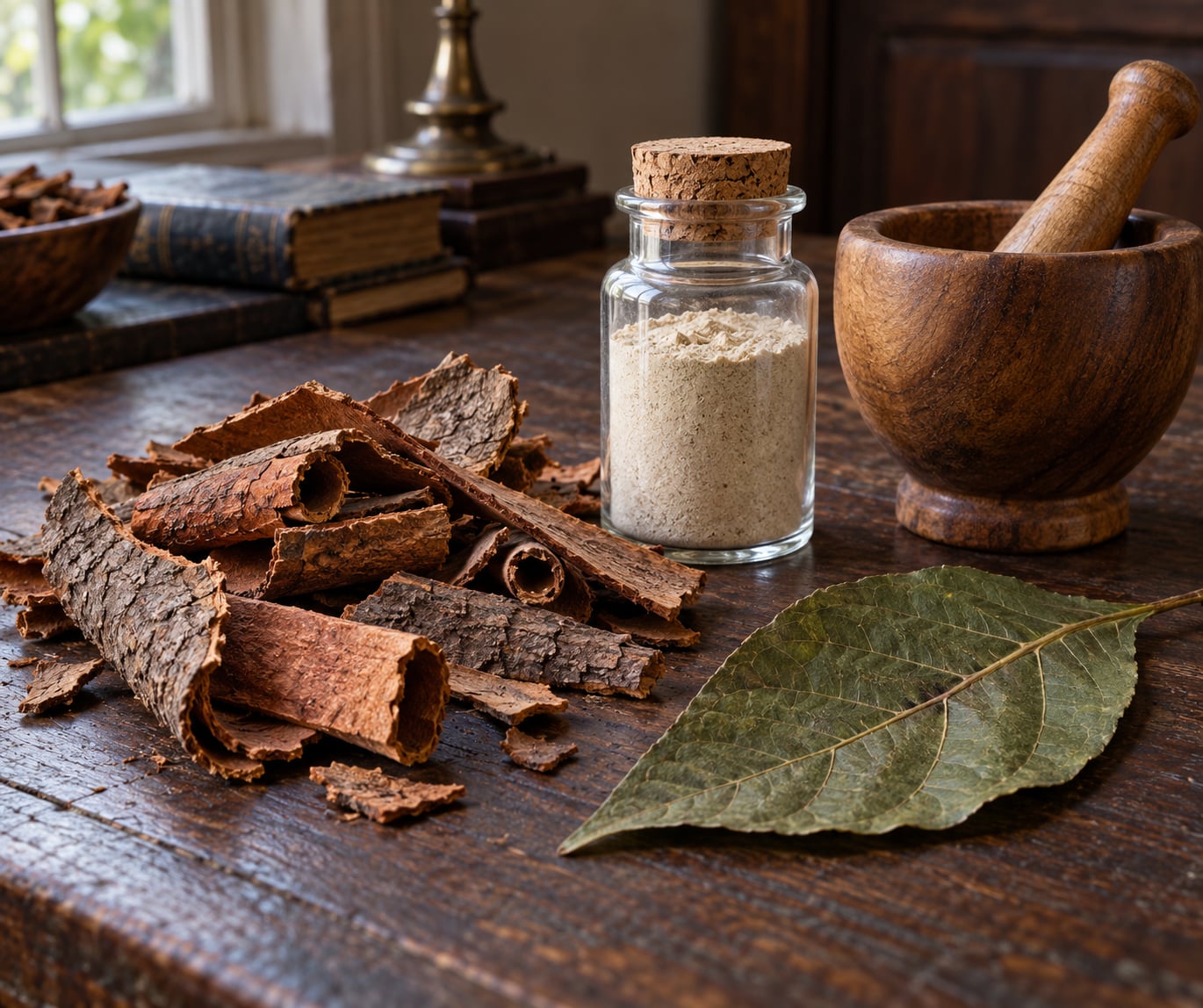
Quinine is the alkaloid isolated in 1820 from the bark of the South American cinchona tree, and for roughly three centuries it was the only reliably effective treatment for malaria. The history of quinine and malaria treatment starts with Indigenous Andean knowledge of that bark, not with a European laboratory, and ends with combination drug therapy shaped by World Health Organization guidance. None of that history turns bark into something you can safely brew at home.
Table of Contents
- 1Where Did Quinine and Malaria Treatment Begin?
- 2How Did Indigenous Andean Healers Use Cinchona Bark?
- 3How Did European Knowledge of Quinine Develop?
- 4Why Indigenous Knowledge Matters in the History of Quinine
- 5When Was Quinine Isolated?
- 6How Did Colonialism Shape the Quinine Trade?
- 7What Changed During the Nineteenth and Early Twentieth Centuries?
- 8Why Did Quinine Cause Serious Side Effects?
- 9How Did Quinine Lose Its Monopoly?
- 10How Does Quinine Work Today?
- 11Why Does the History of Quinine and Malaria Treatment Still Matter?
- 12Frequently Asked Questions
- 13Is cinchona bark safe for treating malaria today?
- 14Who first discovered the antimalarial use of cinchona bark?
- 15Can quinine be used to prevent malaria?
- 16Why did quinine cause side effects?
- 17What modern medicines replaced quinine for malaria?
- 18Why does the history of quinine and malaria treatment matter for readers today?
- 19Conclusion
Where Did Quinine and Malaria Treatment Begin?
Malaria is a parasitic disease transmitted by the bite of an infected female Anopheles mosquito. Before the parasite was understood, Europeans called the disease ague, from an old English word for shuddering fever, and blamed bad air, the miasma, rising from marshland. That misnaming matters because the marsh connection was real even when the cause was not: still water really did breed mosquitoes, so draining the fens genuinely lowered disease without anyone knowing why.
Treating malaria before cinchona reached European pharmacies was mostly ritual. Medieval and early modern physicians reached for theriacs, powdered gems, burnt scorpions and controlled bloodletting, none of which did anything for the parasite. Where bark had not yet been adopted, a physician in the American South or an Indian station had essentially nothing to offer an ague patient beyond comfort. That gap is exactly the one cinchona filled.
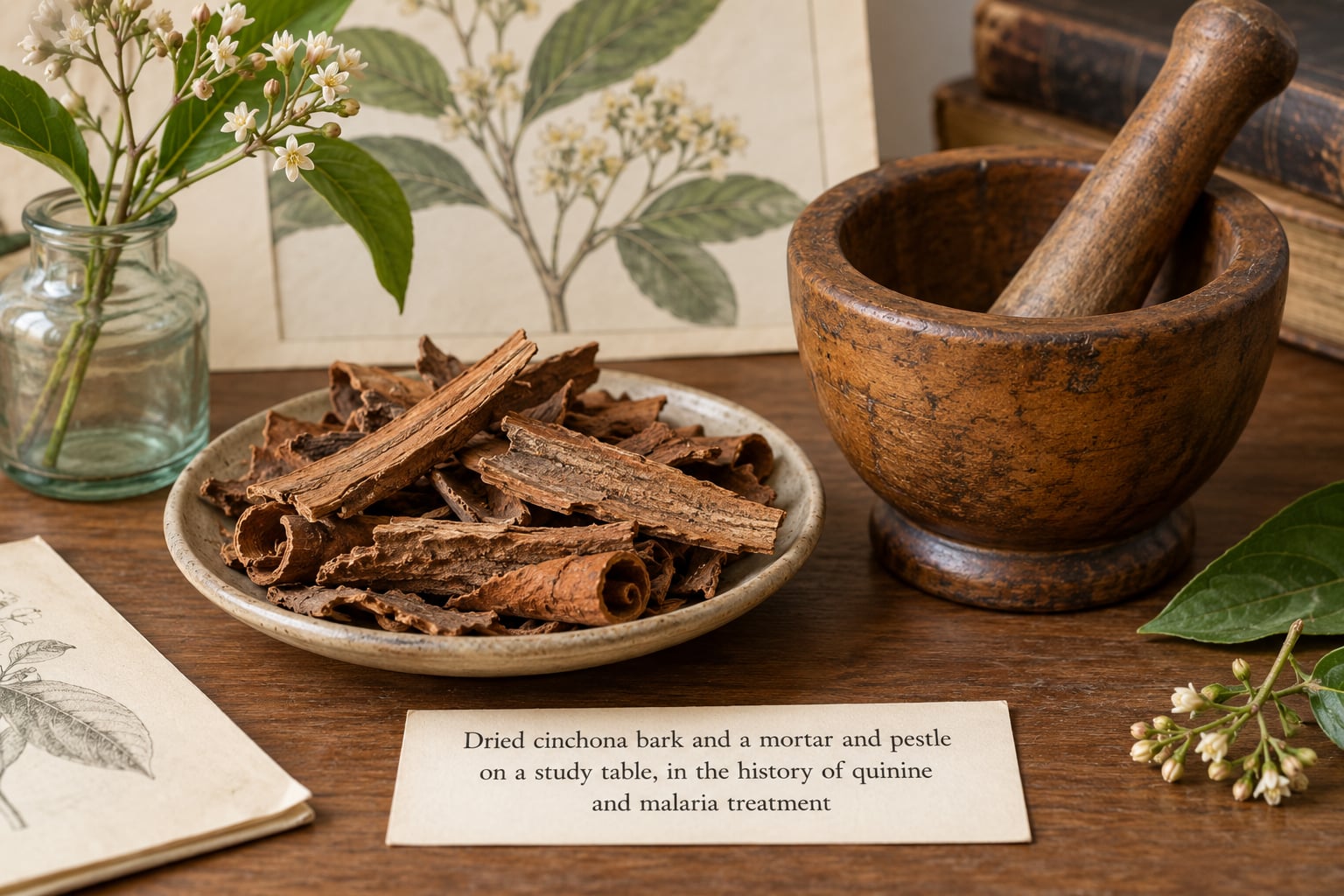
The plant that filled it grew in the Andean cloud forests of what are now Ecuador, Peru, Bolivia and Colombia. Its bark went under several names in the same period: Peruvian bark, fever tree, quina, and later Jesuit’s bark. The bark is the part that matters, since the alkaloids concentrate there, and it is bitter enough that nobody volunteered for a second cup.
How Did Indigenous Andean Healers Use Cinchona Bark?
Long before European documentation, Kichwa and other Andean communities of the Loja region treated periodic fevers with cinchona preparations. They knew the plant, the part to use, the season to harvest, and the fact that a light dose eased the paroxysm while a heavy dose made the patient worse.
That last point is the detail most retellings drop. A bark remedy that works at one strength and harms at another is pharmacologically sophisticated knowledge, and it maps onto what clinicians would later observe about quinine well before anyone could explain it chemically.
How Did European Knowledge of Quinine Develop?
European knowledge of cinchona arrives in writing in the 1630s, from colonial South America, and it arrives late. Indigenous practice was not secret so much as unwritten, and the first documented accounts come from observers who had something to gain from a remedy they did not have themselves. The Mixtec herbal manuscript known as the Badianus, compiled in 1572 in Mexico, already lists cinchona among its remedies, which places the use in writing before the famous European accounts.
From there the reports travelled through medical writers, Jesuit missionaries, merchants and colonial officials, each reshaping the story as it moved. The Countess of Cinchona story is the best-known reshaping. The documented version says the wife of the viceroy of Peru took bark to treat her own malaria in Lima in the early 1620s and sent supplies to Jesuit hospitals, and the plant came to be named for her title. Historians still argue about the details. Treat the name as a documented association and the transmission of the cure as a partly constructed narrative.
The other myth worth retiring early is the lost man in the forest, who drinks bitter pond water and is healed. It is a legend, and a memorable one, but it is not how the record reads. What the record shows is Europeans learning from Indigenous expertise, sometimes grudgingly, and then owning it.
Why Indigenous Knowledge Matters in the History of Quinine
Because without it there is no origin story at all. The isolation in 1820 was done by French chemists, but they worked from bark that Andean communities had already selected, prepared and dosed. A history that begins with Pelletier begins in the middle.
Recognition also matters for how the plant was then treated commercially. Once cinchona became a commodity, the people who had supplied the knowledge had no claim on the profits, the land or the plant itself, and the harvesting rules were written for traders rather than for anyone who had lived alongside the trees.
When Was Quinine Isolated?
Quinine was isolated in 1820 by the French chemists Pierre-Joseph Pelletier and Joseph-Bienaimé Caventou. They announced the compound that same year, first calling it chinchonine before settling on quinine, and they got the formula right, which is still the one on the modern label.
Why did isolation matter so much? Because bark is a variable raw material. Its alkaloid content differs by species, tree, soil and harvest time, so a dose measured in scoops of bark could under-dose a patient one week and poison them the next. A crystalline compound could be weighed, dosed consistently, shipped without spoiling and studied chemically. Dosing stopped being guesswork with a spoon.
The reputation of quinine was enormous for the rest of the century. It became the drug for fevers and malaria across European medicine, military medicine and colonial medicine, and it stayed in continuous use as a prophylactic for travellers and troops well into the twentieth century. Its reputation outran its safety record, which is the subject of its own section below.
How Did Colonialism Shape the Quinine Trade?
Once quinine was cheap to make, the constraint shifted from chemistry to plants. Andean cinchona was already being stripped faster than wild trees could replace themselves, and the demand of European medicine pulled bark out of the region in bulk. So the industry moved.
Java became the centre of the world quinine trade. The Dutch built plantations there, then ran a state buying monopoly that forced growers to sell their cinchona to the government at a price set in The Hague. The arrangement protected the Dutch hold on supply and left growers with very little margin, which is the standard pattern of colonial cash crops and one of the reasons cash crop economies are so fragile for the communities left behind.
Bolivian and Peruvian growers were the obvious suppliers, so the Dutch went about securing plants by other means. The best-known case is the Cinchona Ledger operation, where Charles Ledger offered a large consignment of seeds and cuttings from Bolivia in the 1860s. The consignment was intercepted, seized, and eventually smuggled onward to Java by a botanist working with the enterprise, in an episode the Dutch authorities fought for years. A usable supply of planting material from South America, bred on in Java, then became the global standard, and South American growers lost the market they had started it in.
What Changed During the Nineteenth and Early Twentieth Centuries?
Quinine moved from a botanical curiosity to infrastructure. It was in the field kits of colonial armies, the medical stores of merchant ships, the expeditionary campaigns of the era, and the Panama Canal works, where malaria had killed more workers than engineering accidents. European colonial expansion in tropical regions, and the agricultural economies built inside those regions, were underwritten by a bark that European merchants owned and Andean communities had supplied.
The timeline below separates the dated record from the surrounding folklore, because the two have been repeated together for a very long time.
| Date | Milestone |
|---|---|
| 1572 | The Badianus manuscript, compiled in Mexico, lists cinchona among its remedies. |
| 1630s | Jesuit missionaries and colonial medical writers begin describing the bark in Europe; the Countess of Cinchona story enters the record. |
| 1657-1658 | Oliver Cromwell contracts malaria during the English Civil War and refuses bark in favour of a proprietary remedy, and survives. |
| 1722 | The Italian physician Francesco Torti describes the regular paroxysm pattern of ague in his landmark study. |
| 1820 | Pelletier and Pelletier-Caventou isolate quinine in Paris. |
| 1850s | Java plantations overtake wild South American bark as the main commercial source. |
| 1860s | The Cinchona Ledger consignment is seized, and South American planting material reaches Java by way of a long-running smuggling dispute. |
| 1941 | Japanese occupation of Java disrupts the world quinine supply. |
| 1940s-1950s | Mepacrine and then chloroquine displace quinine for routine use. |
| 1970s | Chloroquine resistance is documented in South-East Asia and then spreads widely. |
| 2000s | Artemisinin-based combination therapy becomes the World Health Organization’s recommended first-line treatment. |
| 2015 | Artemisinin research is recognised with a Nobel Prize, extending the plant-to-drug story. |
Quinine also escaped the medicine cabinet into the drinks trade. Tonic water, carbonated and sweetened to disguise the bitterness, turned a prophylactic into a social drink, and mixing it with gin is the origin of the gin and tonic. The United States Food and Drug Administration removed quinine from over-the-counter drug products and now permits only small regulated amounts in food and soft drinks, which is one reason American tonic water is a soft drink rather than a preventive.
Why Did Quinine Cause Serious Side Effects?
Quinine causes side effects because the bark was never a gentle remedy, and because a pure compound makes it easy to give a dose large enough to matter. The classic syndrome has its own name, cinchonism: ringing in the ears, headache, flushing, nausea and visual disturbance after a dose. Survivors of nineteenth-century and early twentieth-century campaigns described the ringing as the most persistent part, and diaries from the malaria fens and marshes are full of it.
The severe cases are the reason for the current limits. Quinine carries a narrow safety margin, and in higher amounts it can disturb heart rhythm dangerously, cause low blood sugar, and in some people trigger haemolysis. A drug that can stop a fatal parasite and can also stop a heart is a drug that belongs under supervision, which is exactly how current guidance treats it.
No historical source should be read as a dosing guide, and the same goes for the dosage figures that still float around online. Anyone who thinks they have malaria, or has fever after travel to a place where malaria occurs, needs a test and a clinician rather than a bark infusion. Fever after travel is a medical urgency, not a puzzle.
How Did Quinine Lose Its Monopoly?
Quinine was displaced by a sequence of synthetic drugs, each solving a different problem. Mepacrine, also known as quinacrine, was more effective, more palatable and easier to dose during the Second World War, and its propaganda campaign in the Pacific is as well known as the campaign itself. Chloroquine followed in the 1940s, was cheap, safe at normal doses and so much more pleasant that it became the world’s default antimalarial, and it worked beautifully for about twenty years.
Then the parasite adapted. Chloroquine resistance was documented in South-East Asia in the 1970s and spread through the tropics, and the pattern repeated with every later single-drug champion. By the 1990s the answer was combination therapy, because parasites that beat one drug are much less likely to beat two at once.
Quinine kept a role, but a smaller one. The 1941 Japanese capture of Java also mattered strategically, since it removed a large share of the world’s quinine output during a war where malaria casualties in the Pacific exceeded combat deaths on several fronts. What pushed quinine from first line to reserve was safety and resistance, not that anyone declared it useless.
How Does Quinine Work Today?
Quinine works against the malaria parasite by interfering with it inside the red blood cell, where it accumulates and blocks the parasite’s ability to process the haemoglobin it has just digested, generating toxic by-products. It also interferes with DNA, and this is why its effect is brief and why it is always given as part of something else rather than alone.
Today, quinine has a narrow but real job. WHO guidance treats uncomplicated falciparum malaria with artemisinin-based combination therapy, and treats severe malaria with injectable artesunate, which is faster acting and better tolerated. Quinine, usually paired with a second drug such as doxycycline or clindamycin, remains a recommended option in specific settings, including some severe cases and where artesunate supply is constrained. Recent evidence has also reduced its role further as artesunate combinations expanded.
The variable that decides treatment is rarely the drug itself. It is the parasite species, where the infection was acquired, the resistance pattern recorded there, how sick the patient is, and whether the patient is pregnant. Those are clinician decisions made on a test result, not on a family remedy.
Why Does the History of Quinine and Malaria Treatment Still Matter?
It matters because the problems that created cinchona are still running. Resistance surveillance is the same problem that killed chloroquine. Access to effective diagnosis and treatment is the same problem that decided who could afford the 1820 compound. The plants and the people who know them are still being extracted without credit or compensation, which is the unresolved part of every plant-to-drug story, artemisinin included.
Artemisia annua, sweet wormwood, is the parallel case that reinforces the point. Its antimalarial use is recorded in Chinese materia medica, including a 4th-century text, was restudied in the 1970s, and yielded artemisinin in work that earned a Nobel Prize in 2015. Two plants, both known to the people who lived with them, both credited to European and Chinese labs, and both reminders that the discovery step is only part of the story.
Cinchona also leaves a conservation question. The nineteenth-century bark rush stripped wild Andean trees faster than they regenerate, and a tree valued only in another continent’s pharmacy is a tree nobody local has reason to keep standing. Sustainable harvest, cultivated supply and benefit-sharing are practical problems with real patients attached to them.
Frequently Asked Questions
Is cinchona bark safe for treating malaria today?
No. Cinchona bark is not a safe or effective modern treatment for malaria. Its alkaloid content varies by species and batch, so the dose is unpredictable, and the quinine in it can cause cinchonism, dangerous heart rhythm changes and low blood sugar. Current guidance from the WHO, CDC and NIH calls for prompt testing and treatment with approved antimalarial medicines, not plant preparations. Anyone with a fever after travel to a malaria area should seek care urgently and tell the clinician where they have been.
Who first discovered the antimalarial use of cinchona bark?
No single European gets the credit. Kichwa and other Andean communities of what is now Ecuador and Peru used cinchona bark for periodic fevers long before it was written down, and the 1572 Badianus manuscript already lists it among its remedies. European accounts follow in the 1630s through Jesuit missionaries, colonial medical writers and merchants, and the plant came to be called Jesuit’s bark or Peruvian bark. Quinine itself was isolated in 1820 by Pelletier and Pelletier-Caventou in Paris.
Can quinine be used to prevent malaria?
Quinine is not used as a routine preventive. Travellers who need prophylaxis are directed to drugs such as atovaquone-proguanil, doxycycline or mefloquine, chosen with a travel clinic for the destination, the season and the person. Quinine was historically used to protect troops and long journeys, and it appears in small regulated amounts as a bittering agent in tonic water, which is a flavouring, not a preventive. Ask a travel clinic what applies to your itinerary rather than self-medicating.
Why did quinine cause side effects?
Because it has a narrow safety margin. Quinine accumulates in the body and the bloodstream, and a dose large enough to clear parasites can also affect hearing and vision, producing the syndrome called cinchonism: ringing in the ears, headache, nausea and visual disturbance. At higher levels it can disturb heart rhythm and cause dangerously low blood sugar, which is why it is given under supervision rather than freely. Bark is no safer than the compound, because the compound is what the bark contains.
What modern medicines replaced quinine for malaria?
First came mepacrine, then chloroquine, which was cheap and safe and became the default treatment for about twenty years until parasite resistance to it emerged in the 1970s. Today the WHO recommends artemisinin-based combination therapy, in which a fast-acting artemisinin derivative is paired with a longer-lasting drug so that no parasite is left alive to breed resistance. Injectable artesunate is the standard for severe malaria, and quinine plus a second drug is a narrower alternative in specific settings.
Why does the history of quinine and malaria treatment matter for readers today?
It is a working example of the problems medicine still has. Chloroquine failed the same way quinine did, because resistance spreads fast and a single drug is easy to defeat. The cinchona trade also shows what happens when plant knowledge is commercialised without credit or compensation, which is the open question in today’s debates over medicinal plant bioprospecting. Understanding that history keeps expectations honest about what a traditional remedy can and cannot do, and why current guidance rests on testing, dosing and resistance data rather than tradition.
Conclusion
The line runs from Andean cinchona knowledge, to an isolated compound in 1820, to a colonial plantation commodity, to synthetic drugs, to today’s combination therapy. The useful part of that story is not that a folk remedy was vindicated. It is that an expert body of knowledge was recognised, commercialised and eventually taken away from the people who held it, and that the drug derived from it has been superseded rather than retired.
If you are reading this with a fever, a recent trip to a malaria area, or a bark preparation in your kitchen, the history is interesting and the next step is a clinician, a test and current guidance from the WHO, CDC or your national health service.