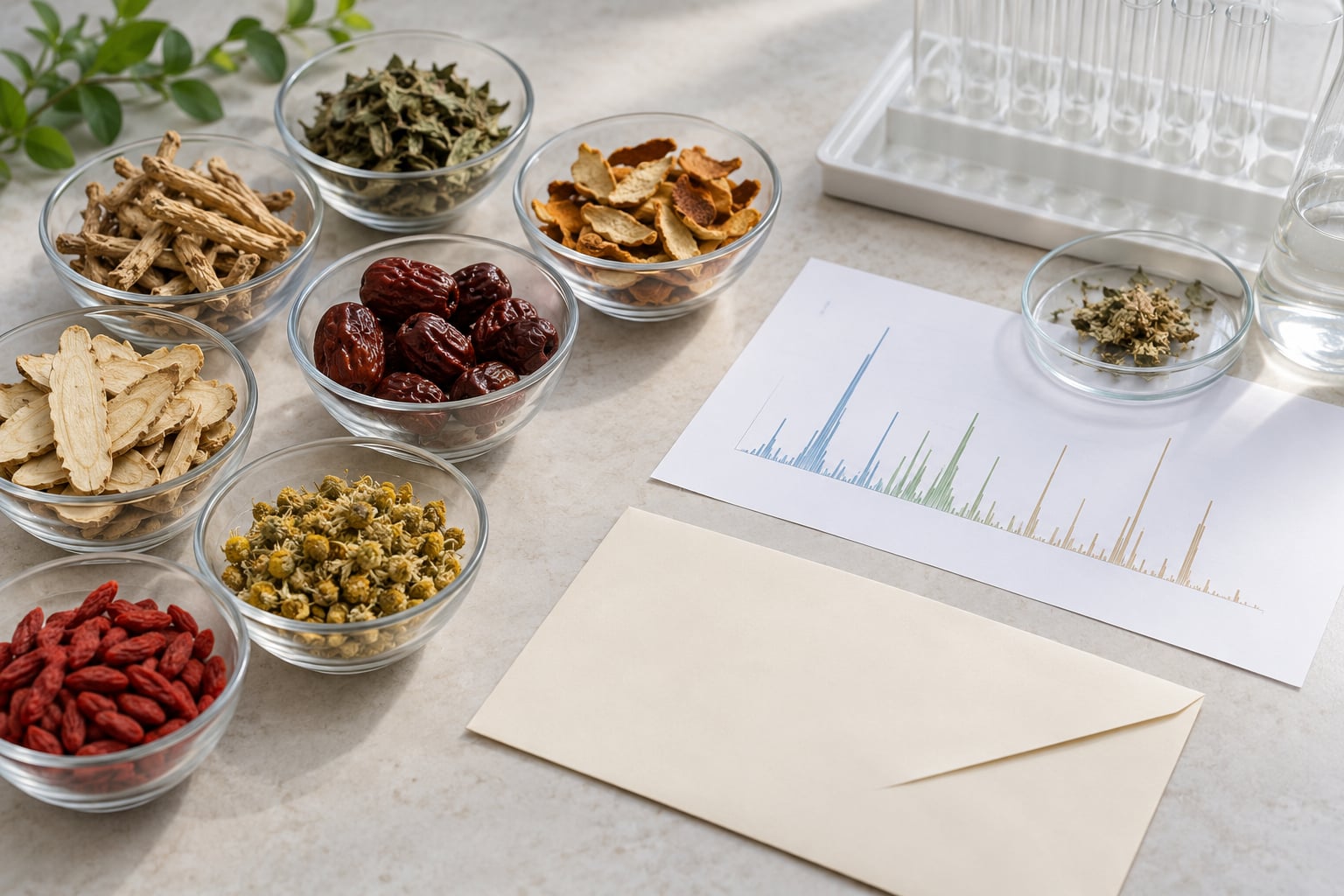
Pesticide residue on dried herbs is the trace amount of a plant-protection product still present in an herb after it has been sprayed, harvested and dried. Drying removes water but not the pesticide, so the residue measured per kilogram of dried herb can be many times higher than in the fresh plant. Most samples tested by regulatory programmes fall within legal limits.
That last sentence matters, because the gap between “a residue was detected” and “this herb will harm you” is where most of the confusion lives. Detection is an analytical fact. Harm is a question about which substance, at what dose, how often, and in which person. Those are separate questions, and they rarely point in the same direction automatically.
This guide walks through where residues come from in dried material, what the numbers attached to them mean, how laboratories test them, and what someone who uses dried herbs daily can reasonably do about it. If you want the short version: buy from suppliers who will talk about testing, treat certified organic as a reduction rather than an elimination, and take any suspected medicinal product to a pharmacist or doctor before using it.
Table of Contents
- 1Pesticide Residue on Dried Herbs: What the Evidence Means
- 2Where Do Pesticide Residues on Dried Herbs Come From?
- 3How Pesticide Residue on Dried Herbs Is Formed and Measured
- 4Does Drying Make Pesticide Residues More Dangerous?
- 5What Do Residue Limits and Tolerance Levels Tell You?
- 6Which Pesticides Deserve Particular Attention?
- 7How Can Pesticide Residues Be Tested?
- 8What Can Consumers Do to Reduce Exposure?
- 9What Should Researchers and Health Writers Check?
- 10Frequently Asked Questions
- 11Is any pesticide residue on dried herbs unsafe?
- 12Can boiling, soaking, or rinsing dried herbs remove pesticide residues?
- 13Are organic dried herbs guaranteed to be free of pesticides?
- 14Does a laboratory non-detect mean a dried herb has zero pesticide residue?
- 15What should I do if I suspect a dried medicinal herb is contaminated?
- 16What to Do First
Pesticide Residue on Dried Herbs: What the Evidence Means
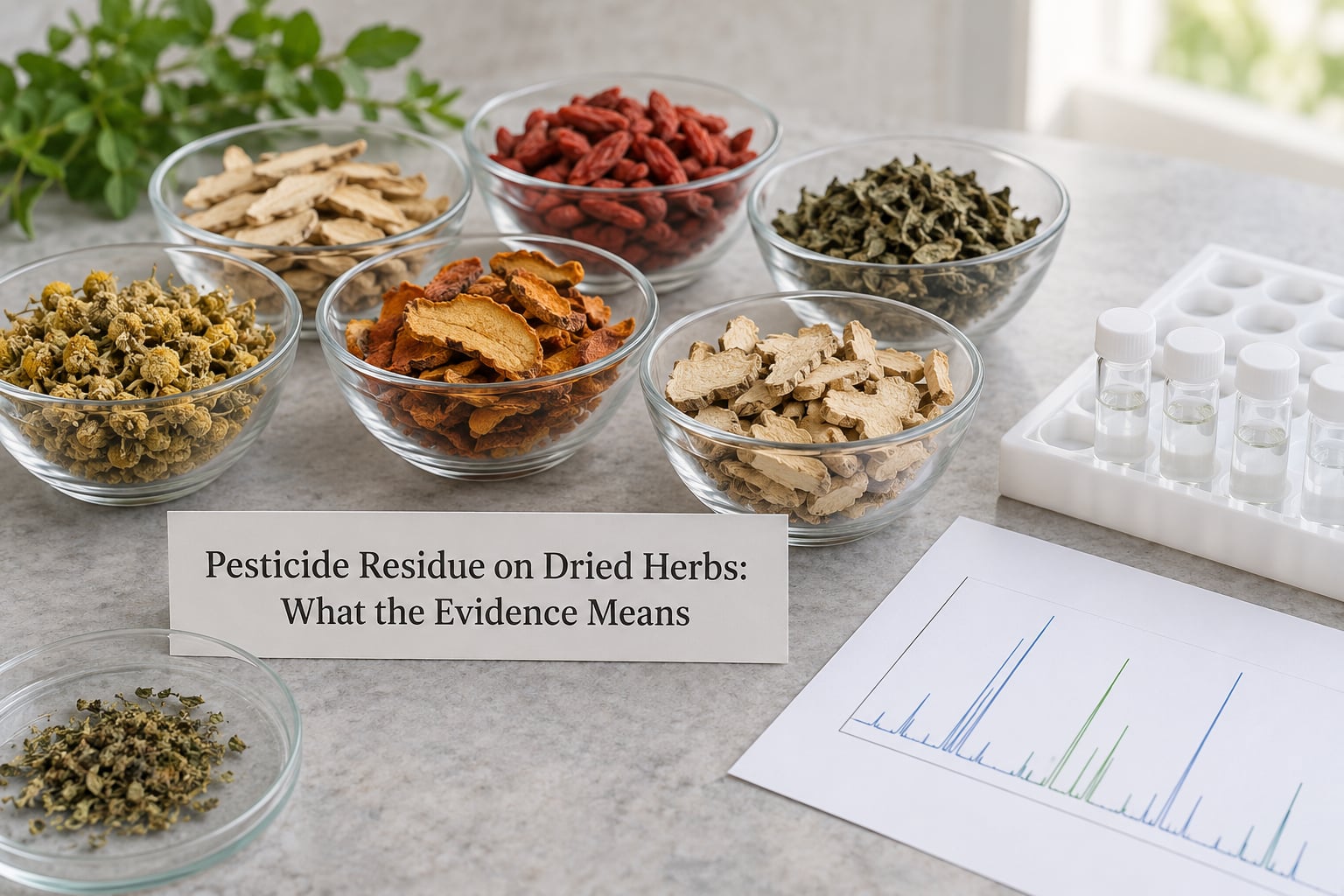
Four things decide whether a detected residue matters, and they rarely all point the same way.
| Variable | Why it changes the answer |
|---|---|
| Which substance | Contact herbicides, organophosphates, chlorinated compounds and pyrethroids behave differently in the body and have different limits. |
| How much | The comparison that matters is the measured concentration against the applicable maximum residue limit for that crop, not against zero. |
| How often | A daily tea or tincture means repeated exposure over months; an occasional cooking herb does not. |
| Who is consuming it | Children, pregnancy and breastfeeding, and liver or kidney conditions all change how a dose should be weighed. |
So the honest answer to “is pesticide residue on dried herbs dangerous” is: it can be, it is often not, and you cannot tell which from the dried leaf alone. That is why questions about sourcing and testing carry more weight than questions about fear.
One more framing point before the details. Regulatory monitoring programmes do not find illegal residues in most samples. The EFSA’s 2018 EU-wide report covered 91,015 samples and found 95.5% of them within permitted levels. The same report found 29% carried two or more detectable residues, which is the number worth thinking about, because it points at mixtures rather than single hits.
Where Do Pesticide Residues on Dried Herbs Come From?
Most dried herbs begin their life as a sprayed crop, so the residue story usually starts in a field rather than a drying shed.
Applications made during the growing season are the biggest source. Insecticides and fungicides applied before or during flowering are often still present at harvest, and the pre-harvest interval rules out some applications close to picking but not all of them. Contact herbicides used to keep a crop clean of weeds can survive on the plant surface, and those surface compounds are the ones most likely to persist through drying intact.
Then there are the less obvious routes. Contaminated soil or irrigation water puts compounds into the root and leaf tissue. Treated seed can carry a coating into the crop. Drift from a neighbouring field lands on herbs that nobody sprayed. Harvest equipment, drying racks, tarpaulins and shared warehouse floors can pass contamination between batches, including into organically grown material handled alongside treated product. Storage in a room with a leaking can or a fumigated room adds its own possibilities.
Accidents happen too. A sprayer cleaned on the ground, a mist applied to the wrong crop, a home garden treated with a product not cleared for that herb. For wild-harvested and smallholder material, the honest statement is that the chain of custody may simply be unknown.
Organic production does not fix this. Organic farming still uses pesticides, they are just usually different ones and restricted to approved lists. Monitoring data from several jurisdictions consistently finds detectable residues in organic samples, typically at lower levels than conventional ones and occasionally at levels that surprise people. “Certified organic” means the production system was audited, not that the plant contains nothing.
How Pesticide Residue on Dried Herbs Is Formed and Measured
Drying changes the number without changing the molecule. A fresh herb is roughly 80 to 90% water. When that water leaves, every kilogram of dried herb represents ten or more kilograms of fresh plant, so the residue that was spread across all that water is now packed into a much smaller mass. The pesticide did not get more toxic; the denominator shrank.
Not every compound behaves that way. Chlorinated pesticides and some pyrethroids are chemically stable and persist essentially unchanged. Others, including a number of organophosphates and some fungicides, break down faster under light and heat, which means sun-drying and high-temperature drying can genuinely lower some residues while leaving the stable ones untouched. That difference is why two dried batches from the same crop can test differently.
Washing behaves differently before and after drying. Washing a fresh herb under running water can remove surface residues, and studies on fresh produce report removal in the region of 75 to 80% for running water, with higher figures claimed for baking soda soaks around 80 to 96%. Those figures come from fresh produce and should not be transferred directly to dried material. A dried leaf rehydrates unevenly, most of a pesticide already sits inside or tightly bound rather than loose on the surface, and soaking dried herbs in water also risks spoilage and microbial growth.
Laboratory estimates have their own limits. A panel reports concentrations for the compounds it was built to look for, at a detection or reporting limit set by the method. It does not tell you the batch will behave identically to the next batch from the same field, and it does not measure your personal dose. A residue result describes material, not a person.
Does Drying Make Pesticide Residues More Dangerous?
Not in the way people usually mean it. Drying concentrates the residue per gram of plant material; it does not make the compound itself more potent or more toxic to the body.
An illustrative calculation helps. Take a fresh herb tested at 0.05 mg/kg of a given pesticide on fresh weight, applied a few weeks before harvest. Dry that herb to roughly 10% moisture. Each kilogram of dried herb now represents about ten kilograms of fresh plant, so the same absolute quantity of pesticide reports as roughly 0.5 mg/kg on dried weight. The numbers are illustrative, not a measurement, but the arithmetic is the whole mechanism: the quantity is unchanged, the mass it is expressed per is not.
What genuinely changes is the size of the serving. Nobody eats a kilogram of fresh basil in a sitting, but a herbal practitioner may use a few grams of dried root daily for months, and a household may drink a dried herb tea every evening for years. Repeated small daily exposure is the reason dried herbs get more attention than the same plant fresh, and it is a dosing question rather than a potency question.
Two variables keep this in proportion. Drying time and temperature decide how much of the less stable chemistry has already broken down, so a sun-dried herb and a low-temperature mechanically dried herb from the same crop need not test alike. And the fraction that degrades does not disappear; it breaks into smaller compounds that a standard panel may not look for. “Not detected” for the parent compound and “nothing there” are different statements.
What Do Residue Limits and Tolerance Levels Tell You?
A residue limit is a legal ceiling on how much of a specific pesticide may be present in a specific food, not a statement that anything below it is harmless.
The systems are built from the same logic. A regulator identifies the substance, works out the amount a person can eat every day over a lifetime without meaningful harm, sets an acceptable daily intake, and then divides that intake across a realistic diet to produce a limit for the crop. The margin between the two is the safety buffer. In Europe this is the maximum residue limit under Regulation 396/2005; for dried herbs and spices, the EU MRL for glyphosate is 0.1 mg/kg. In the United States the EPA sets tolerances, FDA enforces them on raw and processed food, and USDA covers meat, poultry and eggs. The Codex Alimentarius sets international standards for trade.
Two practical cautions. First, values differ by pesticide, crop and jurisdiction, so an EU MRL tells you nothing about a US tolerance for a different compound. Second, and more importantly for dried material, a limit set on fresh weight is not directly comparable to a dried-weight result. This is a known analytical wrinkle in herb and spice monitoring and a good reason to ask a laboratory how it handled the conversion.
Trace detections are worth separating from exceedances. A level reported just above the laboratory’s limit of quantification means the compound was found in measurable trace form; it says nothing about exceedance unless it is also above the legal limit. Monitoring results usually quote both numbers, and press coverage frequently quotes only the first.
Which Pesticides Deserve Particular Attention?
Attention should follow the substance’s toxicological profile and its regulatory treatment, not the size of a detection.
| Class | Typical use | What governs it |
|---|---|---|
| Organophosphates and carbamates | Insecticides applied during the growing season | Classically fast-acting in acute poisoning; chronic relevance depends on the individual compound and its acceptable daily intake. |
| Pyrethroids | Insecticides, including many used post-harvest in storage | Widely tolerated at low dietary exposure; irritation and allergy matter more than systemic toxicity for most people. |
| Chlorinated pesticides | Older organochlorine insecticides and fungicides, some now largely withdrawn | Chemically persistent and lipophilic, so trace detections persist for years and concentrate in fatty material. |
| Herbicides, including glyphosate | Weed control, including some pre-harvest uses | EU MRL of 0.1 mg/kg for dried herbs and spices; tolerances elsewhere differ by crop and use. |
| Fungicides, including residues used on dried material | Crop protection in the field and sometimes post-harvest | Used deliberately after harvest in some cases, which makes them a storage-phase rather than a field-phase exposure. |
Two things this table is not saying. A detection at trace level is not an exceedance, and none of these classes is uniquely a dried-herb problem; the same compounds turn up across all plant foods. What is specific to dried herbs is the combination of concentration during drying, repeated daily use, and the fact that some mixtures co-occur.
That mixture question is genuinely unresolved. Regulators assess substance by substance, and the acceptable daily intake for each assumes a lifetime average rather than a day of unusually high intake across several pesticides at once. Researchers have argued about additive and synergistic effects for years without a settled method for testing them. Treat claims in either direction, that mixtures are far more dangerous than the sum of their parts or that they are simply not a concern, as a genuine open question.
How Can Pesticide Residues Be Tested?
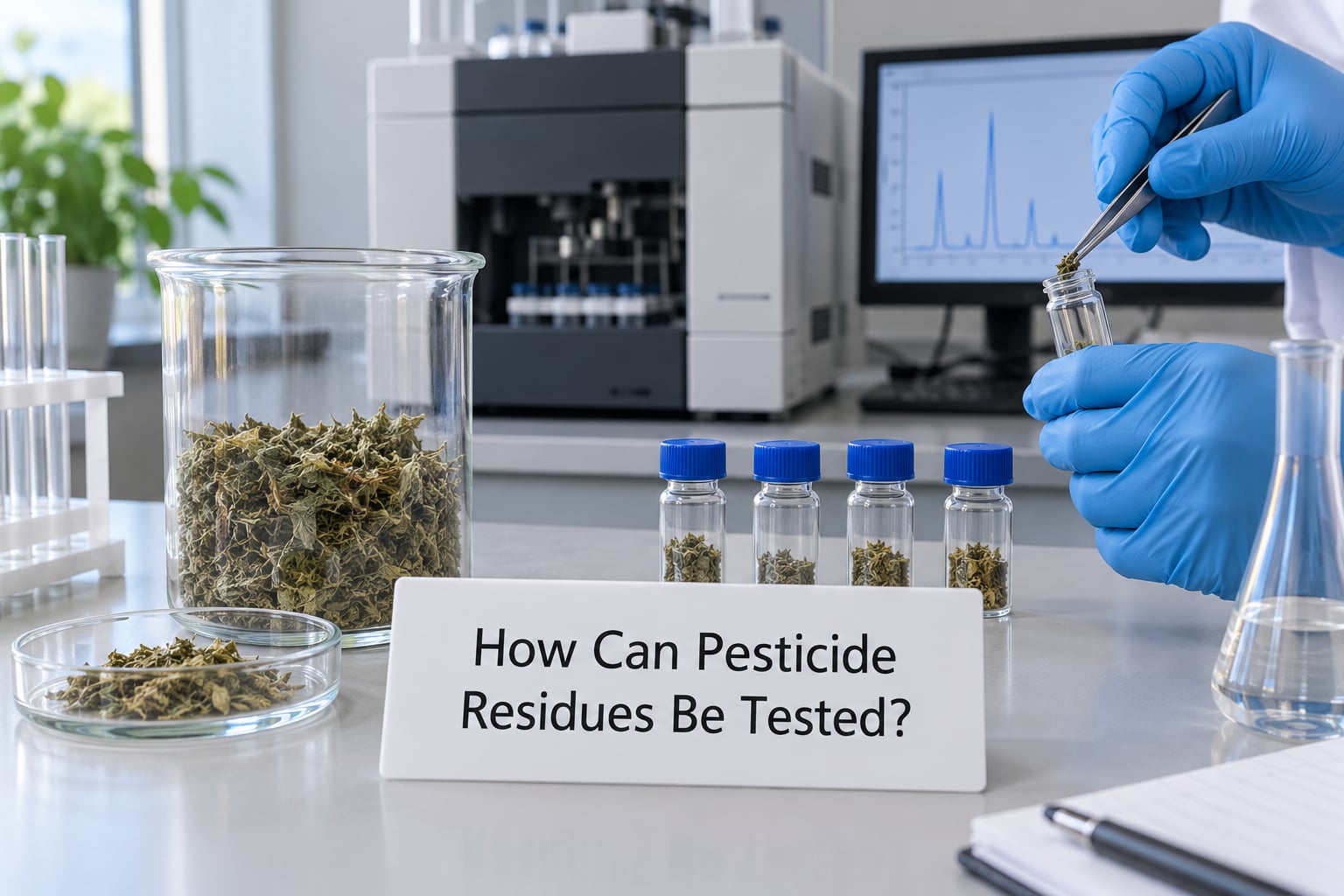
A herb can be screened for many pesticides at once, and that is the first question to ask any laboratory: what does your panel actually cover?
Most modern herb testing uses a multi-residue screen. The sample is homogenised and extracted with a method such as QuEChERS, then analysed by gas or liquid chromatography with tandem mass spectrometry, which is written GC-MS/MS and LC-MS/MS. Peer-reviewed work on spice matrices has demonstrated validated methods reaching limits of quantification around 0.01 mg/kg across several compounds, so fine a limit is enough to see trace levels rather than only large ones.
A targeted test does something narrower and is worth requesting when there is a specific suspicion: one known compound at a high reporting sensitivity, or a fumigant, or a compound a standard panel does not include.
Five things to establish before trusting a result.
- Is the laboratory accredited to ISO/IEC 17025, or working to an equivalent national scheme?
- Which compounds are on the panel, and how many are genuinely included rather than mentioned in a brochure?
- What is the limit of quantification, expressed for dried material rather than fresh?
- Are the results compared against the applicable maximum residue limit for that crop and jurisdiction?
- Does the report cover the batch you are buying, and can it be tied to a harvest and lot number?
Cross-contamination during handling is the quiet failure mode. A lab that grinds and sieves samples in the same room, without blanks between runs, can move residue from a high sample into the next one and report a clean result for contaminated material. Ask about blanks and about sample preparation; a laboratory that answers those two questions plainly is usually a laboratory that does the work properly.
And know what a non-detect means. It means: none of the named compounds was found above the method’s limit of quantification in that sample. It does not mean the sample is free of pesticides, because compounds outside the panel, or below that limit, or metabolites of the compounds tested were not measured at all.
What Can Consumers Do to Reduce Exposure?
You cannot remove every residue at home, and anyone promising you otherwise is selling something. What you can do is change which material enters your kitchen and how much of it you take.
Six questions worth asking a herb supplier, wholesaler or practitioner before you buy in volume.
- Do you test incoming raw material, and can I see a certificate of analysis for this lot?
- Which laboratory runs the tests, and is it accredited?
- How many pesticides does the panel cover, and what is the reporting limit?
- Can the lot be traced back to a harvest date and growing region?
- What does the supplier do with material that exceeds a limit?
- Do you test the co-contaminants as well, meaning heavy metals, mycotoxins and microbial load?
That last question is the one most people never ask. Herb testing is usually bundled, and a laboratory that reports residues while ignoring lead, arsenic, cadmium and fungal toxins has only answered part of the question. Dried herbs are recognised as a priority matrix for exactly this reason; Canada’s Food Safety Action Plan ran dedicated testing for lead in dried herbs and spices in 2011 and 2012, and similar monitoring programmes elsewhere have repeatedly found heavy metals in medicinal material, often above what plant chemistry alone explains.
Once the herb is home, a simple sequence does more than most people expect.
- Rinse briefly under running water before use, and discard the water. This helps with surface residues only, and the fresh-produce data suggests most of what washing removes.
- Use it in an infusion or decoction as directed. Boiling water changes some compounds, though it does not remove all of them, and the wet material must be refrigerated or used promptly.
- Do not try to soak dried herbs for hours to leach them. You mostly raise the moisture and microbial load of the leaf.
- Store away from heat and humidity, in a sealed container, and buy quantities you can finish inside a sensible shelf life.
- Rotate products and suppliers rather than living from one jar.
- Skip claims of pesticide-free without a certificate. Ask instead for the panel, the limit and the lot number.
For anyone taking a dried herb as a medicine rather than a garnish, the sourcing step matters far more than the kitchen step. Speak with a doctor or pharmacist before starting a dried medicinal herb, particularly during pregnancy or breastfeeding, for a child, or alongside prescription medicines. A herbal material with an unclear chain of custody is the wrong thing to put on an unexplained symptom.
What Should Researchers and Health Writers Check?
Residue headlines travel further than the methods behind them, so it helps to know what to look at before repeating a number.
Start with the sample. How many batches, from how many regions, bought where, over what period? A study of material from one supplier’s warehouse tells you about that supplier. Then check the method: what was the extraction, what instrument, what limit of quantification, and were quality control blanks and recovery samples included? A panel that cannot detect below 0.05 mg/kg will report nothing at 0.01 mg/kg, which looks like a clean bill of health and is not one.
Next, check the comparison. A residue number is meaningless without the limit it was measured against, and the limit must match the crop, the compound and the jurisdiction. Papers that report detection counts without any comparison to a maximum residue limit are describing surveillance, not harm.
Finally, check whether the conclusion follows the method. Screening a batch for residues can justify screening every batch for residues. It cannot by itself establish that an illness was caused by a pesticide, that a product is dangerous, or that a regulatory limit is too high. Those need toxicological or epidemiological evidence, and headlines rarely carry it.
Frequently Asked Questions
Is any pesticide residue on dried herbs unsafe?
A detected residue is not the same as an unsafe level. Risk depends on the specific compound, the measured amount compared with the applicable maximum residue limit for that crop, how often you consume it, and who is consuming it. Monitoring programmes such as the EFSA’s 2018 report found the large majority of samples within legal limits. If you take a dried herb daily, ask a doctor or pharmacist about the specific product rather than assuming either safety or danger.
Can boiling, soaking, or rinsing dried herbs remove pesticide residues?
Only partly. A brief rinse under running water can remove surface residues, with studies on fresh produce reporting most of what washing achieves. But dried material rehydrates unevenly and much of the residue sits inside the plant rather than on the surface, so washing removes less than it does from fresh herbs. Extended soaking mainly raises moisture and microbial risk. Boiling changes some heat-sensitive compounds without removing the rest. Sourcing cleanly dried material matters more than any kitchen step.
Are organic dried herbs guaranteed to be free of pesticides?
No. Organic production restricts which products may be used and requires an audited system, but it still uses pesticides, usually at lower inputs and with different compounds. Monitoring programmes routinely find detectable residues in organic samples, generally lower than conventional but occasionally surprising. Certification is evidence about the method, not a chemical guarantee about the leaf. If a supplier claims pesticide-free material, ask for a certificate of analysis naming the panel, the reporting limit and the lot.
Does a laboratory non-detect mean a dried herb has zero pesticide residue?
It means the compounds on the panel were not found above that method’s limit of quantification in that sample. Compounds outside the panel, amounts below the reporting limit, and breakdown products of the tested compounds were not measured. Panels also vary in breadth, from a dozen compounds to several hundred. A meaningful non-detect comes with an accredited laboratory, a stated panel scope, a stated reporting limit for dried material, and confirmation that quality control blanks were run between samples.
What should I do if I suspect a dried medicinal herb is contaminated?
Stop using it and keep the packaging and any remaining material, since the lot and batch details make testing possible. Ask the supplier for a certificate of analysis covering the lot, and take the question to a doctor or pharmacist, particularly if you are pregnant, breastfeeding, giving it to a child, or taking prescription medicines. Report suspected contamination to your national food safety regulator. If anyone has symptoms after using it, contact a poison control service or emergency care rather than waiting for test results.
What to Do First
Four steps, in order, and none of them require a laboratory.
Identify the herb and where it came from. Name, plant part, supplier, lot or batch number, harvest season. Without those details no one can test anything or trace a problem.
Ask for evidence rather than adjectives. A certificate of analysis from an accredited laboratory, naming the panel, the reporting limit and the lot. Without one, treat “pesticide-free” and “natural” as marketing.
Compare any reported result against the right number. Match the compound, the crop, dried or fresh weight, and your jurisdiction’s limit. A number without that context cannot be interpreted.
Then talk to someone qualified before using a suspect product medicinally, especially for a child, during pregnancy, or alongside prescription medicines. If you work with bulk material regularly, build the supplier questions from earlier in this article into your intake routine once.
None of this is about panic. Most dried herbs on sale are fine, and monitoring data says so. It is about knowing which question to ask, and in what order.