Most properly stored alcohol-based homemade tinctures stay usable for three to five years, and well-preserved high-proof batches can keep ten years or more. There is no universal expiry date, though: how long do homemade tinctures last depends on the solvent, the alcohol percentage, how much water is in the plant material, and what happens to the bottle afterwards.
The honest answer is a range, not a date. A 25% ABV tincture made from fresh, wet leaves and a 90% ABV tincture made from dried resinous bark are not the same preparation and will not age the same way. What follows is how those differences work, how to store each type, and how to look at an old bottle and decide.
This is general storage and handling information, not advice about taking any preparation. Questions about whether a particular remedy suits you, or whether a specific plant is safe for you to use, belong with a doctor or pharmacist.
Table of Contents
- 1What Determines a Homemade Tincture’s Shelf Life?
- 2How Long Do Tinctures Usually Last?
- 3What Alcohol Percentage Is Best for Preservation?
- 4How Should You Store Homemade Tinctures?
- 5Does Refrigeration Make Tinctures Last Longer?
- 6What Signs Mean a Tincture Has Gone Bad?
- 7Can You Make an Old Tincture Last Longer?
- 8Start clean
- 9Extract twice, not once
- 10Keep the alcohol percentage honest
- 11Fill and seal properly
- 12Label everything, then act on the label
- 13Rotate and use exhausted material
- 14Know when testing is not sensible
- 15Frequently Asked Questions
- 16Do homemade tinctures have an expiration date?
- 17Is a tincture still good if it is several years old?
- 18Should homemade tinctures be refrigerated?
- 19What can I do if I do not know when a tincture was made?
- 20Can sediment or cloudiness mean a tincture has spoiled?
- 21What to Do First
What Determines a Homemade Tincture’s Shelf Life?
Shelf life is governed almost entirely by the solvent you used. Alcohol at 40% ABV or higher stops most bacteria, yeasts and moulds from multiplying, which is the whole reason the tincture method has survived for centuries. Water, vegetable glycerine and vinegar do not have that power, so those preparations spoil sooner unless they are refrigerated.
The second factor is water content. Fresh plants are roughly half water by weight, and that water dilutes the menstruum. A fresh-herb tincture at a nominal 40% ABV might behave like a 25% batch once the plant material has finished giving up its moisture. Dried material adds little water, so the alcohol percentage you measured on day one still holds on day four hundred.
Third, the plant itself. Volatile oils evaporate and oxidise faster than tannins or resins, so aromatic material fades sooner than a resinous bark even in identical storage. Plant material harvested at the wrong season, or stored damp before it went into the jar, carries extra risk that no amount of good technique later will undo.
Fourth, filtration and container. Fine plant matter suspended in liquid is food for whatever survives, and a bottle filled to the neck has less air than one half full. That is the entire argument for filtering well and topping up.
Finally, the environment. Light, heat and air are the three things that shorten a tincture’s life. Amber or cobalt glass blocks most damaging wavelengths, a cool cupboard slows oxidation, and a tight cap limits the oxygen that gets in.
One more thing worth saying plainly: a homemade batch has no regulatory best-by date. Nobody tested it, nobody labelled it, nobody assigned a shelf life. Tracking that from the day you strain it is your job, and a scrap of masking tape with the date is all it takes.
How Long Do Tinctures Usually Last?
Read these figures as usable windows rather than deadlines. The difference between the bottom and the top of each range is mostly storage quality.
| Preparation | Typical usable life | What limits it |
|---|---|---|
| High-proof alcohol, 60-90%+ ABV, dried plant | 7 to 10 years | Oxidation of lighter constituents over time |
| Standard alcohol tincture, 40-60% ABV, dried plant | 3 to 5 years | Slow potency fade, then colour change |
| Lower-alcohol tincture, 20-25% ABV | 1 to 2 years | Weaker preservative action |
| Fresh-plant tincture at any strength | Shorter than its dried equivalent | Water in the material dilutes the menstruum |
| Glycerite (vegetable glycerine) | 12 to 24 months, refrigerated | Glycerine preserves poorly; no preservative action |
| Vinegar tincture | 6 months to 3 years, refrigerated | Acid helps, but not enough to match alcohol |
| Oxymel (vinegar and honey) | 1 to 2 years, refrigerated | Honey resists spoilage; vinegar leaches water in |
| Infused oil | 12 to 18 months; fresh-herb oils far less | Rancidity, which smells and tastes different from mould |
| Herbal salve in a jar | 6 to 12 months | Water and air in the exposed surface |
| Infused honey | 1 year or longer | Honey itself keeps for years if sealed |
| Water infusion, tea or decoction | 1 to 3 days, refrigerated | No preservative at all |
Vinegar is the row worth arguing about, because the sources genuinely disagree. Henriette’s Herbal archive records one hand giving vinegar tinctures two to three years in cool dark storage while other authors in the same tradition put them at six months. The difference is almost certainly refrigeration, material dryness and the maker’s willingness to discard on any suspicion. Plan on months, not years, and refrigerate from the start.
It also helps to separate two things that get tangled together. Potency fades gradually: an old tincture usually still extracts, just less strongly. Safety risk is different and mostly binary: it arrives when microbes or oxidation products do, and it comes with smell, cloudiness or mould. A five-year-old alcohol tincture that looks and smells normal is far more likely to be weaker than dangerous.
What Alcohol Percentage Is Best for Preservation?
ABV means alcohol by volume, the share of the liquid that is ethanol. 100% ABV would be pure ethanol; 40% ABV is roughly 80 proof. Around 40% ABV is the widely used threshold because it is strong enough to hold back microbial growth while still pulling out a broad range of plant constituents.
Material guides the choice more than any rule about the finished bottle. Fresh herbs need higher proof because they bring their own water. Resinous and woody material, leaves and flowers rich in volatile oils, generally want high proof to extract efficiently at all.
| Starting alcohol | Suits | Expected usable life |
|---|---|---|
| 25% ABV / 50 proof | Mostly dried material; shelf-stable but modest extraction | About 2 years |
| 40% ABV / 80 proof | The general-purpose default for dried herbs | Up to about 5 years |
| 60-75% ABV / 120-150 proof | Resinous bark, seeds, high-water fresh material | Several years |
| 90%+ ABV / 180-190 proof | Volatile oils and gum resins; maximum extraction | 7 to 10 years |
Community herbalists commonly hold that at least 23% ABV is needed for a shelf-stable alcohol tincture, which matches the 25% row above being a floor rather than a comfortable target. Below that line you are effectively making a vinegar-like preparation and should treat it as one.
Once a tincture is made, the percentage you can no longer change except by dilution, and diluting brings water in with it. That is the argument for making the menstruum right the first time.
How Should You Store Homemade Tinctures?
Storage is where most shelf life is either protected or lost. The checklist is short enough to actually do.
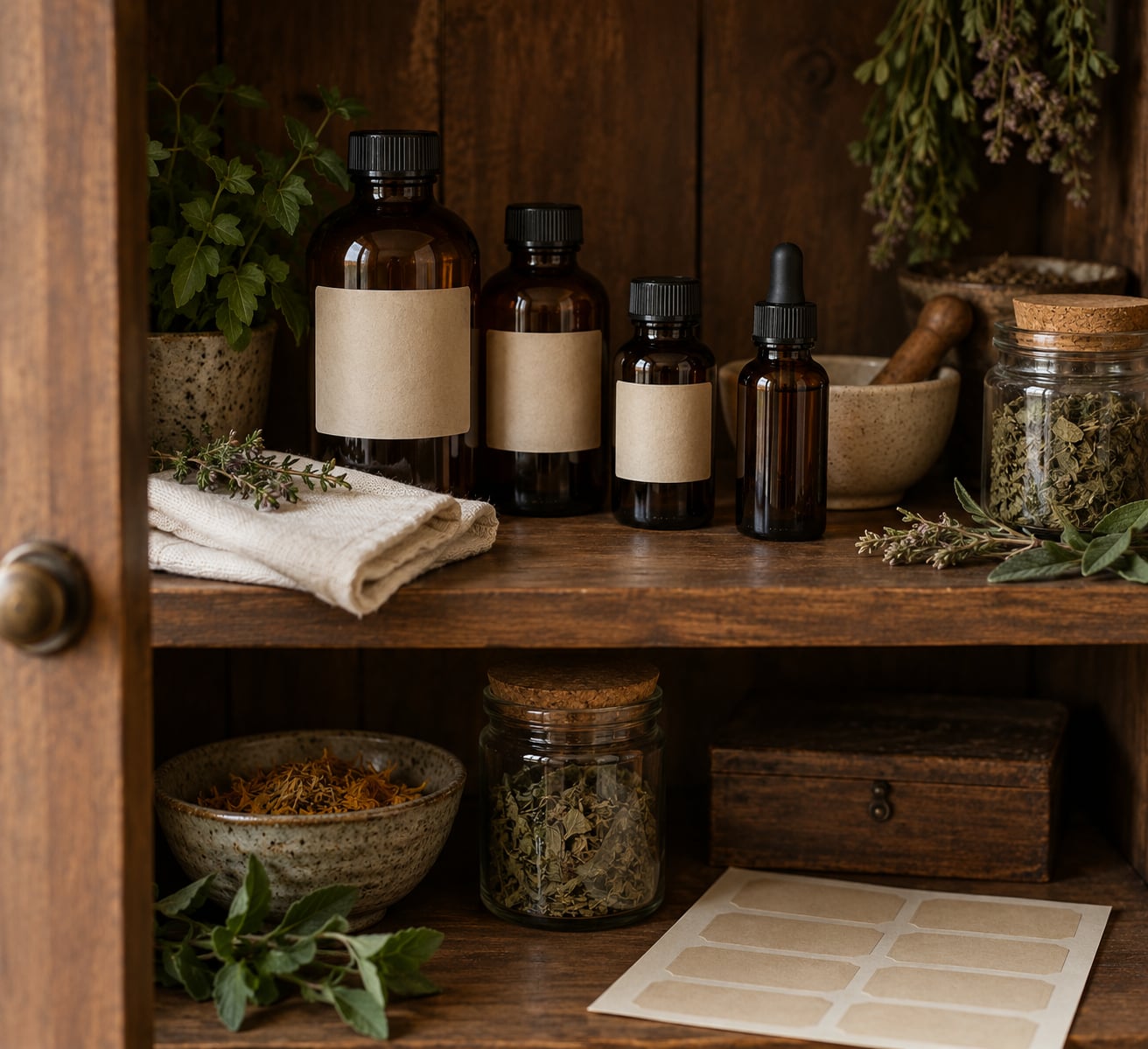
- Use amber or cobalt glass. Dark glass blocks the damaging end of the light spectrum. Clear glass lets a tincture fade on a windowsill in a fortnight.
- Choose screw caps over dropper tops for storage. Dropper bulbs and the liners inside them degrade as alcohol attacks the rubber and wax, and the seal fails quietly over years. Use dropper bottles for the bottle on the bench, screw caps for the shelf.
- Fill the bottle to the neck. Headspace is air the preparation will slowly react with. A bottle three-quarters full ages faster than a full one.
- Keep it cool, dark and steady. A closed cupboard away from the stove and the sun is better than a worktop. Large swings in temperature push condensation up into the neck.
- Label with the date, plant, menstruum and ratio. The date is what makes a decision possible three years later instead of a guess.
- Keep bottles sealed. Every time you dip a dirty dropper in and leave it standing, you are introducing water and microbes into a 40% solution that was designed to be stable.
One habit worth copying is rotating stock the way a kitchen does. Label the date, write the intended use on the front, and work through the oldest bottles first. People in home herbalism communities commonly replace their working tinctures on a two-year cycle even though five is achievable, simply because they prefer certainty over a year of declining strength.
If you are in a hot, humid or tropical climate, the maths changes. Aim for the coolest dark space in the building, and if that is a warm cupboard, a shaded lower shelf beats an upper one every time. A small insulated box or a conditioned store room buys more than a fan ever will. Watch the closures monthly in the first few months, because heat swells closures and pushes leaks, and heat cycling makes condensation that the alcohol then carries down the inside of the bottle.
Does Refrigeration Make Tinctures Last Longer?
For alcohol tinctures at 40% ABV or above, no. The alcohol is already doing the preserving, and a fridge mostly buys you a slower fade plus the cost of the space. Room temperature in a dark cupboard is fine.
Refrigeration matters for the preparations without preservative power. Glycerites, vinegar tinctures, oxymels and any tincture made from fresh plant material belong in the fridge, and their shelf life roughly doubles compared with a warm cupboard.
Two practical catches. Alcohol carries odour, so a fridge that also holds food will start tasting like last week’s tincture. And fridge condensation wets the label and creeps into the cap threads, so wipe bottles dry and check that the label is still readable. If you cannot tell when the batch was made from the label, you have lost the only piece of information that mattered.
What Signs Mean a Tincture Has Gone Bad?
Start from a baseline. The best test is knowing what the tincture looked and smelled like the day you made it, and comparing against that.
- Cloudiness that was not there before, especially if it appeared without sediment settling out beneath it.
- Mould, a film, or growth floating on the surface, whether fuzzy, white, green or dark.
- Sediment that keeps growing, turns slimy, or refuses to settle even after a week standing undisturbed.
- A colour change beyond ordinary fading, particularly darkening or a shift toward a different hue.
- An off smell: sour, vinegary, musty or faintly chemical compared with the sweet herbal smell you started with.
- A leaking bottle, a swollen closure, or gas that pushes liquid into the cap.
Do not taste a questionable tincture to check it. Smell is the reliable test, and once you have a suspicion you have your answer.
Not every change is a problem, and this is where people throw away good batches. A layer of fine sediment that sits still at the bottom after a few weeks is normal. Plant matter in a homemade tincture is never fully strained out, and members of r/bitters describe settling after a few weeks untouched as entirely routine. Shake it, let it settle again, and carry on if the liquid above clears.
Warning signs are cumulative, not individual. Slight sediment with the expected colour and smell is fine. Sediment plus cloudiness plus an off smell is not.
Can You Make an Old Tincture Last Longer?
Most of what determines shelf life is decided before the bottle exists. A few habits carry a preparation from two years into the five-year range.
Start clean
Dry jars and utensils completely, and run them through a hot soapy wash and a rinse before they touch plant material. Residual moisture in a supposedly 40% ABV tincture is exactly the small pocket a mould spore needs.
Extract twice, not once
Strain through fine muslin or coffee filter paper, then let the filtrate stand for several days so the finer particles drop out, and decant off the clear liquid above. That double pass removes sediment that would otherwise sit at the bottom of the bottle for years feeding whatever is present.
Keep the alcohol percentage honest
Measure it rather than guessing by bottle size, and remember that fresh material adds water as it macerates. Starting at 40% with fresh leaves and ending at 30% is common and is the reason many fresh-herb batches disappoint in year two.
Fill and seal properly
Top the bottle to the neck, use amber or cobalt glass, cap it with a screw cap and, if you want insurance, run the sealed bottle through a hot water bath as you would for jam. Wax seals on a screw cap also work well.
Label everything, then act on the label
Date, plant, menstruum, percentage and ratio. If you cannot read it, the batch is already a guess. For a home apothecary of anything wild-harvested, dated labels protect something you cannot replace quickly.
Rotate and use exhausted material
Work through the oldest bottles first. If a tincture has already gone most of its colour and its plant material has nothing left in it, some makers add fresh material and a little more alcohol to start a second extraction rather than discard it. The second pull is weaker than the first, so treat it as a gentle preparation rather than a replacement, and do not layer solvent over solvent indefinitely, since every addition of fresh material brings fresh water.
On long storage of delicate extracts, the freezer gets mentioned often in extract-making communities. Storage in the freezer is reported to extend shelf life considerably, though it suits resinous high-alcohol extracts better than low-alcohol ones and is not necessary for a well-made 40% ABV batch.
Know when testing is not sensible
There is no home test for how much potency a five-year-old tincture still holds. Anyone claiming to smell potency or run a quick assay on the kitchen table is guessing. Judge on spoilage signs, keep an honest date, and when in doubt make a fresh small batch rather than stretching an old one.
Frequently Asked Questions
Do homemade tinctures have an expiration date?
No. A homemade batch has no regulatory best-by date, because nobody tested or labelled it. The maker sets the date and tracks it, so label the bottle with the preparation date, the plant, the menstruum and the alcohol percentage the day you strain it. Most alcohol-based tinctures at 40% ABV or above stay usable for three to five years in cool dark storage, with well-preserved high-proof batches lasting considerably longer.
Is a tincture still good if it is several years old?
Often yes, and the honest answer is that age costs potency rather than safety. A four-year-old alcohol tincture at 40% ABV or above will usually still be sound if it looks clear or has only settled sediment, keeps its expected colour, and smells like it did when you made it. If you cannot recall what it smelled like, that missing baseline makes the judgement guesswork. Make a fresh small batch if you were relying on it for something important.
Should homemade tinctures be refrigerated?
Alcohol tinctures at 40% ABV or above do not need it. A cool dark cupboard is enough, and refrigeration mainly adds odour transfer to your food plus condensation on the label and cap threads. Glycerites, vinegar tinctures, oxymels and anything made from fresh plant material do belong in the fridge, because they have no real preservative action and their shelf life roughly doubles when kept cold.
What can I do if I do not know when a tincture was made?
Work backwards from evidence rather than assuming the worst. Check whether the liquid has a normal amount of settled sediment, whether the colour matches the plant you remember, and above all whether the smell is still the sweet herbal smell you expect rather than sour or musty. Alcohol strength narrows it further: anything above 40% ABV is very likely fine. If the bottle is unlabelled and smells off, discard it rather than guess.
Can sediment or cloudiness mean a tincture has spoiled?
Sediment usually does, cloudiness sometimes. Fine sediment that settles and leaves clear liquid above is ordinary in homemade tinctures because plant matter is never fully strained out. Cloudiness that does not clear after standing a week, sediment that keeps growing or turns slimy, mould, an off smell or a colour change beyond ordinary fading all point to spoilage. Do not taste a questionable bottle to check it. For personal safety questions, ask a doctor or pharmacist.
What to Do First
Pick up the oldest bottle on your shelf and look at it against the light. Clear colour, settled sediment, familiar smell means it is still fine and just weaker than it was. Cloudiness, mould or an off smell means it goes in the bin, and no amount of straining fixes that.
Then write a label on everything else: date, plant, menstruum, percentage. Move the non-alcohol preparations into the fridge, and swap dropper bottles for screw caps before they have a chance to fail on you.
For anything you are considering taking regularly, or any question about whether a specific plant or preparation is right for you, talk to a doctor or pharmacist rather than relying on a shelf-life chart.