If you have ever turned over a supplement bottle and wondered whether the phrase on the back actually means anything, you are not the only one. In plain terms, what does standardized extract mean on a label? It means the manufacturer guarantees a minimum amount of one chosen compound in every batch, checked by laboratory assay, so the number on the label repeats from bottle to bottle.
That guarantee is useful, and it is also narrower than most shoppers assume. A standardized extract tells you the extract hits a chemical floor. It does not tell you the product is safe, effective, or identical to anything used in a research study. Those distinctions matter more than the word itself, so this guide walks through what the term means, how it appears on a label, and where it stops being informative.
Table of Contents
- 1What Does Standardized Extract Mean on a Label?
- 2How to Read an Herbal Extract Label
- 3What Does Standardized Extract Mean on a Label in Practice?
- 4What Is Being Standardized?
- 5How Is an Extract Standardized?
- 6How Do Marker Compounds and Extraction Methods Affect the Label?
- 7Does Standardized Extract Mean Better or Safer?
- 8Standardized Extract vs. Nonstandardized Extract
- 9Questions to Ask Before Buying an Extract
- 10Frequently Asked Questions
- 11Is a higher standardization percentage always better?
- 12Should standardized and nonstandardized herbal extracts have the same effects?
- 13Does standardized extract mean the product has been clinically proven?
- 14Can I use two standardized herbal extract products together safely?
- 15What to Look for First
What Does Standardized Extract Mean on a Label?
A standardized extract is a plant preparation whose manufacturer guarantees a minimum percentage of one specific compound, called a marker, in every production batch. The manufacturer picks a constituent known to be present and predictable, sets a floor for it, then tests each batch by assay and releases only the batches that meet that floor. So a label reading standardized to 5% withanolides is promising at least 5% withanolides by weight of that extract, batch after batch.
Here is what the term does not do. It does not prove the product works. It does not prove the product is safe for you. And it does not mean the whole plant is present, because the rest of the phytochemical profile is neither listed nor guaranteed. Standardization is a consistency tool, not a verdict.
One more note on spelling. Labels, monographs, and search results mix the American standardized and the British standardised freely. They are the same idea, and we use both forms here.
How to Read an Herbal Extract Label
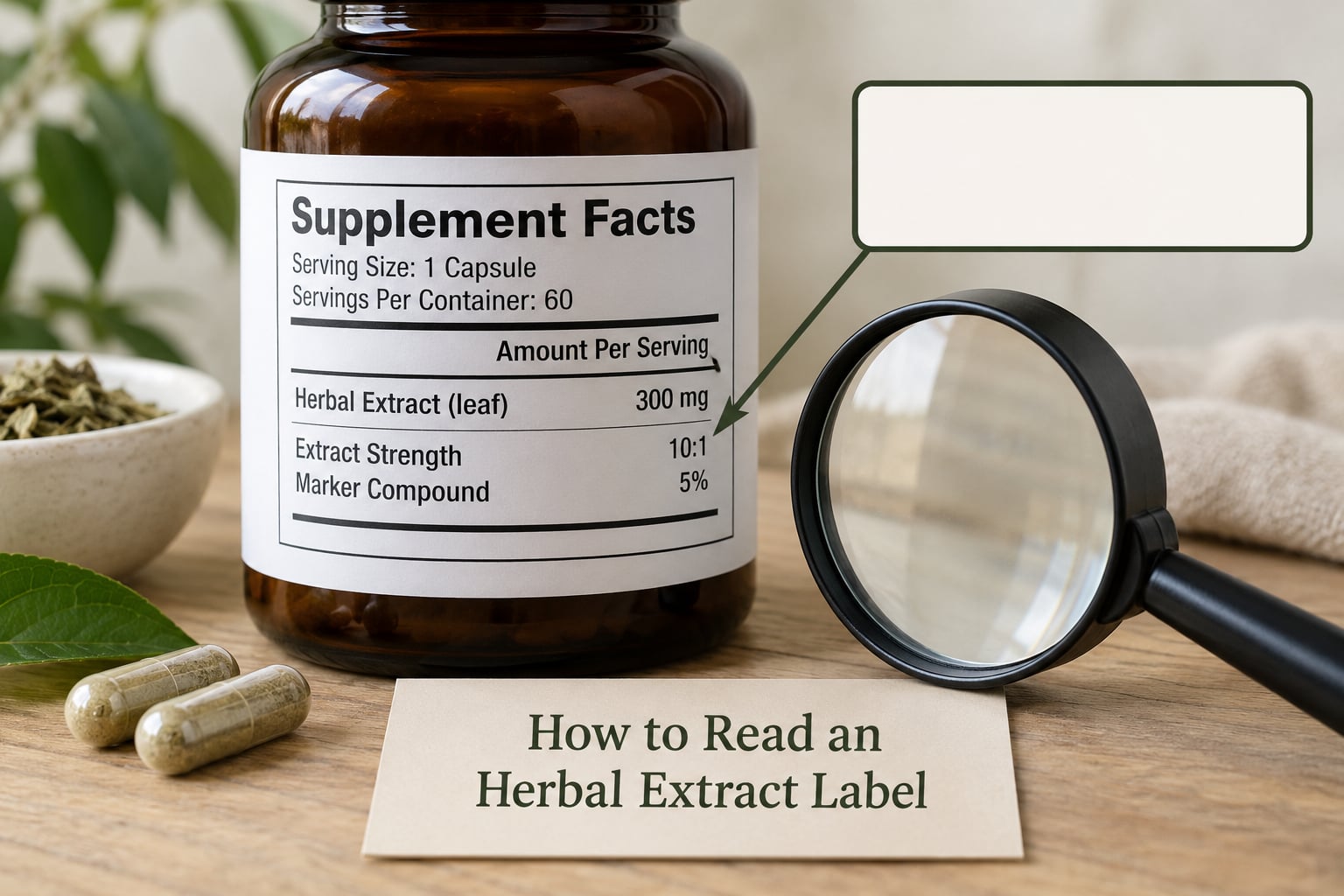
Most extract labels carry the same handful of fields. Reading them in order saves you from the commonest mistake, which is jumping to the percentage before you know what it is a percentage of.
- Plant name. Look for the full botanical name, not just the common name. Ashwagandha is sold as Withania somnifera, and the Latin name removes the guesswork.
- Part of the plant. Root, leaf, bark, seed, and aerial parts hold different chemistry and are used in traditional practice differently. A root-only extract and a leaf extract of the same species are not interchangeable.
- Extract type. Tincture, fluid extract, dry extract, and powdered whole herb all behave differently. Each delivers a different amount of plant material per gram.
- Extraction solvent. Water, alcohol, a water and alcohol mix, or glycerin pulls out different fractions of the plant. Labels usually say so somewhere in the ingredient list or the directions.
- Marker compound. This is the specific molecule the manufacturer guarantees, usually named directly in the standardization statement.
- Standardization percentage. The stated minimum, by weight, of that marker in the extract. A range is sometimes given instead of a single figure.
- Serving size and extract amount. The serving size is stated on the Supplement Facts panel, and the amount of extract per serving is what the percentage gets applied to.
- Lot number. A lot or batch code, usually printed on the base or side of the bottle. It is the handle that ties your bottle to a specific certificate of analysis.
- Directions, warnings, and certification marks. Usage directions, allergen statements, and any third-party certification marks usually sit on the back panel or the carton.
A labeled example helps. Suppose the panel says the serving contains a dry extract of Withania somnifera root, extracted with water and alcohol, standardized to 5% withanolides, 300 mg per serving. That single line gives you the plant, the part, the solvent, the marker, the floor, and the dose. Compare it with a rival label that lists only ashwagandha root extract at 300 mg and says nothing else, and you can see how little the second one lets you verify.
Which of those fields are required commercial information varies by country. The plant identity, net quantity, and directions come from labeling rules. The marker compound, percentage, lot number, and certification marks are mostly voluntary quality signals. When you see them, you are seeing a company choosing to show its work.
What Does Standardized Extract Mean on a Label in Practice?
Turn the percentage into a mass with simple arithmetic. A 100 mg portion of an extract standardized to 5% contains about 5 mg of that marker. A 500 mg portion of an extract standardized to 50% contains about 250 mg of the marker. Multiply the extract amount by the percentage, divide by 100, and you have the marker amount in front of you.
That calculation is genuinely useful and routinely over-read. It tells you how much of one named compound is in the extract portion of a serving. It says nothing about how much the extract as a whole contributes, what the other compounds do, or whether that marker amount is meaningful in a person. Treat it as a way to compare two labels honestly, not as a result.
What Is Being Standardized?
A marker compound is a chemical that is easy to identify and measure, and that shows up at a predictable level in good material. Manufacturers choose markers for practical reasons: a reliable assay method exists, the compound is stable through processing, and its level tracks the plant’s expected chemistry.
Active constituents is a broader, messier category. It covers every compound in the plant that has some biological activity, including many that were never measured and many that work in combination with each other. Standardization normally touches one or a few marker compounds out of that whole set.
This is where the trade-off sits. A standardized extract is deliberately narrowed. It reliably delivers its chosen marker, and it may drop or leave unquantified much of the phytochemical spectrum that traditional whole-plant preparations rely on. Ethnobotanical traditions have always used plant combinations and preparations rather than isolated marker targets, so narrowing is a real change in what the product is.
Percentages also do not travel between plants. Five percent of one compound in one species says nothing about five percent of another compound in another species, even when the number looks identical. Comparing products means comparing same plant, same part, same marker, same percentage. Anything else is a comparison of typography.
How Is an Extract Standardized?
The general sequence runs along these lines. This is an explanation of what happens, not a recipe to reproduce at home.
- Raw material identification. Incoming plant material is identified and checked against a reference, including species and part used.
- Initial testing. The harvested material is assayed to see what the marker level looks like before processing.
- Extraction. Solvent and process are chosen, which fixes which part of the chemistry ends up in the extract.
- Concentration. Solvent is removed to reach the target extract strength.
- Marker analysis. The concentrated extract is assayed against the chosen marker.
- Adjustment or selection. Batches below the specification are either blended with stronger material, reprocessed, or set aside.
- Finished-product verification. The blend is assayed again, and identity, contaminants, and adulterants are checked.
- Release. Only batches meeting the specification are given the standardization statement and a lot number.
The step that matters most for you is the last one. If the percentage was checked on the extract and not on the finished product, the number describes an intermediate, not what lands in the capsule.
How Do Marker Compounds and Extraction Methods Affect the Label?
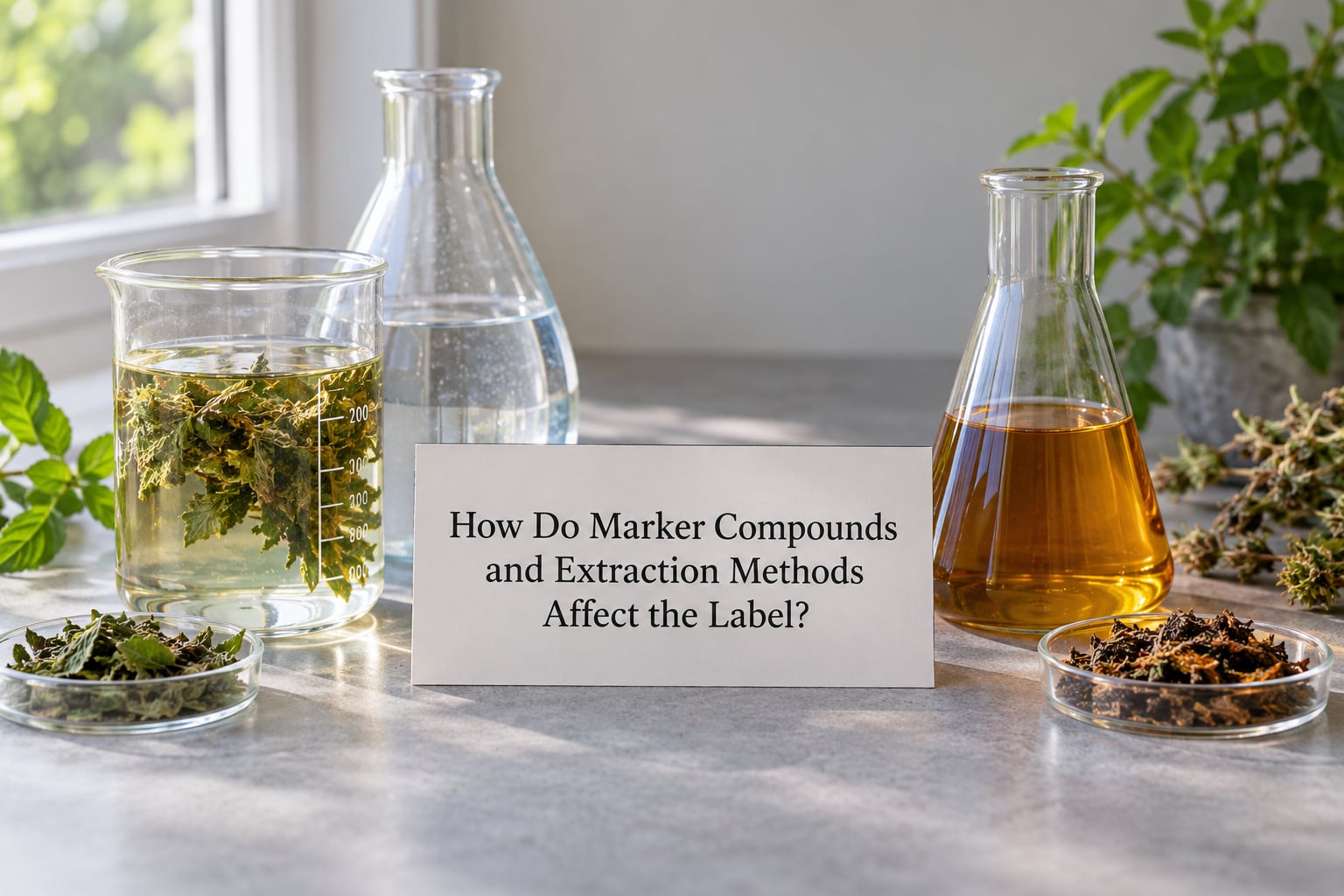
The extraction method decides which compounds are present in the extract at all, and the marker percentage then only describes a slice of that extract. Water pulls the more water-soluble fraction. Alcohol pulls more of the lipophilic fraction. A water and alcohol mixture, or a glycerin-based tincture, sits between them, and glycerin extracts tend to be lighter.
That is why a higher marker percentage is not automatically better. A very high percentage can mean the extraction method was highly selective and stripped the plant down toward one compound, which is a different product with a different profile rather than a stronger version of the same thing.
Extract ratios work the same way. A ratio written as 10:1 says roughly how much plant material went into producing a given weight of extract, so a 10:1 extract is more concentrated than a 5:1 one. Ratio and standardization are separate numbers answering separate questions: ratio describes concentration, standardization describes a measured floor for one compound. A bottle can carry both, either one, or neither.
Does Standardized Extract Mean Better or Safer?
No. Consistency is a narrower achievement than safety, and neither is the same as effectiveness. A standardized extract can be consistently dosed and still be the wrong choice for a particular person.
Identity testing asks whether the plant really is the plant named. Contaminant testing looks for heavy metals, pesticides, microbes, and residual solvents. Adulteration is a longer game in which a cheap plant is passed off as a dearer one, or a different species is substituted. Batch variation is the underlying problem standardization exists to solve, not something it eliminates on its own.
Two people can react to the same extract very differently, and concentrated marker compounds reach the bloodstream in a more predictable and sometimes larger amount than compounds arriving in a whole-plant preparation. Allergen statements, drug interactions, pregnancy and breastfeeding cautions, and conditions such as liver or kidney disease all belong on your reading list. So do the specific plant, the marker compound, and the solvent.
For anything that touches your personal medical situation, talk to a doctor or pharmacist rather than to a label. Seek prompt medical care for warning signs such as jaundice, dark urine, severe abdominal pain, unusual bleeding, swelling, or difficulty breathing after starting a supplement. This guide is general information about labels, not medical advice.
Standardized Extract vs. Nonstandardized Extract
| What to check | Standardized extract | Nonstandardized extract or whole herb |
|---|---|---|
| What the label tells you | A named marker compound and a minimum percentage by weight | Plant and part, sometimes with no chemical figure at all |
| Potential advantage | A repeatable amount of the marker across batches | A broader mix of the plant’s natural compounds |
| Main limitation | Other constituents are unquantified and may be reduced | Amounts of any single compound can vary widely |
| Best suited to | Comparing potency and matching research amounts | Traditional whole-plant preparations and blends |
| What you can verify | Marker, percentage, extract amount, lot number, certificate of analysis | Species, part, solvent, lot number if the maker publishes one |
Neither form is universally better. A whole-plant preparation with a named species, a stated part, and a clean solvent profile may be a better fit for traditional use than a hyper-concentrated single-marker extract, and a standardized extract may be the better choice when you need a repeatable figure. Attention to part of the plant, extraction method, dose information, and the manufacturer’s quality controls matters in both cases.
Questions to Ask Before Buying an Extract
Run through these before you commit to anything.
- Is the full botanical name and the plant part stated?
- Is the marker compound named, and is the percentage clearly tied to the extract rather than the capsule or the bottle?
- Does the label distinguish the extract amount from the filler and the raw plant amount?
- Is a lot or batch number printed, and can that lot be traced to a published certificate of analysis?
- Is third-party testing relevant and current, rather than a general promise printed on a different product in the same line?
- Are directions, warnings, and allergen information complete?
- Does the manufacturer explain the extraction solvent and the marker they chose?
Buy from sellers who make quality information accessible. A company that publishes batch-level assay results has nothing to hide, and a company that will not tell you what it assays, or on which lot, is telling you something too. Keep the certificate of analysis for your bottle rather than trusting a generic badge, since a certificate is only useful if it matches the lot in your hand.
Frequently Asked Questions
Is a higher standardization percentage always better?
No. A high percentage usually means the extraction was selective, leaving a product concentrated toward one marker compound while other constituents drop or become unquantified. Compare extracts by looking at the same plant, the same part used, the same marker, and the extract amount per serving. A lower, honestly declared percentage of a full-spectrum extract may suit a traditional use better than a very high single-marker figure.
Should standardized and nonstandardized herbal extracts have the same effects?
Not necessarily. The two are not simply weaker and stronger versions of one thing. A standardized extract reliably delivers its named marker in a repeatable amount, while a nonstandardized or whole-plant preparation carries a broader and less predictable mix of the plant’s compounds. If your goal is a repeatable figure, one suits it better; if your goal is traditional whole-plant preparation, the other does.
Does standardized extract mean the product has been clinically proven?
No. Standardization shows a manufacturer can hold a chemical floor from batch to batch. It says nothing about whether the product has been tested in people, at what amounts, or with what result. Published research on an extract usually used a specific preparation with its own ratio, part, and marker specification, so matching those details matters. Check independent study literature, and treat the word on the label as a consistency statement.
Can I use two standardized herbal extract products together safely?
Sometimes, but do not assume. Standardized extracts deliver predictable amounts of named compounds, and two of them can stack up on the same marker or push overlapping effects past what you intend. Overlapping markers, shared solvents, and added liver or kidney strain are the parts worth checking first. Bring both bottles to a doctor or pharmacist with their ingredient panels so they can look at the combined amount rather than each product alone.
What to Look for First
Start with identity, then strength, then proof. Confirm the botanical name and the part of the plant, find the extract type and the solvent, read which compound was standardized and to what percentage, and finally check the manufacturer, the lot number, and whether a current certificate of analysis exists for that lot. Once you know what does standardized extract mean on a label in those four steps, the marketing language on the front becomes much easier to discount.