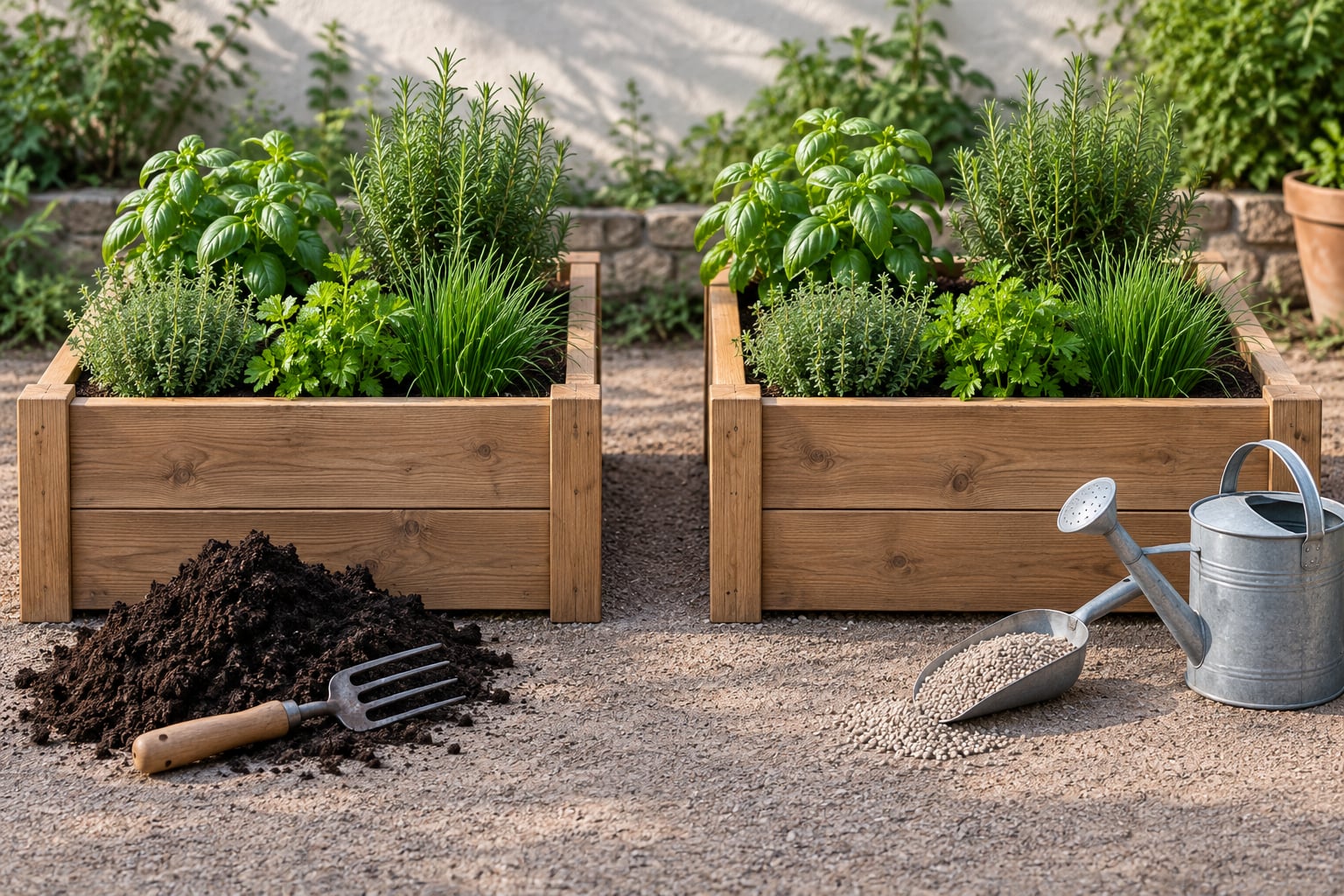
The organic vs conventional herb growing differences come down to what is allowed into the crop and on the soil, and what that means afterwards. Organic herb growing rules out most synthetic pesticides, herbicides and artificial fertilisers, and leans on compost, rotation and biological pest control. Conventional herb growing permits synthesised inputs applied during cultivation. Everything else, from residue load to labour, follows from those two definitions.
People argue about this as if there were one verdict. There isn’t, and anyone who tells you otherwise is selling something. A backyard grower with basil and mint can run either system successfully. A commercial herb operation faces a very different set of constraints, where certification and traceability matter as much as anything that happens in the field.
What this guide does is lay out the real differences one at a time, including the ones that are inconvenient for the organic side.
Table of Contents
- 1Organic vs Conventional Herb Growing Differences at a Glance
- 2What Is Organic Herb Growing?
- 3How Do Approved and Synthetic Inputs Differ?
- 4How Does Soil and Fertility Management Compare?
- 5What do organic vs conventional herb growing differences mean for soil?
- 6Which Approach Has Better Pest and Disease Control?
- 7Do Organic Herbs Taste Better or Produce More Yield?
- 8What Are the Labor, Cost, and Certification Differences?
- 9Which Approach Is Better for the Environment?
- 10Which Should You Choose?
- 11Frequently Asked Questions
- 12Are organic herbs more nutritious than conventionally grown herbs?
- 13Is organic herb growing easier for beginners?
- 14Can a home gardener become organically certified?
- 15Does conventional growing always mean pesticides are left on the herb?
- 16Which type of grown herb is safer to use medicinally?
- 17Conclusion
Organic vs Conventional Herb Growing Differences at a Glance
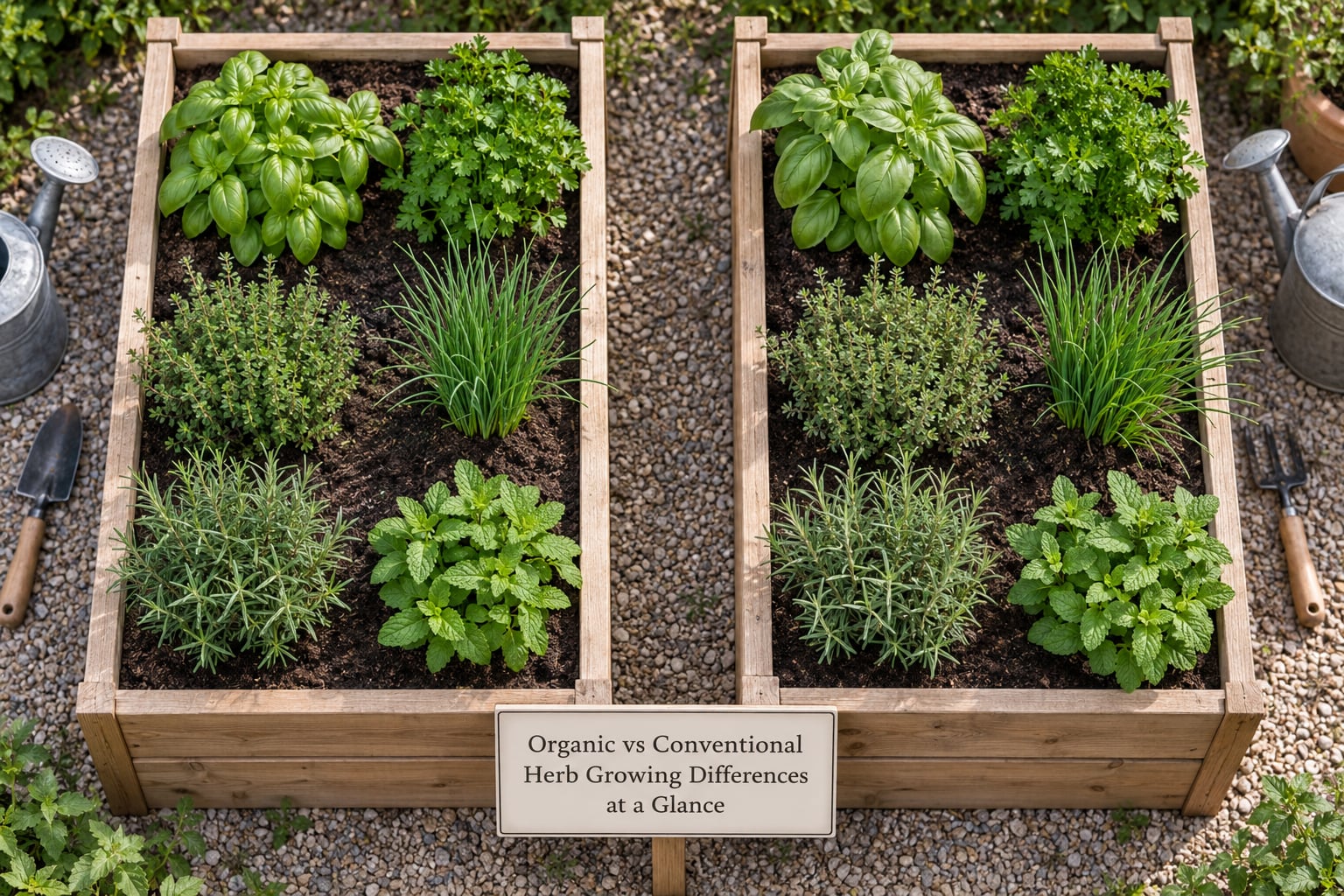
Certified organic growing restricts synthetic inputs and requires an audited record trail, while conventional growing allows a wider range of fertilisers and crop-protection products for faster, more predictable results. Neither approach guarantees better flavour, higher nutrition or lower cost. The right choice depends on your herb, your pest pressure, your labour budget and whether you need a certificate buyers will accept.
| Criterion | Organic herb growing | Conventional herb growing |
|---|---|---|
| Certification | Required for the organic label, with inspection and annual records | No certificate needed; input records may still be required for buyers |
| Fertiliser | Compost, manure, bone meal, seaweed, approved mineral sources | Water-soluble and controlled-release synthetic fertilisers are routine |
| Crop protection | Prevention first, then approved biological or botanical products | Scheduled or threshold-based applications of synthetic products |
| Weed control | Mulch, hand weeding, cover crops, flame weeding, approved herbicides | Herbicide sprays, tillage and hand weeding |
| Seed | Certified organic seed or organically grown seed, no GMOs | Any seed, including treated and GMO varieties |
| Transition | Usually 24 to 36 months before land qualifies as organic | None |
| Labour | More scouting, more weeding, more recordkeeping | Fewer hours on prevention, faster correction of problems |
| Cost profile | Higher per unit in labour and certification; inputs often pricier | Lower input cost per unit, higher intervention frequency possible |
| Yield consistency | More variable between seasons, wider swings in a bad year | Tighter, more predictable harvest weights |
| Traceability | Documented batch trail, useful for herbal trade and export | Depends on the buyer and supply chain |
| Best suited to | Certified producers, buyers of bulk dried herb, low-input home plots | Home containers, high pest-pressure crops, commercial volume |
What Is Organic Herb Growing?
Organic herb growing is the use of a defined standard, not just the absence of one product. Under a certification system such as the EU organic regulation or the USDA National Organic Program, a farm must operate under a written plan, keep inputs on an approved list, buffer from neighbouring conventional land, survive an annual inspection and record every input and harvest lot. The certificate follows the parcel and the crop, which is why it can be checked by a buyer who has never met the farmer.
Plenty of growers use what I would call organic-style methods without certifying. They build soil with compost, mulch heavily, grow flowers to host beneficial insects and hand-weed. The growing is genuinely different from conventional. The only thing missing is the paperwork and the audit, and without those, the harvest cannot legally be sold as organic in most markets.
That gap causes most of the confusion in the herbal trade. A bag of dried roots cannot be verified by smell or appearance. Buyers who care about how a plant was grown are relying on a certificate number or a supplier’s audit trail, not on the finished product.
It is worth being clear about one thing: avoiding all pesticides is not the same as following an organic standard. Pesticide-free is a narrower claim that says nothing about how fertility was managed or whether a crop was rotated. Some of the most sprayed crops in the world are grown with no synthetic pesticide at all, using synthetic fertiliser instead.
How Do Approved and Synthetic Inputs Differ?
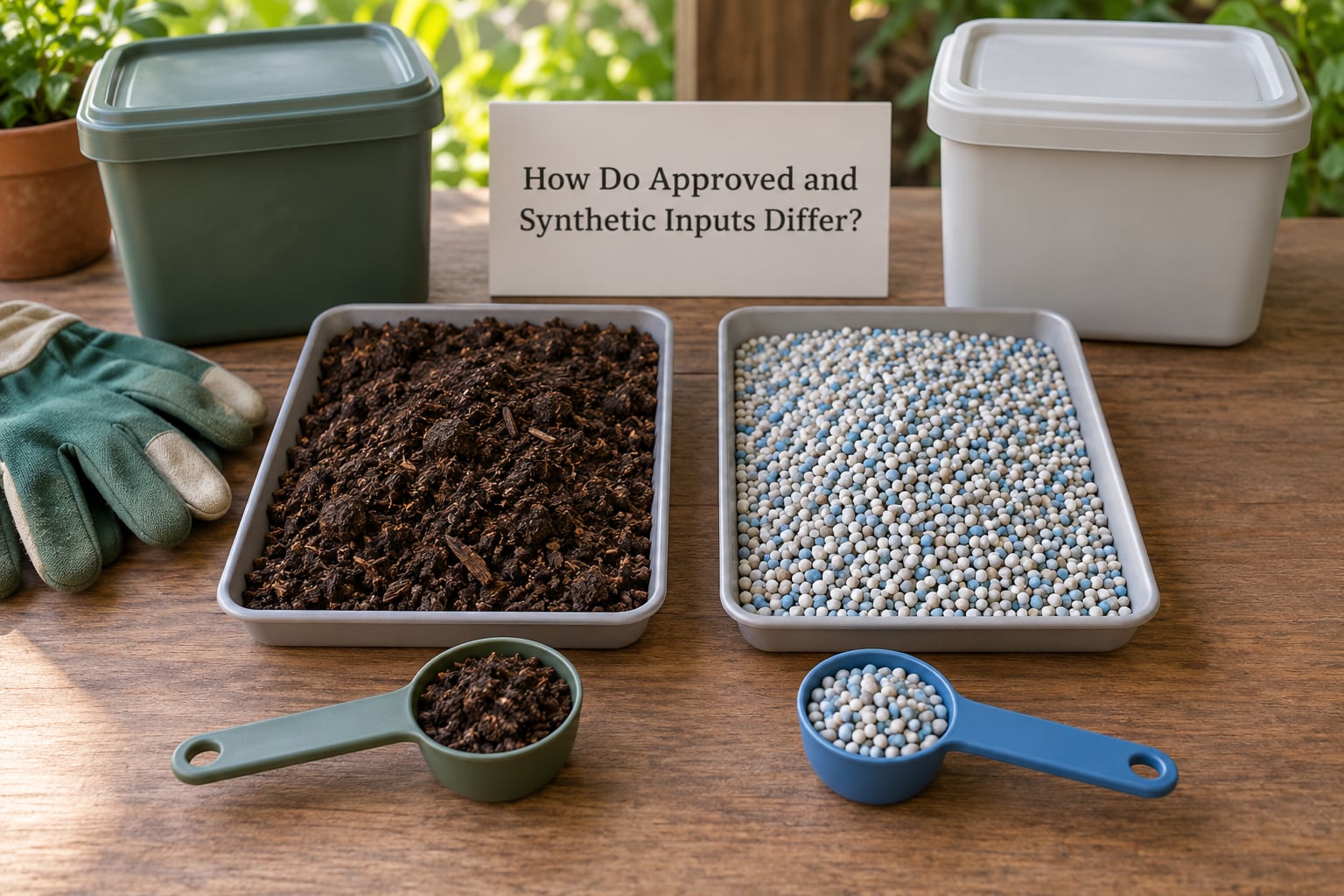
The fertiliser difference is the one most home growers notice first. Conventional practice leans on water-soluble and controlled-release products that deliver a known amount of nitrogen, phosphorus and potassium over a set period. Organic practice splits fertility across slower sources: compost, aged manure, bone meal, seaweed extract, rock phosphate and the occasional approved mineral fertiliser.
For nitrogen especially, there is no natural equivalent to a 46 percent urea prill. Organic growers get nitrogen slowly, from microbial activity breaking down organic matter, which means slow release, a cooler burn profile and a genuine risk of running short at peak growth.
Crop protection is where the rules get stricter. Synthetic products are excluded in organic systems, including most pyrethroids and neonicotinoids. What remains is a shorter list of biological controls, microbial products, insecticidal soaps, horticultural oils and a small set of botanicals. The list is not short enough to make decisions easy, and it is not generous enough to cover every problem.
Weed control follows the same logic. Mulching, hand weeding, cover cropping and flaming are the organic toolkit, with limited herbicide options for large plots. Conventional growers get a wider chemical palette, which is often the honest reason a herb operation chooses that system.
Residue rules differ too. Conventional production works to legal tolerance limits set by a regulator, which is not the same as zero. Organic production works to a stricter rule that restricts which substances may be used in the first place, rather than testing the harvest and comparing it to a limit. The permitted-input list also depends on the crop, the country and the certification scheme, so read the current list your certifier and extension service work from rather than a list written for a different region.
How Does Soil and Fertility Management Compare?
Conventional fertility management is essentially a delivery problem. You decide how much nutrient a crop needs per hectare, pick a product that delivers it, and correct the shortfall as it appears. Organic management is a soil-building problem. You add organic matter, grow something in between cash crops, and let the soil release nitrogen slowly through the season.
That difference shows up in three practical ways. Conventional nutrients arrive in a predictable burst, which suits fast greenhouse production and leafy herbs harvested every few days. Organic nutrients arrive gradually, which suits perennial herbs, woody cuttings and plants expected to sit in the ground for years.
Runoff and salt accumulation are the two costs that get discussed most. Repeated soluble fertiliser use raises the electrical conductivity of a substrate over time and pushes salt into the root zone, which is why soilless growers flush their systems. Surface-applied nitrogen on bare soil moves readily into drainage water. Compost-based systems reduce both problems, though a heavy application of fresh manure can still carry salts.
Claims about soil biology need the same scepticism as nutrition claims. Healthy organic systems do tend to carry more organic carbon and more active fungal and bacterial communities, but demonstrating a consistent yield advantage from that biology alone across climates and soils is difficult, and the honest position is that the evidence is suggestive rather than settled.
What do organic vs conventional herb growing differences mean for soil?
Mostly they mean slower release, fewer easy corrections and more long-term payoff. Organic fertility becomes stronger the longer you build it, since every compost cycle adds organic matter that mineralises each season. Conventional fertility can rescue a crop in a week, which is exactly what you need when a basil planting is two weeks from harvest. Whichever you choose, test the soil before you assume anything, since the gap between systems is smaller than the gap between a well-managed bed and a neglected one.
Which Approach Has Better Pest and Disease Control?
Neither approach eliminates pests or disease. That is the honest starting point, because much of the argument online comes from people who tried one system for a season and declared a winner.
Conventional growers can treat a problem quickly and get the harvest back. If aphid pressure hits a greenhouse basil crop near its cutting window, an approved spray can mean the difference between a saleable cutting and a destroyed one. The cost is that the treatment interval, re-entry period and harvest timing now sit between the grower and the finished product.
Organic growers cannot do that. In exchange, they can plant a diverse rotation, run insectary borders that host hoverflies and lacewings, use resistant varieties where they exist, keep spacing wide enough for airflow, remove infected material rather than composting it, and treat thresholds instead of calendars. Scouting walks become a routine rather than an option, and that is where the labour goes.
The practical outcome depends on the herb and the place. Where a crop has few resistant varieties and pressure is heavy, such as many commercial salad and herb crops, the conventional toolkit is a real advantage. Where the crop is a perennial with plenty of natural enemies nearby, the organic toolkit can match it.
Growers who run all three systems have described the trade-off plainly: organic gives the most pleasure and also the most headache. That framing is more useful than any general claim, because the headache is predictable and manageable. You will lose plants you would have saved. You will scout more often. You will choose the tolerable pest over the tolerable chemical.
Do Organic Herbs Taste Better or Produce More Yield?
On yield, conventional growing usually wins on consistency. Herbs fed with water-soluble fertiliser in a greenhouse grow faster and produce heavier, more uniform harvests, which is why greenhouse herb research keeps finding growth and shelf-life differences tied to fertiliser type. Perennial medicinal herbs on good soil are a closer call, and a well-built organic system on a diversified rotation can match or beat a thin conventional one.
On composition, the picture is mixed. Reviews of organic versus conventional cultivation in herbal plants report higher dry matter content in organically grown green leafy herbs, and many growers report stronger aroma and more bitterness. Dry matter matters because it concentrates everything else per kilogram, which affects both dosing and drying time.
The proposed mechanism is stress. A plant protected throughout the season by synthetic inputs invests less in chemical self-defence, while a plant under moderate, intermittent stress builds more phenolics and terpenes. It is a plausible and supported idea, not a certainty. Cultivar, water stress, harvest timing, day length, soil type, drying temperature and storage all move essential oil and polyphenol levels as much as the production label does, and frequently more.
Much of the enthusiasm out there rests on laboratory work. Measuring antioxidant capacity or salvestrol content in a dish is not the same as demonstrating a health benefit in a person, and no established cancer claim follows from either cultivation system. What you can say without overreaching is that organic herbs often carry more of their own defence chemistry and leave less synthetic residue on the leaf, and that neither fact settles the nutrition argument.
Two concrete notes on practical quality. First, bitterness and astringency in organic herbs often read as stronger flavour to a cook and as superior quality to a tea blender, but it is a concentration effect, not a free upgrade. Second, drier material holds its volatiles better, so herbs with higher dry matter often store longer, which matters far more for a dried-herb seller than for someone growing a windowsill pot.
What Are the Labor, Cost, and Certification Differences?
Organic production carries costs that are easy to miss. A certified operation pays inspection and certification fees, spends administrative time on input records, buffer zones and harvest logs, and often carries higher purchase costs for compost and approved inputs. The land itself usually has to go through a transition period, commonly 24 to 36 months, during which it can be farmed conventionally but not sold as organic. That is a substantial cost for a smallholder who cannot simply absorb two years of lower returns.
It is also why informal organic-style growing is so common, and why the word organic means wildly different things on different bags. Community-harvested material and wild-collected herbs present a further distinction. A wild-collected plant may never have seen a fertiliser, or may have come from land treated by a neighbour. Certification schemes for wild collection exist precisely because that uncertainty cannot be resolved by looking at the product.
Conventional production pays less in fees and paperwork and more in input volume, with a different rhythm of spending: cheap products, applied often, bought continuously.
Labour is the line most growers quote first. Organic means more weeding, more scouting and more recordkeeping, spread across the season. Conventional means fewer prevention hours and more intervention hours at the worst possible time, when a crop is already under stress. If you are doing this alone on a small plot, that arithmetic often decides the question before taste ever enters it.
Which Approach Is Better for the Environment?
Organic systems generally reduce synthetic pesticide load, which limits exposure for farm workers, neighbouring households and non-target insects, and slows the development of resistant pest populations. They also build organic carbon, keep living roots in the ground for more of the season, and reduce nitrate leaching relative to heavy soluble nitrogen use.
Organic is not impact-free. Where yields drop, the same tonnage of herb comes from more land, and more land means more clearing, water and transport. Higher labour demand has an energy cost of its own. Some organic-approved products are not automatically benign for soil life, and compost production can involve meaningful emissions depending on the material and the process. Organic wine, tea and herb operations have also been criticised for accepting food-safety shortcuts in the name of a label.
Conventional systems have their own environmental record: efficient fertiliser use has cut fertiliser per unit of food produced substantially over the past half century, and greenhouse herb production can be very land-efficient. Their risk profile leans on containment, because runoff, drift and resistance are the failure modes. Neither system wins on a single metric, which is why claims of a universally greener choice should be treated carefully.
Which Should You Choose?
For containers, a windowsill or a small kitchen plot, grow the way that is easiest for you to maintain. A healthy basil in a pot that gets daily attention beats a certified organic basil that dried out for a week. Most home growers do not need certification at all, because nobody is paying for the label.
For a plot larger than a few square metres, if you already compost, mulch and rotate, an organic-style system is realistic and gets cheaper each season as the soil improves. If you are starting from poor soil, under real pest pressure, or trying to hit a hard harvest window, conventional inputs are a legitimate tool rather than a failure of commitment.
For commercial and medicinal supply chains, traceability usually matters more than philosophy. If you sell dried herb, roots or bark wholesale, or if buyers need residue compliance documentation, certification is not optional. Buy from suppliers who can show an audit trail rather than a self-declared natural label, and treat wild-collected material as a documented provenance question, not a purity upgrade.
For readers worried about medicinal purity, the things worth checking are residues on the harvested leaf, correct identification of species, and clean drying and storage, because a contaminated drying shed undoes careful growing. Check the rules that apply where you live, and talk to your local extension service or certifier before committing.
Frequently Asked Questions
Are organic herbs more nutritious than conventionally grown herbs?
The difference is real but small and inconsistent. Trials find organic leafy herbs with higher dry matter and sometimes higher antioxidant capacity, but the gaps shrink once cultivar, soil, water and harvest timing are accounted for. Nobody has shown that eating organic herbs improves health outcomes in people. Judge herbs on freshness, correct identification and clean handling first, and treat the organic label as a secondary signal.
Is organic herb growing easier for beginners?
It is easier in the sense that you start with fewer things to learn about sprays and intervals. It is harder in practice, because you rely on scouting, spacing, airflow, rotation and soil building instead of correcting problems quickly. Beginners who follow a prevention-first routine usually succeed in both systems. Beginners who try to rescue a bad crop with organic-only tools often give up early.
Can a home gardener become organically certified?
Usually not for a backyard plot. Certification is designed for commercial production and requires an inspector, buffer zones from neighbouring conventional land, approved inputs and records for every lot. Smallholder groups and cooperatives can often share certification costs, and some programmes support lower-income producers through funded inspections. If you simply want to avoid synthetic inputs, you can grow that way without any certificate, you simply cannot sell the harvest as organic.
Does conventional growing always mean pesticides are left on the herb?
No. Residues are governed by legal tolerance limits set by a regulator, and conventional production is tested against those limits. Some conventionally grown herbs sit well below the threshold, especially in crops that receive few treatments. Drying and storage also change residue levels, and dried products can concentrate what remains. If residues matter to you, ask your supplier for recent test results instead of assuming from the label.
Which type of grown herb is safer to use medicinally?
Neither system guarantees a safe medicine. Species identification, correct dose, contamination of the raw material, and preparation method all affect safety far more than the growing system. Organic or wild-collected material can still be misidentified, adulterated or harvested from contaminated ground. If you take herbs alongside prescribed medicine, or you are pregnant, breastfeeding or managing a long-term condition, ask a pharmacist or qualified clinician before using any herbal remedy.
Conclusion
Start where the argument is least theoretical: test your soil, then decide whether you can realistically scout and weed often enough to make prevention work. Grow that way for a season and keep notes on labour hours and harvest weight, because those two numbers tell you more than any argument online. If you plan to sell dried herb or need a certificate, choose organic early, since the transition period cannot be compressed.