If you have ever wondered how long to steep different herb parts, the short answer is simple: soft parts go in last and come out fast, dense parts take heat and patience. Leaves and flowers usually need a covered steep of 5 to 10 minutes, while bark, roots, seeds and dried fruit want 10 to 25 minutes of gentle simmering instead. Those are starting points, not rules.
Before any number matters, you need to know which plant you are holding and which part of it you are holding. A jar of unidentified “root powder” is not a steeping question. It is a safety question. Once the plant and the part are settled, timing becomes a manageable adjustment rather than a guess.
I have burned my share of cups on the kitchen counter, and almost every disappointing batch traced back to one of three things: too little plant material for the water volume, one timer used for a root and a flower together, or an uncovered cup that let the aroma walk out the door. The rest of this guide is how to fix those three things and nothing more.
This is preparation information for cooking and traditional use. It is not medical advice, and it does not cover dosing for treatment of any condition. If you are pregnant, breastfeeding, taking medication, or considering a plant you have never used before, ask a doctor or pharmacist first.
Table of Contents
- 1How Long to Steep Different Herb Parts at a Glance
- 2What Is the Difference Between Steeping and Simmering?
- 3How Long Should You Steep Leaves and Flowers?
- 4How Long Should You Simmer Bark, Roots, and Seeds?
- 5How Do You Steep Herb Parts Safely?
- 6What Factors Can Change the Steeping Time?
- 7How Long to Steep Different Herb Parts When the Cut or Age Varies
- 8Water, Vessel and Altitude
- 9Can You Steep Different Herb Parts Together?
- 10What Should You Do If a Preparation Seems Too Strong?
- 11Frequently Asked Questions
- 12How long should leaves be steeped?
- 13How long should roots and bark be simmered?
- 14Can flowers be steeped longer than leaves?
- 15Is it safe to steep herbs overnight?
- 16Should I cover herbs while they are steeping?
- 17Does steeping longer make herbal tea stronger?
- 18What to Do First
How Long to Steep Different Herb Parts at a Glance
The table below is the reference most people are looking for. It lists general starting points by plant part, with the method that suits each tissue type. Treat every time as a starting point you adjust after tasting.
| Plant part | Examples | Water temperature | Time | Method |
|---|---|---|---|---|
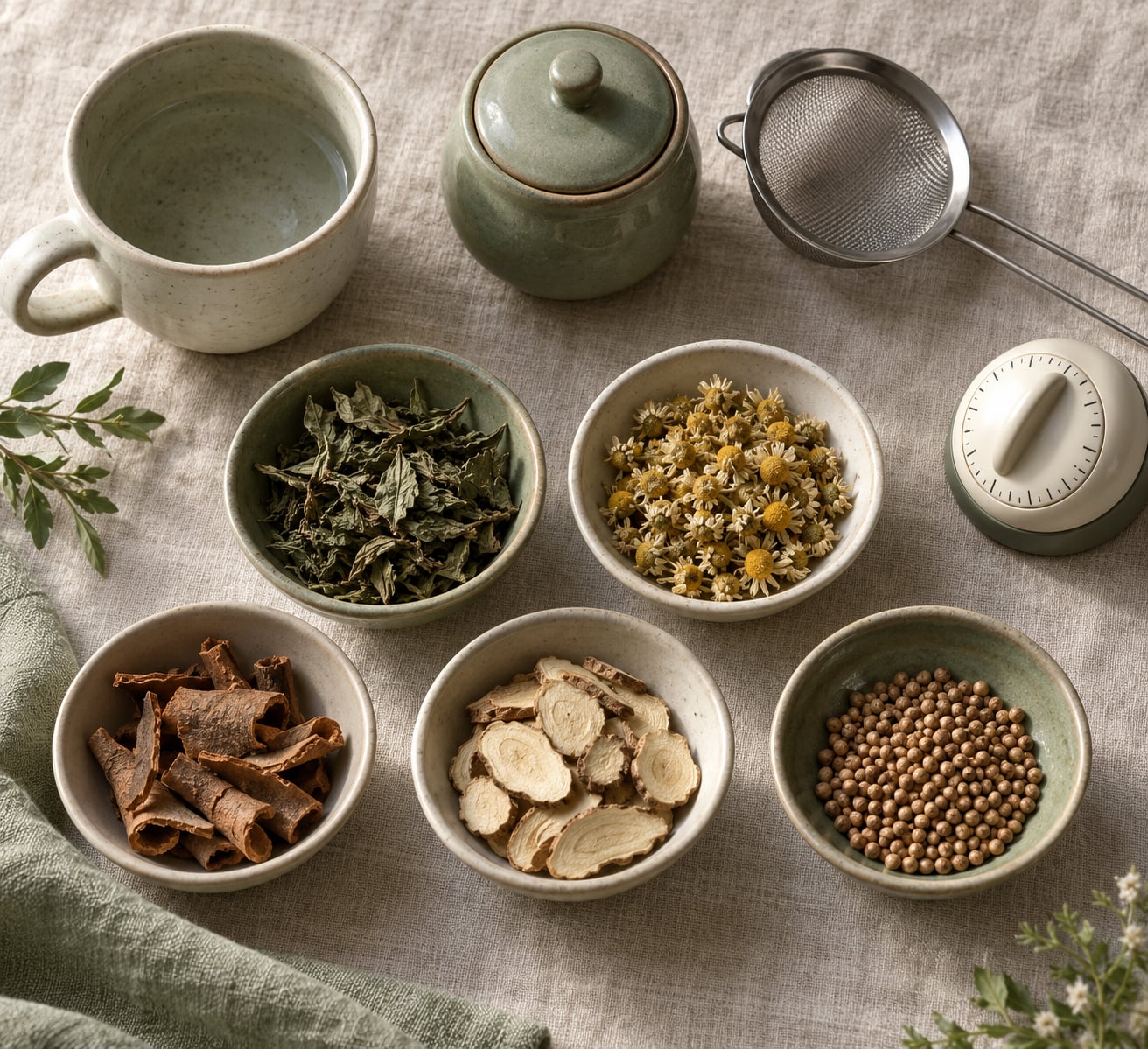
| Flowers and petals | Hibiscus calyces, chamomile, lavender | 93-96 C / 200-205 F | 5-10 minutes | Covered infusion |
| Leaves and needles | Rooibos, lemon balm, peppermint, green tea | 90-96 C / 195-205 F | 5-10 minutes | Covered infusion |
| Fresh leaves | Mint, lemongrass, basil | Near boiling / 205 F | 3-5 minutes | Covered infusion |
| Dried fruit and husks | Hibiscus whole, rose hip, cascara hulls | 96 C / 205 F | 10-20 minutes | Covered infusion or light simmer |
| Rhizomes and dense roots | Ginger, turmeric, dandelion root pieces | Rolling simmer | 15-25 minutes | Decoct, covered |
| Bark | Cinnamon, cinnamon-bark blends, willow bark in food use | Rolling simmer | 15-25 minutes | Decoct, covered |
| Seeds | Fennel, anise, coriander, cumin | Lightly crushed, then simmer | 10-20 minutes | Crush first, then decoct |
| Mucilaginous parts | Marshmallow root, baobab fruit pulp, flaxseed | Cold water | 4-12 hours | Cold infusion |
| Mixed parts | Any blend of the above | Depends on the densest part | Follow the slowest part | Decoct the dense parts first, then add the soft parts |
Two things in that table deserve emphasis. First, water temperature matters less than people assume for leaves and flowers, and matters a great deal for bark and root. Second, a cold infusion is not a lazy option; for mucilaginous material it is the correct method.
What Is the Difference Between Steeping and Simmering?
Steeping and simmering differ in one variable only: whether the plant material sits in still water or in water that is moving and staying below a boil. That single difference decides which plant parts you can prepare at all.
An infusion is hot water poured over the material, with no simmer. It works for anything with a thin, soft, aromatic structure because the water itself does the extracting. A decoction puts the material in cold water and brings it to a simmer for a set time, which suits woody, dense or starchy parts. A cold infusion uses fridge-cold water over many hours and pulls the gentlest profile.
You will see confident sources recommending full boiling water and equally confident sources insisting on 70 to 82 C / 160 to 180 F. Both are working from a real effect. Boiling water extracts more of the bitter and astringent compounds quickly, which suits a traditional decoction and makes a brisk black-green tea. Cooler water protects volatile aromatic compounds that boil away, which suits flower and leaf infusions where aroma is the point. The rule most herbalists settle on is to match the method to the part rather than pick a temperature once and never vary it.
Covering is the second argument. A cover traps volatile compounds in the cup, which helps mints, lemon balm and resinous leaves. Leave aromatic herbs uncovered when the aim is a light, purely drinkable cup, and keep the cover on when you want a full-bodied infusion. Practitioners split on this, and the disagreement is genuine rather than a failure to read the instructions.
If you want the wider vocabulary before going further, our notes on herbal safety basics cover how traditional preparation differs from concentrated extracts.
How Long Should You Steep Leaves and Flowers?
Leaves and flowers need 5 to 10 minutes as a covered infusion in water just off the boil, or 3 to 5 minutes for fresh material. That range holds for hibiscus calyces, chamomile flowers, rooibos needles, lemon balm and most kitchen herbs. Past about 10 minutes an uncovered cup is losing aroma fast, and bitterness builds whether the lid is on or off.
Soft aerial parts have a large surface area relative to their mass, so they give up their compounds quickly. You can watch it happen: the colour in the water runs deep within the first two minutes for rooibos and hibiscus, then deepens only slowly after that. That first surge is most of what you want.
Fresh and dried are not a straight swap. Dried material has lost its water, so a heaped teaspoon of dried leaf gives you far more plant than a similar-looking spoon of fresh. Many traditional preparations use roughly a third to a half as much fresh herb as dried and shorten the steep slightly. If your fresh cup tastes thin, the amount is the first thing to adjust, not the clock.
Two special cases sit inside this range. Very aromatic leaves such as peppermint and lemon balm taste harsh past 10 minutes because their essential oils keep coming. Bland leaves such as rooibos tolerate longer and reward 10 to 15 minutes in a pot rather than a cup.
How Long Should You Simmer Bark, Roots, and Seeds?
Bark, roots and seeds generally want 10 to 25 minutes of gentle simmering with a lid on, started in cold water so the heat reaches the inside of the piece. A covered infusion rarely extracts enough from these parts, which is why a thin root slice can leave you with a pale cup that tastes like hot water.
Think about what you are dealing with. Bark and dense roots contain woody tissue built with lignin, which resists water penetration. Seeds carry concentrated essential oils locked inside a hard coat and usually need to be split first. Starting them in cold water and bringing them up to a simmer lets heat and water work together from the inside out, instead of shocking a hard exterior that never gets wet through.
Within the root category, thickness changes the time as much as the part does. Thin slices of licorice root or a cut turmeric coin give up their contents in 10 to 12 minutes; a thick chunk of the same root can still be sitting there at 25. Roughly double the time for pieces more than about 1 cm thick, or cut them smaller. Dandelion root is a good case: roasted root slices behave differently from a whole dried taproot, and the whole root needs the longer end of the range.
Mucilaginous material breaks the pattern entirely. Marshmallow root, baobab fruit pulp and flaxseed produce their slippery, soothing texture only through a long cold soak, usually 4 to 12 hours in the fridge. Heat can flatten the effect you are after, so the simmering ranges above do not apply.
Across African, South Asian and Latin American traditions, the same principle holds across hundreds of preparations. Ginger rhizome, cinnamon bark and hibiscus calyxes are decocted or soaked hot in their documented traditional forms; rooibos needle leaf is poured with hot water and steeped. The plants differ, the timeline logic does not.
How Do You Steep Herb Parts Safely?
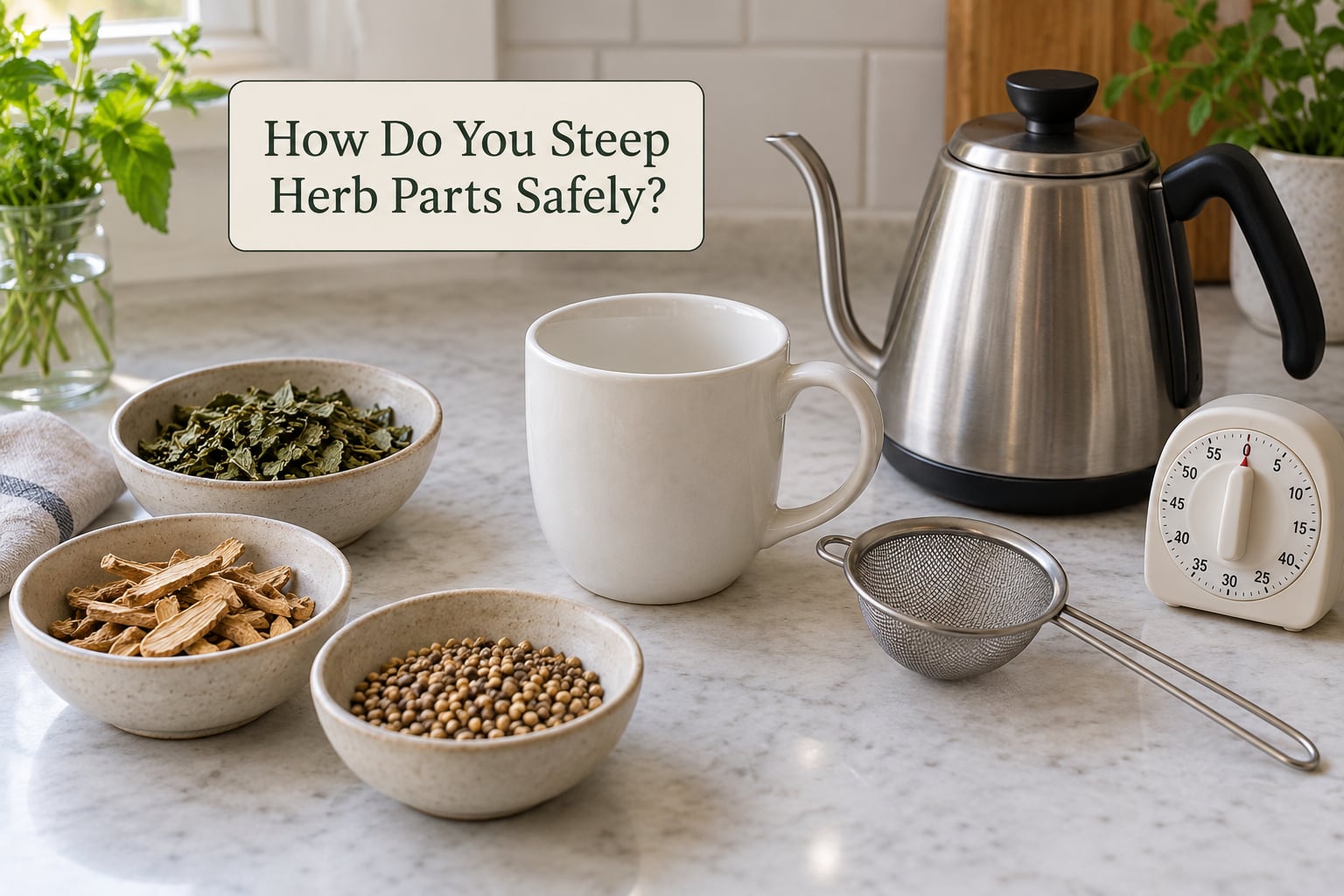
A safe preparation has a fixed order, and skipping the first step invalidates everything after it. Use this as the framework for both infusions and decoctions.
1. Identify the plant and the part. Confirm the botanical name and the part you are holding. Look-alike confusion is the most common serious problem in home herbal preparation.
2. Check the material itself. Look for mould, damp clumps, an off or musty smell, or a seal that has been broken. Smell is a genuinely useful test here; dusty, flat or stale aroma means the material has lost most of what you came for.
3. Work with clean equipment. Rinse the pot, the strainer and the cup. Use filtered water if your tap water tastes strongly of chlorine or minerals.
4. Measure by volume and weight. A heaped tablespoon of coarse cut material per 250 ml is a common starting ratio. Do not use an eyeballed teaspoon in an oversized mug; that is the single most common reason a cup comes out watery.
5. Time from the moment the water reaches temperature. For an infusion, that is the moment you pour. For a decoction, that is the moment you bring it to a simmer. Set a timer rather than trusting memory.
6. Strain while hot. Do not leave the plant material sitting in the cup. Anything still in contact with water keeps extracting.
7. Label anything you keep. Write the plant, the part, the date and the method on a cold infusion jar. Unlabelled cold infusions are how people accidentally drink a preparation twice.
8. Stop if something goes wrong. If a preparation causes nausea, dizziness, itching, swelling or any breathing difficulty, stop using it and seek medical care rather than trying to brew it differently.
What Factors Can Change the Steeping Time?
The part of the plant sets the baseline, but five or six other variables move the result far more than most people expect. Get these straight and you can adjust any recipe without guessing.
How Long to Steep Different Herb Parts When the Cut or Age Varies
Particle size is the biggest lever. The same licorice root sliced thin, cubed and powdered extracts in minutes rather than half an hour, because breaking the cell wall increases surface area. Whole pieces want the top of the range; fine cuts want the bottom. Drying also concentrates everything, so older, more brittle material generally gives up its compounds faster than material that was dried quickly and kept airtight.
That last point is why a traditional decoction often runs long in an old recipe but produces a thin cup today. The plant has less left in it, so it needs more extraction time to yield the same cup.
Water, Vessel and Altitude
Water chemistry matters. Hard water slows extraction and dulls aromatics; soft water lifts flavour faster. A wide pot returns heat to the surface and keeps a longer steep moving, while a narrow mug cools quickly and slows things down. An insulating preheated vessel effectively extends the steep.
Altitude shifts the boiling point, roughly one degree Celsius lower per 300 m of elevation. In high-altitude towns the same kettle produces cooler water, which is one reason mountain tea traditions often extend their times. If your cups consistently come out weak, check your elevation before you blame the herb.
Can You Steep Different Herb Parts Together?
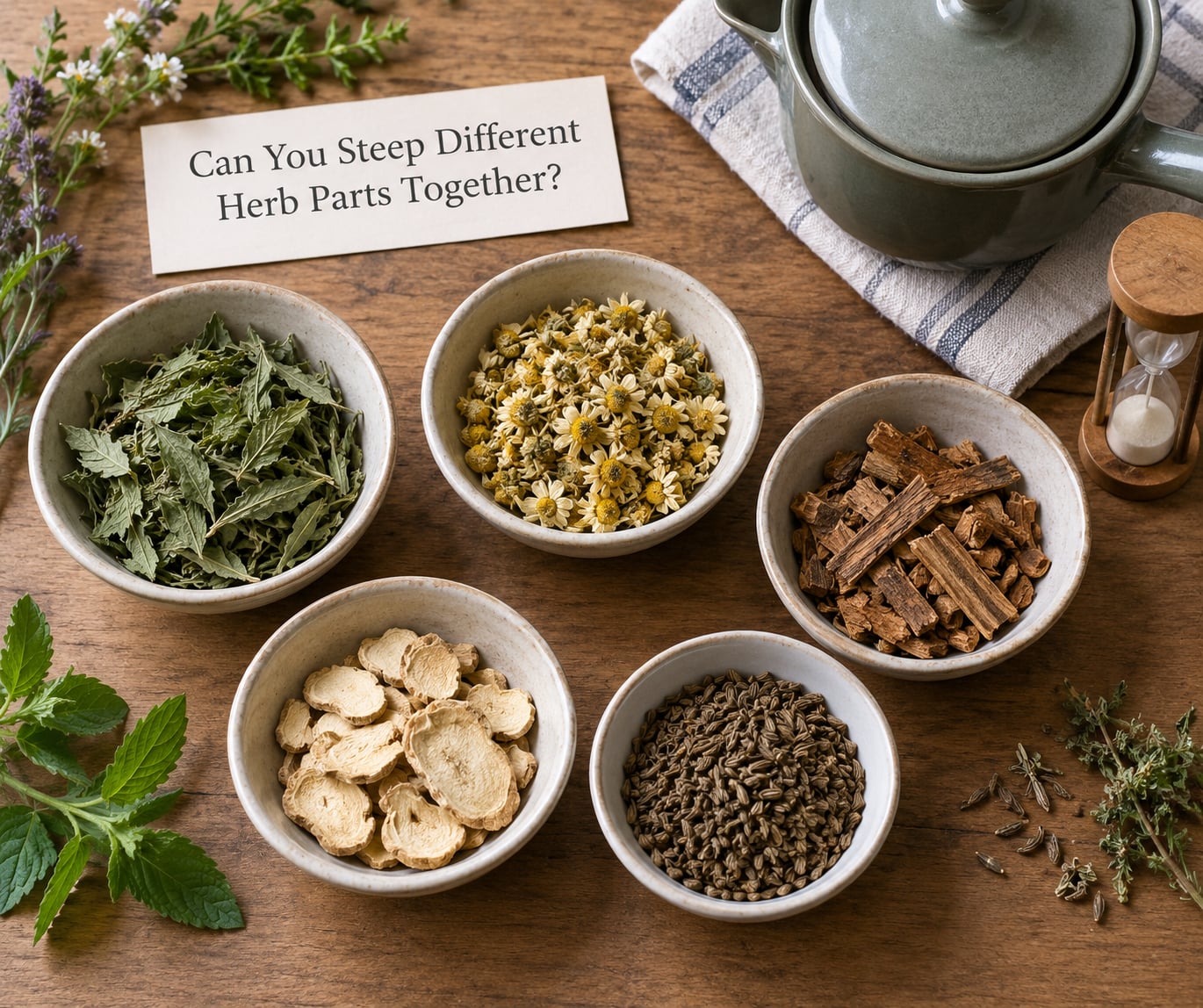
Yes, but mixed preparations need a separate timing decision for each part, not one shared timer. The working rule is that the blend finishes when the densest part in it has finished.
Decompose the blend. Simmer the bark, root, seed and dried fruit components first for 10 to 25 minutes. Turn the heat off, add the leaf and flower components, cover the pot, and let the whole thing stand for 5 to 10 minutes more. The soft parts get their time in hot water without being cooked, and the dense parts get the sustained heat they needed. This is the classic infusion-decoction blend and it works far better than pouring boiling water over everything at once.
Where tradition documents a fixed combination, use that combination. Do not improvise with unidentified or potentially toxic plants, and do not add a plant to a blend simply because it seems mild; some of the most concentrated preparations in traditional practice are the least forgiving.
Long cold steeps of 4 to 24 hours have a real following, and cold water is arguably the gentlest extraction available. What matters is that this is a deliberate method with a clean container and a known plant, not a way to make a failed hot brew stronger.
What Should You Do If a Preparation Seems Too Strong?
If a cup tastes too strong, bitter or astringent, dilute it before you throw it away. Add hot water in the cup, a third at a time, and taste again. This is the fastest fix and it costs nothing.
For the next cup, use less material rather than less time. Halving the quantity of root while keeping the simmer time protects the extraction you wanted and removes the harsh edge. Shortening the time works for leaves and flowers, where bitterness comes from continued contact.
One more caution: strength and safety are not the same axis. A pale cup is not proof of a safe preparation, and a dark, bitter one is not proof of a dangerous one. Appearance and taste tell you about extraction, not about whether a plant is right for you. That question belongs with a doctor or a qualified practitioner.
Frequently Asked Questions
How long should leaves be steeped?
Most dried leaves are used as a short covered infusion, often for about 5 to 10 minutes, and fresh leaves for 3 to 5 minutes. The correct time depends on the plant and the preparation rather than on a fixed number. Rooibos tolerates closer to 10 to 15 minutes in a pot, while peppermint and lemon balm can turn harsh past 10. A traditional source or a product label should take priority over any general range.
How long should roots and bark be simmered?
Roots and bark are generally prepared as decoctions because their dense, woody tissues may not extract well in a brief infusion. A general starting point is often 10 to 25 minutes of gentle simmering with a lid on, started in cold water. Thick pieces need longer than thin slices of the same root. Documented preparation instructions from a traditional or clinical source always outrank a general figure.
Can flowers be steeped longer than leaves?
Not necessarily. Flowers are often delicate and can become bitter or overly aromatic with a long steep, so many are infused for roughly 5 to 10 minutes. Hibiscus calyces are an exception and are frequently soaked for 10 to 20 minutes in a wide range of traditional drinks. The correct method depends on the species, the part used and the preparation the source documents.
Is it safe to steep herbs overnight?
Overnight soaking is not automatically safer or stronger, and a warm preparation left sitting can encourage microbial growth. Cold infusions of 4 to 12 hours in a refrigerator are a legitimate method for mucilaginous material such as marshmallow root or baobab pulp. Use a clean container, keep it refrigerated, and follow a reliable recipe or label. If no source specifies a time, treat an overnight steep as improvisation.
Should I cover herbs while they are steeping?
A cover traps volatile compounds and generally makes a fuller, more aromatic infusion, which suits mints, resins and lemon balm. Uncovered steeping suits a lighter cup and is sometimes recommended for very aromatic herbs so they do not come across as sharp. Practical advice is to cover leaves, flowers and all cold infusions, and to keep the lid on during any simmer so water does not boil away.
Does steeping longer make herbal tea stronger?
It makes extraction more complete, and it also pulls more of the compounds you may not want, particularly tannins and bitterness. For a plant with a documented preparation method, a much longer steep changes the preparation rather than strengthening it. Highly active material such as licorice root or valerian is the case to watch: prolonged hot extraction of those plants can raise exposure without anyone intending it.
What to Do First
Start by naming the exact plant and the exact part in front of you, then find a reliable source or product label that documents how that part is prepared and follow its directions. Only once you have that should you choose a steeping range, and you should treat any number in this guide as a starting point you adjust by taste.
None of this is medical advice. If you are considering a plant for a health condition, or you are pregnant, breastfeeding, taking medication or managing a condition, talk to a doctor or pharmacist before you brew anything.