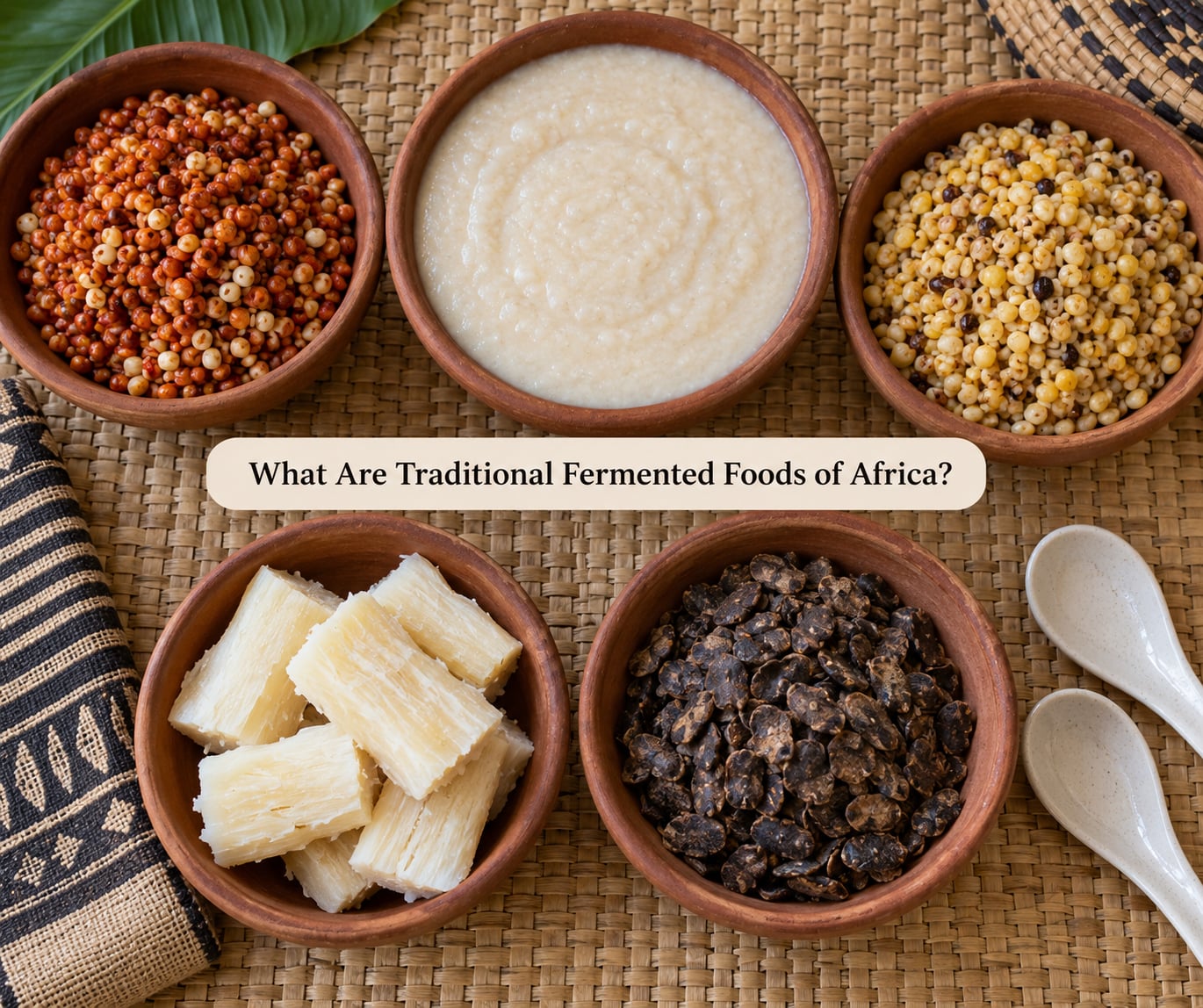
Traditional fermented foods of Africa are everyday staples made by letting bacteria and yeasts transform crops such as maize, millet, sorghum, teff, cassava, locust beans, coconut and milk until they turn sour, thicken, or fizz. The result is food that keeps longer without refrigeration, tastes sharper and softer, and sits at the centre of daily meals across the continent. Ogi, injera, amasi, fufu, kenkey, banku, iru and gari are all examples, and each one belongs to a particular region rather than to a single African cuisine.
There is no single list. What gets fermented in a household depends on the crops that grow nearby, the season, the equipment on hand and the knowledge passed down through a family or a village. The same ingredient can be turned into something completely different two countries apart.
Table of Contents
- 1What Are Traditional Fermented Foods of Africa?
- 2How Is Food Fermented in Africa?
- 3What Are the Most Common Fermented Foods Across Africa?
- 4Which Regional Examples Should Readers Know?
- 5Traditional Fermented Foods of Africa: Grain and Staple Crop Examples
- 6Traditional Fermented Foods of Africa: Vegetable, Seed, and Animal Examples
- 7Why Are Fermented Foods Important in African Cultures?
- 8What Health Benefits Are Actually Supported by Evidence?
- 9Are African Fermented Foods Safe to Eat?
- 10How Do You Choose, Store, and Prepare Fermented Foods?
- 11Frequently Asked Questions
- 12Are traditional African fermented foods better for digestion?
- 13Why do some African fermented foods taste sour or fizzy?
- 14Do fermented foods in Africa always contain alcohol?
- 15How can I tell whether a fermented food has spoiled?
- 16Are fermented cassava, maize, and millet products gluten-free?
- 17Can anyone eat African fermented foods during pregnancy?
- 18Conclusion
What Are Traditional Fermented Foods of Africa?
Fermentation is a controlled transformation. Microbes consume sugars and starches and, in the process, produce acids, enzymes, alcohol and gases. Those byproducts are what change the smell, taste, texture and keeping quality of the food.
Two broad families cover almost everything on the continent:
- Lactic acid fermentation, done by lactic acid bacteria, which sour the food and slow spoilage. Ogi, banku, injera, gari and most milk ferments sit here.
- Alcoholic fermentation, done mainly by yeasts, which produce alcohol and carbon dioxide. Pito, palm wine, marula drinks and beer belong here.
Many foods go through both in sequence, which is why some African fermented foods are mildly alcoholic and sour at the same time. Traditional fermented foods of Africa are not exotic imports or health products. They are bread, porridge, condiments and drinks that people have made at home for generations.
How Is Food Fermented in Africa?
Techniques vary widely, but most follow the same order of operations:
- Choosing and cleaning the raw material. Grain is sorted, destoned and washed; cassava is peeled and grated; locust beans are boiled until tender.
- Preparing the substrate. Cereal is soaked, drained and ground into a smooth paste or flour, and cassava flour is pressed to remove starch.
- Making a starter. Some families keep a portion of the previous batch as a starter, a practice often called back-slopping or wild fermentation. Others use a maintained culture or a commercial starter.
- Controlling moisture. Dry or firm ferments use a little water; wet ferments such as ogi or gari keep the mass damp and oxygen-limited.
- Holding temperature. Warm conditions speed lactic acid fermentation, and cooler or longer rests suit others. Storage at a warm room temperature is normal for many household ferments.
- Judging the end point. Taste, aroma and texture decide when the food is ready, not a clock. Sour aroma, a drop in pH and the texture the cook wants are the usual signals.
- Stopping or shaping the ferment. Some batches are cooked immediately. Others are rested further, dried, pressed or formed and then cooked to order.
- Storing or cooking. Drying and smoking extend shelf life further; cooking to a safe internal temperature finishes most dishes before eating.
Fermentation is not the same thing as spoilage. In a controlled ferment, acid rises, the texture changes predictably and the result smells clean and pleasantly sour. In spoilage, bacteria that we do not want take over, the food smells rotten, and mould or slime appears.
Scale differs too. Most production is household or small-business, and many steps are still done by hand rather than with factory equipment.
What Are the Most Common Fermented Foods Across Africa?
Grouping the examples by what they start from is clearer than listing them by country, because the same base ingredient recurs across borders and climate zones.
| Fermented food | Where it is common | Main ingredient | Typical use |
|---|---|---|---|
| Injera | Ethiopia, Eritrea, Sudan | Teff, sometimes blended grains | Flat bread eaten with stews |
| Kisra | Sudan, Ethiopia | Sorghum | Sour porridge, breakfast staple |
| Ogi and akamu | Nigeria, Benin, Togo | Maize, millet, sorghum | Thick porridge, pap, akamu |
| Uji | Kenya, Tanzania, Uganda | Maize, millet, sorghum | Savory drink and light meal |
| Banku | Ghana, Togo | Maize and cassava | Dumpling eaten with soup or fish |
| Akpeteshie | Ghana | Barley or maize | Cooling malt drink |
| Kenkey | Ghana and neighbouring countries | Maize | Boiled and eaten with fish or stew |
| Gari | Nigeria, Ghana, Benin | Cassava | Cassava granules eaten with fish or soup |
| Lanhouin | Benin, Togo | Cassava | Flour for dough and dumplings |
| Fufu | West and Central Africa | Cassava, plantain, yam | Staple starch served with soup |
| Iru | Yoruba communities, Nigeria | Locust beans | Umami condiment for soups |
| Dawadawa | West Africa | Locust beans | Seasoning cube and soup base |
| Ogiri and netetu | Igbo communities, Nigeria | Locust beans | Strong-smelling seasoning |
| Fermented soybeans | Nigeria, Ghana, Uganda | Soybean | Steamed or mashed fermented beans |
| Fermented leafy greens | Nigeria, Kenya, Cameroon | Waterleaf, amaranth, cleome, corchorus | Seasoning for soups and stews |
| Nunu and pendidam | Cameroon, Kenya, Uganda | Fresh milk | Fresh or cooked fermented drink |
| Amasi and maas | South Africa, Zimbabwe, Eswatini | Cow’s milk | Drunk or eaten with pap |
| Mursik | Kenya, Uganda, Tanzania | Milk in a calabash | Fermented drink sold as street food |
| Gappal | Burkina Faso, Fulani communities | Millet dough and milk | Refreshing drink made from drained fermented porridge |
| Amahewu | South Africa, Zimbabwe | Sorghum and maize | Cold drink sold in summer |
| Pito | Nigeria and neighbouring countries | Millet, sorghum, maize | Traditional alcoholic drink |
| Palm wine and marula drinks | Sub-Saharan Africa | Sap from palm or marula trees | Fresh or naturally fermented drink |
| Fermented fish | Ghana, Nigeria, Mali, DRC | Fish, anchovies | Cooked into stews and sauces |
Which Regional Examples Should Readers Know?
Most of these foods travel. Trade routes, migration and colonial-era movement of crops have carried methods far from where they started, so a name may be shared by several countries or mean different things in each one.
Traditional Fermented Foods of Africa: Grain and Staple Crop Examples
Injera is a sourdough-style flatbread made by fermenting a batter of teff, sometimes mixed with a little wheat, rye or barley. The batter is poured into open pans or on a hot clay mitadio half and steamed, and the resulting spongy sheets are eaten with stews and vegetables using the bread itself to scoop. Because the bubbles trap a little oil and moisture, injera appears at every meal in Ethiopian and Eritrean homes.
Kisra is a fermented sorghum porridge from Sudan and neighbouring areas, eaten with okra-based sauces. Sour taste and a thick, spoonable texture are normal.
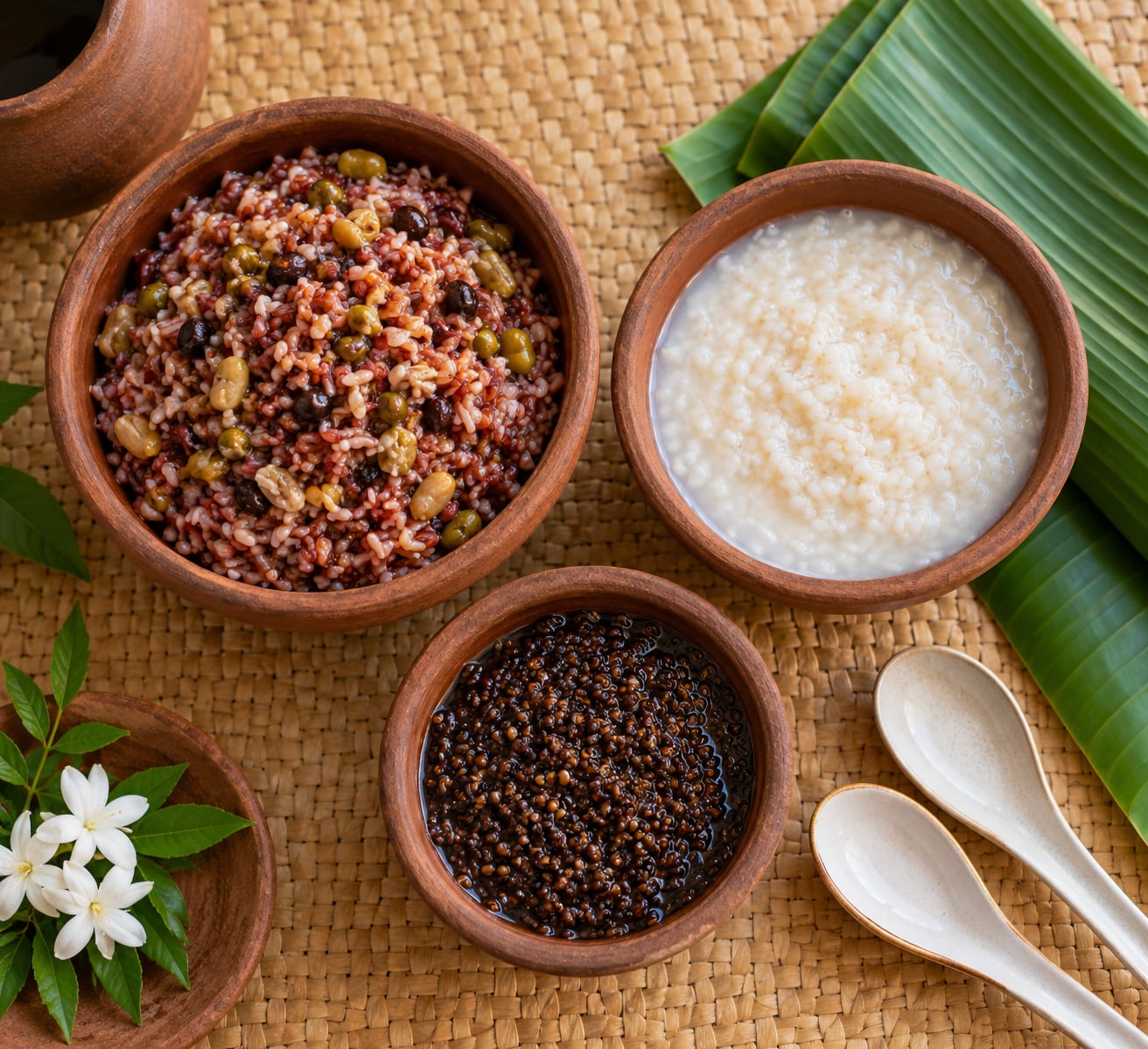
Ogi, sold as akamu or familiar as pap, is fermented maize, millet or sorghum. The grain is soaked for days, drained and milled, then the powder is cooked with water into a smooth, silky porridge. It is a breakfast food, a pairing with soups and stews, and the most common first food given to babies in Nigeria. Uji is its East African relative, thinner and often drunk rather than eaten with a spoon.
Banku is a Ghanaian and Togolese dumpling made by fermenting maize and cassava together until sour, then cooking the dough and shaping it while hot. It is served with okra soup or with fish. Akpeteshie, a Ghanaian drink, is made from malted barley or maize and is more refreshing than boozy.
Kenkey is fermented maize dough cooked into a firm dumpling, usually boiled and served with fish, stew or pepper sauce. Fufu is a broad term for a pounded, elastic starch, and in many parts of West and Central Africa the cassava used for it is fermented first, partly to soften it and improve its keeping quality.
Gari is fermented cassava granulated and dried into fine flour-like particles, eaten dry or as a paste with fish and soup. Lanhouin is the cassava ferment used for a stable dough in Benin and Togo.
Traditional Fermented Foods of Africa: Vegetable, Seed, and Animal Examples
The fermented condiments from locust beans are the backbone of West African cooking. Iru, dawadawa, ogiri and netetu are all locust bean ferments, and the beans are boiled, pressed into cakes and left until a strong aroma develops. The flavour is deep and savoury, closer to a concentrated stock than to a spice, and households measure it by scent rather than by grams. Each community’s version smells distinctly different, because the mixed wild microbes carried by the beans change from place to place.
Fermented greens do the same job on a smaller scale. Leafy vegetables and wild plants including waterleaf, amaranth greens, cleome and corchorus are salted and left to soften over a day or two, then used to season soups. Soybean ferments are widespread in Nigeria, Ghana and Uganda, and steamed fermented beans are eaten with maize or rice.
Milk ferments are just as widespread and vary with climate. Amasi, known as maas in parts of southern Africa, is set soured milk eaten with pap or drunk plain. Nunu in Cameroon and Kenya, and pendidam in Uganda, are fermented milks sold fresh. Mursik is milk fermented inside a sealed calabash and served as a drink. Gappal, from Fulani communities in Burkina Faso, is made by fermenting millet dough, draining off the sour liquid and drinking it.
There are also fermented plant drinks such as akasa, made from fermented millet or maize, and amahewu, a sorghum and maize drink from southern Africa. Palm wine and marula drinks ferment naturally after harvesting, and the fish ferments of West Africa add a savoury depth to soups and stews.
Why Are Fermented Foods Important in African Cultures?
Fermentation solved a practical problem: how to keep food edible through the hungry season and long journeys without a cold chain. It extends shelf life, concentrates nutrition in a small volume and turns cheap, abundant crops into food that is easy to store and cook quickly. The women who manage the household pot, the pots on market stalls and the jars in the household were the ones holding this knowledge for generations.
Fermented foods also carry identity. A particular porridge, drink or condiment marks a household, an ethnic community, a festival and a region, and recipes travel with families. Giving a piece of that knowledge to the next generation is part of how that identity stays alive.
None of this means these foods are frozen in amber or sacred to everyone. Refrigeration has changed what families eat, commercial products have replaced some home batches, and younger generations have had less reason to learn the long ferments at all. Several of these techniques are now harder to find than they were a generation ago.
What Health Benefits Are Actually Supported by Evidence?
The honest summary is that fermentation reliably does several things to food, and that the size of the benefit depends on the food, the microbes, the process and the portion.
- Better digestibility. Fermentation breaks down some of the components that make cereal starches and legumes hard to digest, which is why ogi and fermented porridges are widely used as weaning foods.
- Lower antinutrient levels. Microbial enzymes reduce phytate in grains and legumes, and phytate binds minerals such as iron and zinc. Less phytate can mean better mineral absorption from the same meal.
- More available protein. Fermentation partially breaks down proteins into smaller peptides and free amino acids, including lysine, which cereal staples are short of.
- Vitamins and other compounds. Microbes make B vitamins and generate organic acids and other bioactive substances during the ferment.
- Live microbes. Ferments eaten unheated can deliver a mixed microbial community, though the number that survives digestion varies a great deal.
- Fewer harmful organisms. Acid produced during fermentation suppresses many spoilage and foodborne bacteria, which is a major reason these foods have been safe to store in the first place.
Some of the strongest published findings come from fermented maize and sorghum porridges, which are regularly studied for how they affect blood glucose, lipids and digestive complaints in malnourished children. Claims that one food is the healthiest on the continent are not something the evidence supports. Traditional fermented foods of Africa are dietary staples, and eating them within a balanced meal is what the research actually describes.
Are African Fermented Foods Safe to Eat?
Most traditional ferments are safe when they are made and kept correctly, and fermentation itself reduces risk. Trouble usually comes from storage and from contamination after cooking, not from the ferment.
Practical rules:
- Buy from producers who name their ingredients, state a storage instruction and batch or date their product.
- Follow the label. Dry, granulated or powdered products keep much longer than fresh or liquid ones.
- Refrigerate fresh and liquid ferments such as set milks and drinks promptly, and use them within the time the manufacturer states.
- Discard anything with mould, slime, an off or rotten smell, a swollen package or a broken seal.
- Keep cooked fermented foods out of the temperature danger zone. Reheat suitable cooked dishes to 165°F (74°C), and cook fish and other seafood to 145°F (63°C).
Pregnant people, young children, older adults and anyone with a weakened immune system should get individual advice before eating raw or unpasteurised fermented foods, and should speak to a doctor or registered dietitian about their own situation.
How Do You Choose, Store, and Prepare Fermented Foods?
For packaged products, read the ingredient list and the allergen statement. Locust bean, peanut and soy ferments share production equipment, and a product may contain added sugar even when the taste reads as savoury. Check the label for an added preservative or a live culture count if that matters to you.
For your first taste, start small. A spoonful of iru, a small portion of kenkey or a few bites of injera with a familiar stew tells you far more than a large bowl of something unfamiliar. Fermented flavours run from mild and tangy to quite sour and funky, and pungent condiments can overwhelm a plate if you are heavy-handed.
In the kitchen, use a separate spoon for condiments so the jar stays clean longer, and keep raw and cooked items apart. Store products where the manufacturer says, not where it is convenient. Squeeze a paste or drop a dollop of a fresh ferment into a hot stew with a wooden spoon, and give cooked foods a proper reheat before serving.
If a dish is unfamiliar and you are unsure of an ingredient, ask what it is before you order. A short explanation from the cook is more reliable than a guess from the menu.
Frequently Asked Questions
Are traditional African fermented foods better for digestion?
Often, yes, but it depends on the food and the person. Fermentation breaks down some starches and proteins that are hard to digest raw, and lowers phytate in grains and beans so minerals absorb better. That is why fermented porridges such as ogi and uji are used as weaning foods. The benefit is not automatic, and people with an intolerance to a specific ingredient may still react to it.
Why do some African fermented foods taste sour or fizzy?
Sourness comes from lactic acid bacteria converting sugars into acid, and fizziness usually comes from yeast and gas production during a wet ferment. Both are signs that the microbial process ran as intended. A clean sour smell with a smooth texture is normal. A rotten smell, mould, slime or an unexpectedly fizzy, swollen package is a different matter entirely.
Do fermented foods in Africa always contain alcohol?
No. Many are purely lactic ferments with no alcohol at all, such as ogi, injera, gari, banku and set soured milks. Others, including pito, palm wine and marula drinks, are genuinely alcoholic, and a few such as banku and akpeteshie can carry trace amounts from mixed microbial activity. Anything sold to children, such as akasa, is normally prepared without alcohol.
How can I tell whether a fermented food has spoiled?
Trust your senses and the packaging. Discard food with visible mould, a slimy surface, a rotten or ammonia-like smell, a swollen or leaking package, or a damaged seal. A ferment that smells clean, sour and fruity is working normally. When in doubt, throw it out, especially for children, older adults and anyone with a weakened immune system.
Are fermented cassava, maize, and millet products gluten-free?
Plain fermented cassava, maize and millet products are naturally gluten-free, since none of those crops contains gluten. Check the label anyway, because some blends add wheat, barley or rye, and shared production lines can introduce gluten. Fufu made from cassava or plantain is usually gluten-free, while a version made from wheat or a mixed dough is not.
Can anyone eat African fermented foods during pregnancy?
Fully cooked and properly stored products are generally fine for most people, but fermented foods vary enormously. Avoid raw or unpasteurised fermented milk and drinks, check labels for alcohol, and skip anything past its use-by date. If you have any condition, allergy or concern, ask your doctor or midwife about the specific product rather than relying on general guidance.
Conclusion
Traditional fermented foods of Africa are a family of traditions built on ordinary crops and local microbes: grain ferments such as injera, ogi and banku, cassava products like gari and fufu, locust bean condiments like iru and dawadawa, soured milks like amasi, and drinks from sorghum, millet and palm sap. They matter because they preserve food, feed people cheaply, and hold a community’s identity at the table.
Start with one familiar, clearly labelled example from a seller you trust, and eat a small portion first so you know what you like. If you are pregnant, managing an allergy or immunocompromised, ask a qualified clinician about the specific food rather than guessing from a general guide.