If you want a working method rather than a list of brands to avoid, learning how to spot fake herbal supplement claims comes down to four checks you can do in about ten minutes: read the Supplement Facts panel against the front-of-bottle promises, test the claim itself for specificity and a traceable study, match a batch-level Certificate of Analysis to the lot number on your bottle, and confirm any certification seal in the certifier’s own database. No supplement is pre-approved by the FDA, so that verification burden sits with you.
That matters because the four ways these products go wrong are different problems, and a fix for one does nothing for another. A label can be entirely truthful about identity while the marketing copy lies about what the product does. Or the contents can differ from the label while every claim on the packaging is technically accurate.
| Failure mode | What it is | How it shows up | What it can mean for you |
|---|---|---|---|
| Mislabeling or substitution | The bottle holds a different plant, part, or filler than the label names | Vague plant names, no plant part, cheap powder in place of extract | You get none of the herb you paid for |
| Adulteration | Pharmaceutical drugs or stimulants added without declaration | Effects far stronger or different from the label implies, undeclared stimulants in weight, sexual, and bodybuilding products | Real interaction risk, and legal exposure for the seller |
| Contamination | Heavy metals, pesticides, microbes, or adulterant colorants enter the batch | Heavy metals in imported Ayurvedic and traditional Chinese medicine products; lead chromate used to brighten turmeric | Toxic exposure with no warning on the label |
| False marketing claim | The product may be genuine, but the claim for it is unsupported | Cure language, guarantees, “clinically proven” with no citation, fabricated news references | Delayed diagnosis, wasted money, unsafe self-treatment |
A 2023 analysis in JAMA of 57 herbal supplements found roughly 40 percent contained no detectable amount of a labeled ingredient (Cohen et al. 2023, JAMA). Separately, Tucker and colleagues found products carrying FDA warning letters still contained unapproved pharmaceutical ingredients (Tucker et al. 2018, JAMA Network Open). These are not rare defects.
This is educational information about how to evaluate marketing and labeling, not medical advice. If you take prescription medication, manage a chronic condition, are pregnant or nursing, or are considering a remedy for a symptom that needs attention, talk to a doctor or pharmacist first.
Table of Contents
- 1What You Need
- 2Step-by-Step: How to Spot Fake Herbal Supplement Claims
- 3Step 1: Check What the Product Actually Contains
- 4Step 2: Separate Traditional Use from Research Evidence
- 5Step 3: Look for Independent Quality and Safety Testing
- 6Step 4: Investigate the Seller and the Company
- 7Step 5: Compare the Claim with Trusted Health Sources
- 8Step 6: Decide Whether the Product Is Worth Buying
- 9Common Mistakes
- 10Treating natural as safe
- 11Counting customer reviews as clinical proof
- 12Ignoring dose and interaction warnings
- 13Assuming a third-party seal proves the product works
- 14Trusting home authenticity tests
- 15Skipping the boring checks
- 16Frequently Asked Questions
- 17How do I know if a supplement company is legitimate?
- 18What are the red flags for supplements?
- 19Are proprietary blends bad in supplements?
- 20What is the difference between USP Verified and NSF certified supplements?
- 21Is traditional use enough evidence that a herb works?
- 22How do I report a fraudulent supplement?
- 23Conclusion
What You Need
You need very little, and none of it is expensive. Five minutes and a notebook will do more than any gut feeling.
- The physical product or a full photo of the label. The Supplement Facts panel, not just the front, because that is where dose and blend information lives.
- The lot or batch number. Printed on the base or side panel. Without it you cannot tie any test result to your specific bottle.
- Manufacturer contact details. A real street address and a working customer service channel. A PO box and a form-only contact page are a starting red flag.
- Access to public databases. The FDA Health Fraud Product Database, the FDA warning letter database, the USP Verified product search, the NSF certified product database, the NIH NCCIH herbal safety pages, and reportfraud.ftc.gov.
- A way to record claims. A notes file where you paste each claim verbatim with the exact wording used. Wording is the evidence.
- Optionally, a copy-paste email template for requesting the batch Certificate of Analysis from the company.
One practical note from people who work in this industry: the questions that get straight answers are specific ones. “Is this third-party tested?” gets a brochure. “Please send the Certificate of Analysis for lot number X, showing test dates and the laboratory name” gets either a document or a very telling refusal.
Step-by-Step: How to Spot Fake Herbal Supplement Claims
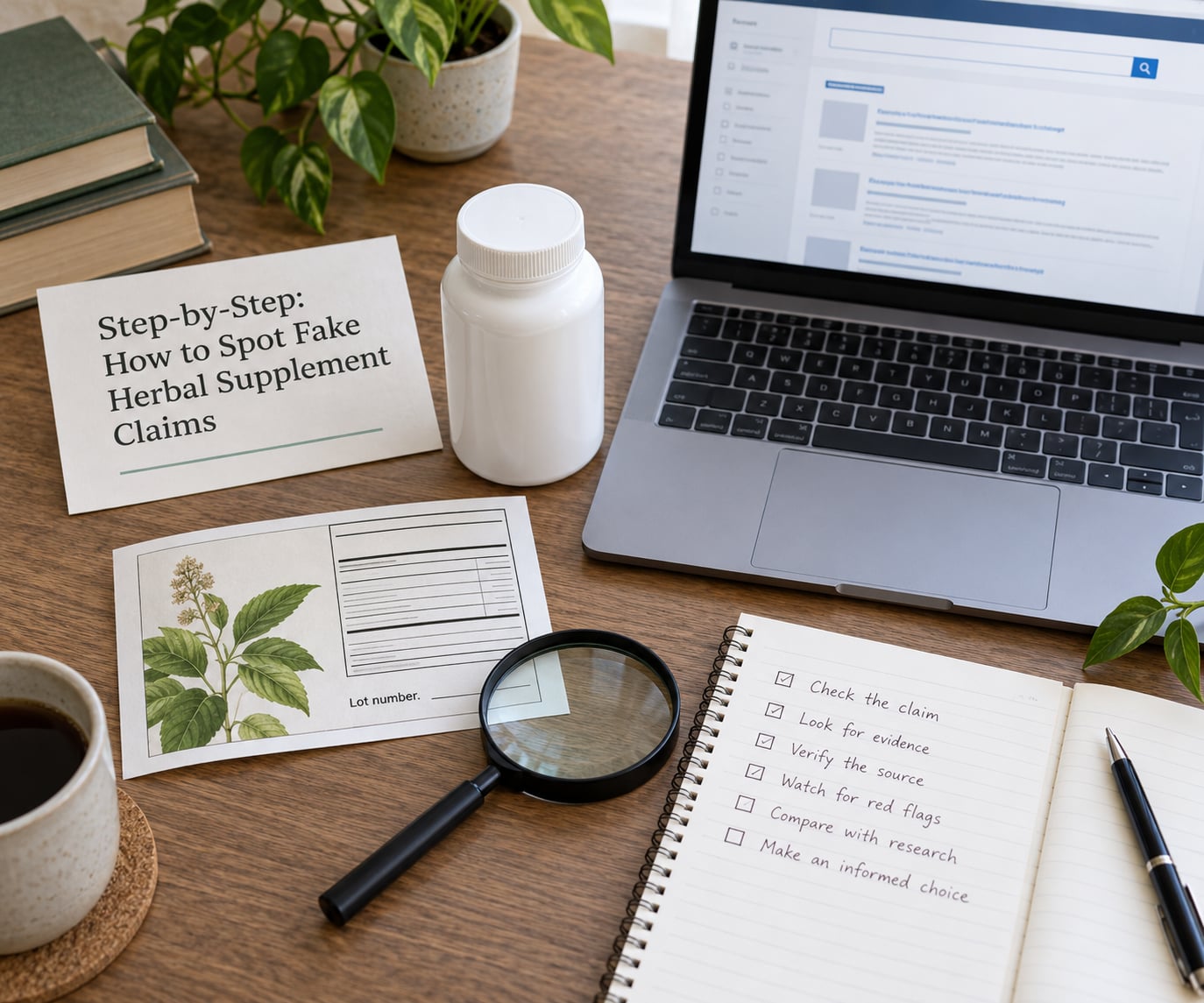
The audit runs in order because each step depends on the one before it. There is no point requesting lab documents for a product whose label will not tell you what the plant species is.
Step 1: Check What the Product Actually Contains
Turn the bottle over and read the Supplement Facts panel, then hold it next to the front label and ask whether they tell the same story. Most false claims are visible right here, because the marketing side and the regulatory side are printed by different people.
A credible botanical label gives you the Latin binomial, not the common name. “Ginseng” tells you nothing; Panax ginseng tells you the species. It names the plant part used, because root, leaf, bark, and seed carry different compounds and different amounts of contaminants. It gives a real milligram amount per serving. And for extracts, it states the extract ratio and what the extract is standardized to.
Red flags in this step:
- Proprietary blend with no amounts. This is the single most useful tell. When several ingredients share one undisclosed total weight, even a small amount of an undeclared drug can hide inside it. You have no way to compute a dose, and neither does anyone else.
- A common name with no Latin name. “Ginseng,” “goji,” “starflower,” “hemp” without a species and a cannabinoid profile.
- No plant part. If the label says only Aloe barbadensis and never says leaf gel versus whole leaf, the more irritating compounds come along.
- Quantities that do not add up. A capsule weight far too small to hold the declared dose, or a per-serving amount that changes between label versions.
- Every ingredient declared only as a percentage of a blend. Legitimate single-ingredient products state the amount plainly.
- “Standardized to X%” with no compound named. Standardized to what? A number without a target compound means nothing.
Watch for proportions too. A study of North American commercial herbal products used DNA barcoding and found that nearly a quarter of the samples contained material other than the species on the label, including filler and in some cases substitutions (Newmaster et al. 2013, BMC Medicine). Label reading is not a substitute for lab testing, but it catches the majority of sloppy products on its own.
Step 2: Separate Traditional Use from Research Evidence
A long history of use tells you a plant has been consumed by people, not that it produces the effect a seller claims. Those are different claims, and herbal marketing constantly blurs them.
Sort any heritage story into one of five tiers, weakest first:
- Myth and folklore. Widely repeated, rarely documented outside the marketing copy.
- Documented ethnobotanical use. Recorded in a published ethnobotanical or ethnopharmacological source, ideally with the community and region named.
- In vitro or animal work. Real data, but it does not translate directly to a dose taken by a person.
- Observational human data. Associations in populations, where other factors may explain the effect.
- Randomized controlled trials and systematic reviews. The only tier that can support a claim about effectiveness in people.
Ask a sharp question about tier two: is the traditional-use story traceable, or was it written for this product? A genuine ethnobotanical claim names a plant, a preparation method, a population, and a specific use. “Used for centuries in Ayurveda” with no preparation detail and no source is marketing copy wearing a lab coat.
Species matters just as much here as heritage does. Certain mu tong substitutes on the market belong to the Aristolochia genus, which carries aristolochic acid, a compound associated with kidney damage and cancer. No traditional-use story makes that substitution safe, and the danger sits in the identity question, not the tradition.
Then look at whether the tier matches the promise. A seller running a centuries-old use story and citing a single small trial as proof is moving the goalposts. Conversely, mild variance in marker compounds between harvests is normal chemistry and terroir, not fraud; genuine fraud looks like a product that is not the plant at all.
Step 3: Look for Independent Quality and Safety Testing
Third-party testing is worth something, but only when you know which program it is and confirm it independently. A gold badge printed by the brand itself is decoration.
| Program | What it checks | How to verify it yourself |
|---|---|---|
| USP Verified | Identity, potency, purity, and manufacturing quality against a monograph standard; voluntary certification mark | Search the product in the USP Verified Product Search database; the entry should match the exact label version |
| NSF International | Product-level testing against the claims made, plus facility standards | Look the brand up in the NSF certified product database rather than trusting the bottle |
| NSF Certified for Sport | Adds testing for a banned substance list, which matters for athletes | Confirm in the NSF database; the certification is program-specific, not a company-wide endorsement |
| Informed Choice | Batch-level testing against sport banned substance lists, common in sport nutrition | Ask for the certificate with the matching lot number |
| ConsumerLab | Independent paid testing, seals appear only on tested lots in some programs | Search the brand on ConsumerLab’s site; some results are member-only |
Certification tells you about identity and purity. It never tells you the product works, because no certifier evaluates whether a supplement treats the condition the ad implies.
Batch-level documentation is a different level. A Certificate of Analysis, or COA, is the lab report for one batch. Legitimate ones carry the product name, the lot number, the testing laboratory with its accreditation, sample and test dates, the analytical method used, and numeric results with units. Anything phrased as “passes purity” with no numbers is not a COA.
The most common forum objection is worth taking seriously: brands commission their own testing and reuse one PDF across batches. That is why the lot number has to match the bottle in your hand, and why the test date has to be after the manufacture date. A document that covers a lot you never received is not evidence about your product.
Here is the email that works. Copy it, change the two bracketed parts, send it:
Hello, I am considering purchasing [product name, exact label version]. Before I do, could you send me the Certificate of Analysis for lot number [lot number], showing the testing laboratory, its accreditation, the sample and test dates, the analytical methods used, and numeric results with units for identity, marker compounds, heavy metals, and microbial screen? If that batch has not been tested, please tell me which batches have been and how often testing is run. Thank you.
Refusal is informative. So is a vague reply with no document attached.
One more lab detail worth knowing. The method tells you what was measured. HPLC and UPLC quantify marker compounds in a plant extract. ICP-MS measures heavy metals at trace levels. GC-MS suits volatile oils. HPTLC gives a chromatographic fingerprint for identity across several compounds at once. DNA barcoding answers a species question rather than a potency question. If a company cannot name the method, they may not have run one.
Step 4: Investigate the Seller and the Company
Even a genuine formula can arrive as a counterfeit, so the seller gets its own audit. Check whether the company has a real address, a working customer service contact that answers a specific technical question, and a refund policy you can find without emailing them.
Then check the channel. Manufacturer websites usually publish an authorized retailer list. If you are on a marketplace and the seller name does not match that list, you have no chain of custody, and counterfeit packaging with a matching lot number is exactly what shows up on resellers’ sites.
What sellers have done that raised eyebrows in buyer discussions:
- Storefront names that appear, disappear, and reappear under a slightly different name after complaints.
- Prices far below every other listing for the same product and lot.
- Packaging that arrives with wrong pill color, size, or shape, or a misspelled label.
- Free-trial offers that start a recurring charge with a cancel button hidden in an account menu.
- “Unavailable in your country” and countdown-timer urgency on a page that never actually stops selling.
Check the company’s regulatory history rather than only its testimonials. A company with FDA warning letters can still make a decent product, but you should know that before you buy, not after.
Step 5: Compare the Claim with Trusted Health Sources
Now take the marketing sentence apart and test the language itself. Under the Dietary Supplement Health and Education Act of 1994, manufacturers may make structure and function claims, such as supporting healthy joints, but may not claim to diagnose, treat, cure, or prevent a disease. That legal line is where fraudulent claims usually sit, and it is also the fastest read.
| Claim language | What it signals | Regulatory standing | What to do |
|---|---|---|---|
| “Cures,” “treats,” “reverses,” “prevents” a named disease | Drug claim, and the FTC requires competent and reliable scientific evidence for it | Not permitted for supplements | Walk away; report to the FTC and FDA |
| “FDA approved” | No supplement is FDA approved; the agency approves drugs, not supplements | False by definition | Disregard the rest of the listing |
| “Clinically proven” with no study named | The proof may not exist or may be about a different extract, dose, or population | Deceptive advertising risk | Ask which study, on which species, at which dose |
| “Backed by science,” “doctor formulated,” “researched for centuries” | Heritage and laboratory framing standing in for human outcome data | Allowed only if not a disease claim | Look for the human trial, not the tradition |
| Guarantees, before-and-after photos, celebrity or doctor endorsements | Testimonials, frequently stock imagery or unpaid imagery with a disclosed relationship | Testimonials cannot substantiate a health claim | Ignore the images entirely and read the facts panel |
| Links to news sites or studies with vague or fabricated citations | Manufactured credibility; check whether the article exists and says what the ad implies | Potential FTC deception case | Search the citation; treat a missing study as no evidence |
| “No known side effects,” “100 percent safe,” “works for everyone” | No botanical is free of interactions or toxicity at some dose | Absolute safety claims are false | Take it to a pharmacist |
| “Clinician grade,” “pharmaceutical strength” with no milligram amounts | Vagueness covering an undisclosed dose | Allowed wording, uninformative content | Ask for the milligram amount per serving |
Then run the claim through a three-question test. Is it specific? “Supports energy” fails; “improves walking endurance in adults over 60 in a trial of at least eight weeks” passes. Is it traceable to evidence you can locate and read? And is the dose plausible, meaning does the per-serving milligram amount sit in a range similar to what the cited research actually used?
Cross-check against public health sources rather than the seller’s page: the NIH NCCIH herb fact sheets, WHO monographs on selected medicinal plants, and clinical guidance from national health agencies. Compare what they say about the proposed use, safety profile, and interactions with common medications.
Pay attention to the standard disclaimer on the label. “These statements have not been evaluated by the Food and Drug Administration. This product is not intended to diagnose, treat, cure, or prevent any disease.” That is not a warning about the product. It is the legally required notice that nobody has checked the claims for you.
Step 6: Decide Whether the Product Is Worth Buying
Decide with a rule rather than a feeling. If you cannot confirm the plant species and plant part, the per-serving dose, and a real milligram amount, walk away. No amount of marketing polish changes that math.
If those check out, ask whether the batch documentation exists and whether the third-party certification is real. Then read the safety side: known side effects, contraindications, pregnancy and nursing status, and specific drug interactions. Watch for ginkgo, ginseng, and St John’s wort alongside anything from your prescription list. If any of that is unclear, that is a pharmacist conversation, not a purchase decision.
Finally, judge the claim, not just the bottle. A perfectly labelled product sold with cure language is still a product whose seller is telling you something untrue, and that seller is selling you other things too.
Report anything suspect. FDA handles product safety, adulteration, and misbranding. The FTC handles advertising and deceptive claims through reportfraud.ftc.gov. Your state attorney general takes marketplace sellers. Send the label photos, the lot number, the purchase receipt, and the exact claim text. Reports from consumers are how these investigations start.
Common Mistakes
Treating natural as safe
Natural origin says nothing about safety. Some of the most toxic plants on earth are entirely natural, and several are traditional medicines. Weight, other medicines you take, kidney and liver function, and pregnancy all change the risk of an otherwise ordinary herb.
Counting customer reviews as clinical proof
Reviews describe experience, not efficacy, and before-and-after images are the least reliable evidence on the page. Forum readers are widely skeptical of them, and plenty of them are stock photos, filtered shots at different angles, or generated images. Reviews are useful for spotting batch-to-batch inconsistency, because people frequently notice when a product that once worked stops working. That is a potency signal, not a proof of effect.
Ignoring dose and interaction warnings
A standardized extract is not automatically a verified effective dose. “Standardized to 5 percent” simply says every batch was adjusted to hit that number for a named compound, which says nothing about whether that amount matters to you. Interactions are where the serious harm comes from, and they appear on labels people skip.
Assuming a third-party seal proves the product works
Certification programs test identity, potency, purity, and, in some cases, banned substances. None of them evaluate whether the product treats the condition in the advertisement. A seal is a quality statement, not an effectiveness claim.
Trusting home authenticity tests
The freezer test, the water or curing test, and the paper-drop test are easy to find on social media and none of them proves identity or potency. They were designed to produce an answer, not to measure one. A thicker oil may simply be a less refined one. Play it safe and treat a failed home test as meaningless rather than damning.
Skipping the boring checks
The lot number, the Latin binomial, the milligram amount, and the certifier’s database take five minutes and catch most of what goes wrong. Prevention here is dull and effective: check these before you buy rather than reasoning about the product afterwards, buy from authorized channels, keep the box and receipt in case you need to report something, and take the bottle to a pharmacist when a specific question about your own health comes up.
Frequently Asked Questions
How do I know if a supplement company is legitimate?
Look for a verifiable physical address, working customer service that answers technical questions, an authorized retailer list on the manufacturer’s own site, and a refund policy you can find without asking. Then check the company’s record in the FDA warning letter database. A company that supplies a lot-number-matched Certificate of Analysis on request is behaving like a real manufacturer; vague answers and refusal to share batch documents are the warning sign.
What are the red flags for supplements?
The usual signals are cure or treat language, the phrase FDA approved, clinically proven with no named study, proprietary blends with no milligram amounts, common plant names with no Latin binomial or plant part, missing lot numbers, no batch testing available, prices far below market, and a company with no street address. Also treat celebrity or doctor endorsement images with no disclosed relationship as decoration rather than evidence. Any single one is a prompt to ask questions; several together are a reason to walk away.
Are proprietary blends bad in supplements?
They are not automatically unsafe, but they remove your ability to know a dose. When several ingredients share one undisclosed total weight, nobody can compute how much of each is present. That matters most for undeclared pharmaceuticals, because a small quantity can hide inside a large blend. It also makes the product impossible to compare against research, which used a specific amount of a specific extract. If a manufacturer will not state per-serving milligram amounts, treat that as the finding.
What is the difference between USP Verified and NSF certified supplements?
Both are voluntary third-party programs, but they run differently. USP Verified certifies against a USP monograph, covering identity, potency, purity, and manufacturing quality, and its mark can appear only on products meeting those standards. NSF tests products against specific claims and certifies facilities against NSF standards, with a separate sport program that screens for banned substances. Neither program evaluates whether a product treats a health condition, and you verify either one in the certifier’s own search database.
Is traditional use enough evidence that a herb works?
No. Traditional use establishes that people have taken a plant, not that it produces a particular effect in a modern context, at a modern dose, with a modern preparation. A documented ethnobotanical use is a useful research lead and a claim worth asking about, but the evidence tiers differ by a wide margin: myth, documented tradition, laboratory or animal work, observational human data, and randomized controlled trials. Ask where the traditional-use story is recorded and whether human trials exist for the exact use the seller advertises.
How do I report a fraudulent supplement?
Match the agency to the problem. Report a product you believe is adulterated, misbranded, or contaminated to the FDA, and use the FDA Health Fraud Product Database to check whether the product or brand is already listed. Report deceptive marketing, miracle cures, and fake testimonials to the FTC through reportfraud.ftc.gov. Marketplace sellers can also be reported to your state attorney general. Send label photos, the lot number, the receipt, and the exact claim wording, because the claim text is what regulators can act on.
Conclusion
Start with the facts panel, not the front label. Confirm the Latin botanical name and plant part, find the real milligram amount per serving, write down the lot number, then request the Certificate of Analysis that matches that lot. After that, read the claim against public health sources and decide whether the language is honest.
Fake herbal supplement claims are not hard to spot once you know what each part of the label is doing. They are common because nobody checks them before you do.
Take anything personal to a doctor or pharmacist, especially if you take medication, and seek care promptly for warning signs rather than treating them with a bottle.