You tell by naming the herb precisely, writing down everything you take, and checking that pair against sources that grade their evidence, then asking a pharmacist or clinician before you combine them. It takes about fifteen minutes with the product packaging and a written list. Nobody can screen a specific combination for you from an article, so treat everything below as a preparation step for that conversation.
This is general information about herb-drug interactions, not medical advice. It does not diagnose anything and does not cover doses. If you take any prescription or over-the-counter medicine alongside a herb, tea, tincture or traditional preparation, the check belongs with a pharmacist, doctor or other qualified health professional who knows your history.
Two facts shape everything else. Documented herb-drug interactions have caused hospital admissions, including internal bleeding, serotonin syndrome, liver failure, dangerously low blood sugar and toxic drug levels. And the opposite is also true: most people combining a herbal product with medicine have no problem at all, which is exactly why a quick structured check beats guessing.
Table of Contents
- 1What You Need
- 2Step-by-Step: How to Tell if an Herb Interacts With Medication
- 3Identify the herb and preparation accurately
- 4Write down every medicine and supplement
- 5Check the interaction and understand the evidence
- 6Ask a pharmacist or clinician before combining them
- 7Watch for warning signs and know when to seek help
- 8Common Mistakes
- 9Frequently Asked Questions
- 10Can I check whether an herb interacts with my medication at home?
- 11Are herbal supplements more likely to cause interactions than dried herbs or tea?
- 12What should I do if I think an herb is interacting with my medication?
- 13Why can the same herb interact differently with different medicines?
- 14What information should I give a pharmacist when checking an herbal product?
- 15Conclusion
What You Need
Gather this before you look anything up. The quality of your answer is limited by how precisely you describe what you are taking.
- The exact product name as printed on the label, including the botanical name in Latin, the plant part used, the preparation method and the manufacturer.
- The full contents list, including added ingredients. Blends, multi-herb formulas and flavoured teas hide the plant that matters.
- A written list of every medicine and supplement: prescriptions, over-the-counter products, vitamins, minerals, other herbal products, teas used daily, and traditional remedies.
- How often and when you take each product, and whether anything changed in the last few weeks. A supplement started after your medicine can still shift a lab result.
- Your health context: current conditions, allergies, whether you are pregnant or breastfeeding, your age, and whether you take several medicines at once.
- Your prescriber’s advice on that herb, including when it was given and who gave it.
A few safety notes before you go further. Keep the packaging, or a clear photograph of the ingredient panel, because that is what a pharmacist will ask for. Essential oils are concentrated forms and are not interchangeable with the dried plant or a tea. Never stop, reduce or skip a prescribed medicine because of something you read here. And if a product is a remedy handed down through your family or community, it still needs the same screening as anything bought in a shop.
Step-by-Step: How to Tell if an Herb Interacts With Medication
Work through these in order. Each step depends on the one before it, and skipping step one makes everything after it guesswork.
Identify the herb and preparation accurately
Start with the plant itself, because common names are unreliable. Bushveld tea, Sutherlandia frutescens and wild ginger can each refer to different species in different households, and two plants can share one English name while sharing nothing chemically. Latin binomials are printed on most labels for this reason: licorice appears as Glycyrrhiza glabra so that you can recognise it inside a blend you would otherwise never connect with a blood-pressure tablet.
Then record the preparation. Dried leaf, a tea infusion, a tincture, a capsule extract, a standardised extract and an essential oil can carry very different concentrations of the same plant’s compounds. Concentrated extracts carry the most risk, because the extraction method concentrates whatever is active. Write down what you have, not what you assume the product does.
Write down every medicine and supplement
Build one list and keep it current. Include prescription medicines, over-the-counter painkillers and cold remedies, vitamins, minerals, other herbal products, herbal teas you drink daily, and traditional preparations such as roots, bark or mixtures sold loose. Do not include only the things you consider medicine. People on several prescribers at once are the group most likely to be caught out by an ingredient they did not write down.
The same substance can appear under more than one name on your list, and multi-ingredient blends are where the real surprises hide. Practitioners report that the most frequently overlooked items are the ones buried in a blend or a tea, not the single-ingredient bottle sitting on the counter.
Check the interaction and understand the evidence
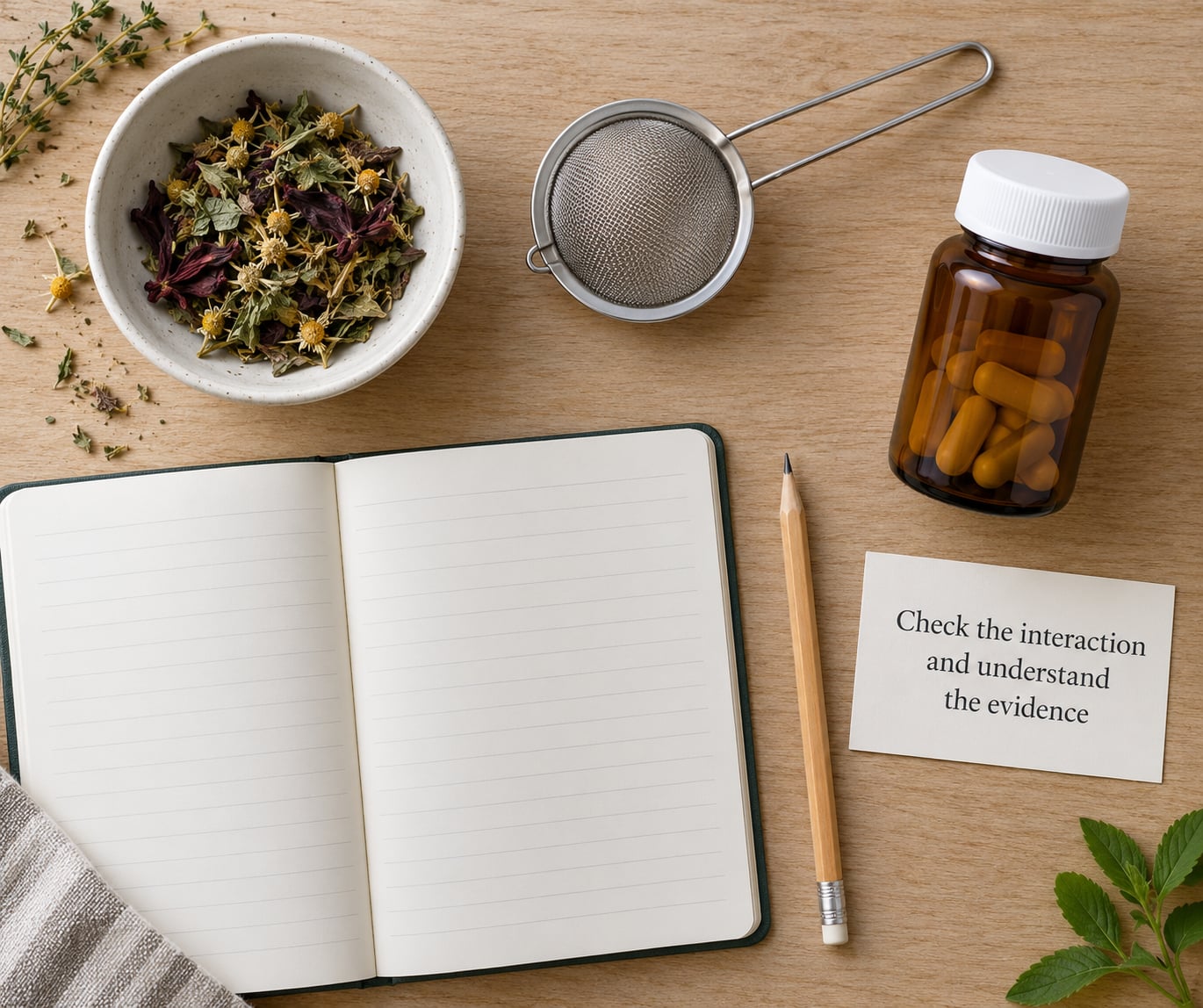
Two free NIH resources make a sensible first pass: MedlinePlus, which lists herbs and supplements with known interactions, and the National Center for Complementary and Integrative Health, which summarises what is known about specific plants. Commercial tools such as Natural Medicines, Drugs.com and WebMD run the same kind of lookup, usually free at a basic level.
Read the result more carefully than the colour of the dot tells you. There are three very different answers a database can give you, and mixing them up causes both panic and false reassurance:
- Documented interaction. The effect has been reported in people, often as case reports and sometimes supported by laboratory values. Licorice with digoxin, or a herbal product with warfarin affecting the INR, sit in this category.
- Theoretical interaction. The plant affects a liver enzyme, a transport protein or a receptor in a laboratory study, and the same pathway is plausible in people. No harm has been demonstrated in patients, but the mechanism is real and the effect is not predictable.
- Something other than the herb. Reported reactions sometimes trace to a drug wrongly detected in a capsule, a heavy metal, an undeclared pharmaceutical, or a mismatch between the label and the plant actually used. A product failing a quality test is a different problem from an interaction, and it needs a different response.
A search result that returns nothing means no known interaction in that particular database. It does not mean no interaction, because many plant combinations have never been studied in people at all. That gap between no evidence of harm and evidence of no harm is the single most important thing to keep in mind.
Ask a pharmacist or clinician before combining them
Bring the packaging, the written list and your questions. Clinicians respond far better to a list of everything you take than to a vague mention of some herbs, and the pharmacist can usually check the pair the same day.
Ask what is actually known about this specific herb and this specific medicine, not just the herb in general. Ask how strong that evidence is and whether your own situation makes it more relevant, since age, kidney and liver function, pregnancy and the number of medicines you take all change the picture. Ask which signs would matter and how soon after starting you would expect them. If you have surgery coming up, mention every herbal product, because some affect bleeding and some affect anaesthetics. If the answer is that nobody can say, that is a useful answer too.
Watch for warning signs and know when to seek help
Most interactions announce themselves as a change from your usual baseline, often within days of starting or stopping a product. General signs that deserve attention include an unexpected rash, itching or swelling; unusual bleeding or bruising; nosebleeds or bleeding gums; severe dizziness, fainting or confusion; a racing or irregular heartbeat; persistent vomiting or diarrhoea; marked drowsiness; agitation or restlessness; dark urine, pale stools or yellowing of the skin or eyes; and any large shift in your blood sugar, blood pressure or INR reading.
Look for change, not just presence. A symptom you have had for years is a different question from one that started three days after you began a new blend.
Get urgent medical help for difficulty breathing, swelling of the face or throat, fainting, a severe or rapidly spreading rash, chest pain, confusion, uncontrolled bleeding, yellowing of the skin or eyes, or a seizure. Do not wait to see whether it passes. The same applies if you suspect your medicine is no longer working as it should, which can show up as a relapse of the condition being treated.
Keep checking for a few days after any change. Stopping a product can alter a drug level just as starting one does, and a drug that was interacting invisibly for weeks can reveal itself when the interaction ends.
Common Mistakes
Assuming natural means safe. The word describes origin, not risk. Fix: screen every herbal product on the same basis as an over-the-counter medicine, which in practice means showing it to a pharmacist.
Treating a tea as different from a supplement. An infusion can deliver a substantial dose of the plant’s compounds, and a multi-herb blend can contain three or four species at once. Fix: treat any prepared herbal drink as a product with a label, not as plain water with flavour.
Using one herb name for several plants. Fix: record the Latin binomial and the plant part, and if a preparation arrives loose or hand-made without a label, treat its identity as unknown until someone qualified confirms it.
Combining products without checking for duplicates. Fix: lay every label out side by side and look for repeated plant names, including Latin ones. The same plant in a tea and a capsule is still two sources.
Stopping a prescribed medicine because a herb seems to be doing the work. Fix: raise the idea with your prescriber and let them make any change. Symptoms returning after a medicine is stopped on your own is a common and avoidable admission.
Reading no result as a clearance. Fix: ask what the database actually searched. Absence of a documented interaction mostly reflects what has been studied, and for traditional and African medicinal plants the studied list is short.
One habit covers most of these: keep a dated, written inventory of everything you take, take it to every appointment, and update it the week something new starts. Practitioners on ethnobotanical and herbal prescribing say the same thing from different directions, that the item missing from the conversation is almost always the one nobody thought counted as medicine.
Frequently Asked Questions
Can I check whether an herb interacts with my medication at home?
Partly. You can identify the plant precisely, list everything you take, and look the pair up in NIH MedlinePlus, NCCIH or a commercial interaction tool. That screening catches known and plausible problems fast. It cannot tell you what will happen in your body, because evidence is thin and your own medicines, conditions and organ function change the picture. Treat the home check as preparation for a pharmacist or clinician, not as the decision itself.
Are herbal supplements more likely to cause interactions than dried herbs or tea?
Capsules and concentrated extracts usually carry more risk, because extraction concentrates the plant’s active compounds and a capsule can carry a dose no cup of tea delivers. Tea and dried material are not risk-free, since an infusion of an active plant can be potent and blends multiply the species involved. Risk also climbs when a product is unlabelled, loose or handmade. Whatever the form, screen it and ask a pharmacist before combining it with a medicine.
What should I do if I think an herb is interacting with my medication?
Do not take a further dose of either until you have spoken to someone qualified, and do not stop your prescribed medicine on your own. Note what you took, when, how much and what has changed, then contact a pharmacist or your prescriber the same day. If symptoms are severe, such as breathing difficulty, facial swelling, fainting, confusion, uncontrolled bleeding, yellowing of the skin or eyes, or a severe rash, seek urgent medical care immediately.
Why can the same herb interact differently with different medicines?
Because interactions depend on what sits beside the herb. A plant that slows liver enzyme activity can raise the level of a drug broken down by that enzyme while having no effect on a drug cleared by another route. The same herb can also act on a different target from a given medicine and simply add to its effect. Your age, kidney and liver function, other medicines and genetics all shift the outcome further, which is why a personal review matters more than a generic list.
What information should I give a pharmacist when checking an herbal product?
Bring the packaging or a clear photo of the ingredient panel, and bring a written list of every medicine, supplement, tea and traditional remedy you use, with doses and timings. Say why you want the herb, how long you have used it, whether you are pregnant or breastfeeding, and any conditions, allergies or reactions you have had. Mention upcoming surgery, and any past interaction you suspect. That is enough for a same-day check of the specific pair rather than a general conversation.
Conclusion
Start with one product. Get its botanical name, its plant part and its full ingredient list, write down every medicine, supplement, tea and traditional remedy you use, and take both to a pharmacist or clinician before you combine them.
The honest answer to how to tell if an herb interacts with medication is that the identification work and the written list are yours, and the judgement is theirs. Do your part properly and the conversation takes minutes. Seek urgent medical care for breathing difficulty, fainting, uncontrolled bleeding, confusion, severe rash or yellowing of the skin and eyes.