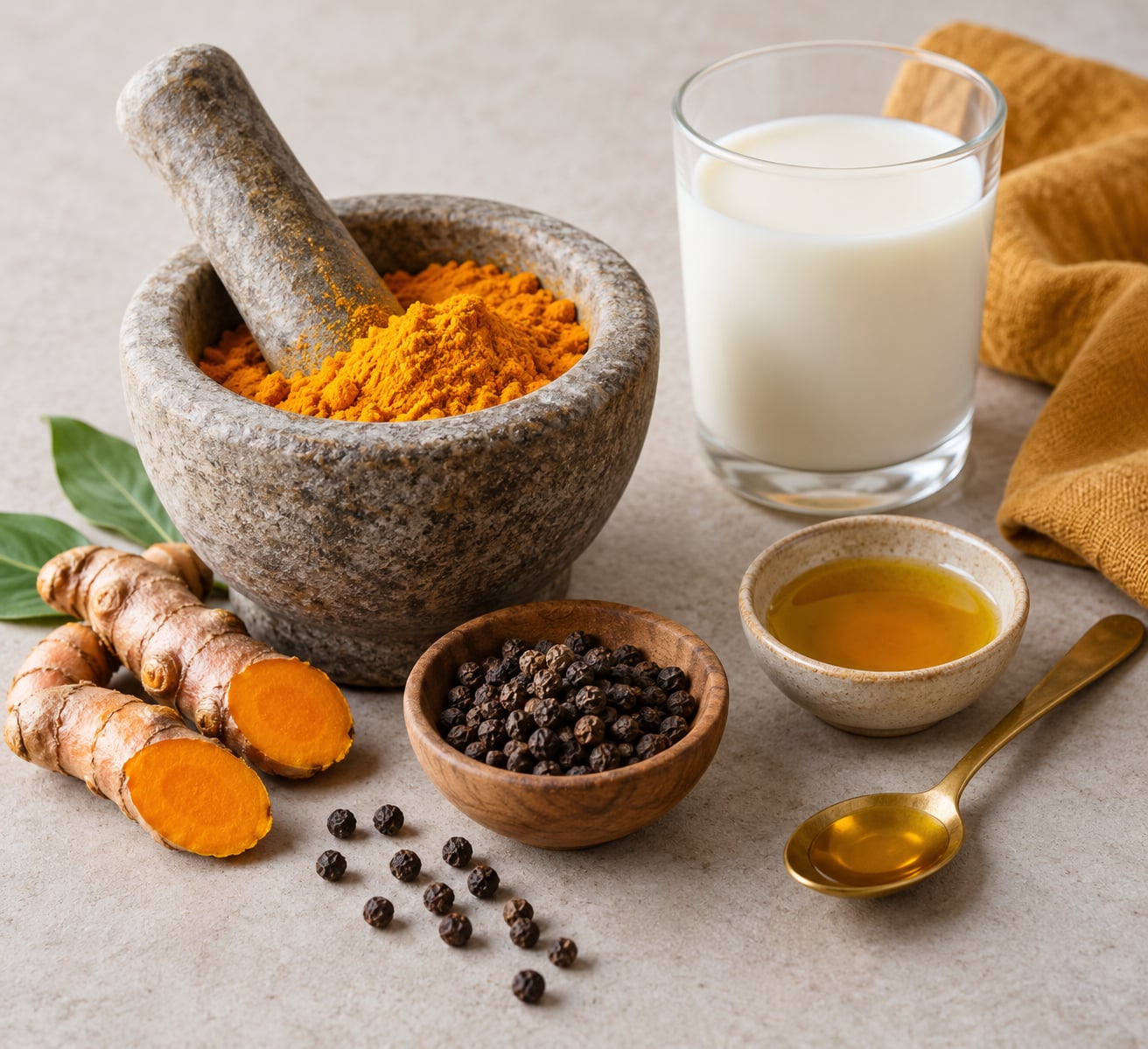
Turmeric’s curcumin is poorly absorbed on its own, and the piperine in black pepper may raise how much reaches your bloodstream by slowing the enzymes and transporters that clear it. That is a real pharmacokinetic effect, but whether it translates into better health outcomes is far less certain. Turmeric absorption with black pepper explained starts with that gap.
It is a distinction most articles skip. They quote a dramatic percentage from a single small study, treat it as settled, and never mention that later researchers have struggled to repeat it.
Table of Contents
- 1Turmeric Absorption With Black Pepper Explained
- 2Why Curcumin Is Difficult to Absorb
- 3What Black Pepper May Do
- 4Why Turmeric Absorption With Black Pepper May Improve
- 5What Human Research Actually Shows
- 6Does the Combination Improve Health Outcomes?
- 7Food, Supplements, and Formulation Differences
- 8Safety and Interactions
- 9Who Should Ask a Healthcare Professional First
- 10Frequently Asked Questions
- 11Does black pepper really increase turmeric absorption?
- 12How much turmeric should I take with black pepper?
- 13Is turmeric with black pepper better than turmeric alone?
- 14Can you absorb curcumin without black pepper?
- 15Can turmeric and black pepper interact with prescription medicines?
- 16Conclusion
Turmeric Absorption With Black Pepper Explained
Curcumin, the bright yellow compound that gives turmeric its colour, does not dissolve well in water and is quickly altered by liver enzymes after you swallow it. Piperine, the pungent molecule in black pepper, appears to interfere with two of the body’s handling systems at once, so more curcuminoid stays in the blood for longer.
Higher blood levels are a pharmacokinetic measurement, not a health benefit. A supplement can raise a compound in your plasma without improving anything you can feel.
Bottom line: black pepper may increase curcumin exposure, and the mechanism is well described. Evidence that the combination improves clinical outcomes is thin, and concentrated piperine supplements carry real interaction risks. Cooking-level use and supplement-level use are not the same activity.
Why Curcumin Is Difficult to Absorb
Turmeric is a plant, and plants ship a mix of compounds. Curcuminoids are the small family that includes curcumin itself, plus demethoxycurcumin and bisdemethoxycurcumin. They are not highly soluble in water, which matters because the gut lining is a water-based environment.
Dissolution is only the first gate. Whatever dissolves still has to cross the intestinal wall, which is built for water-soluble nutrients. Poorly soluble compounds often slide past into the large intestine instead.
Then there is metabolism. The liver and gut wall attach small chemical tags to curcuminoids, a process called glucuronidation. The tagged version is easier to excrete, so it leaves through bile and urine rather than staying in circulation.
Most of a curcumin dose does end up in waste products rather than the bloodstream. That is normal for plant compounds and not a sign the plant is broken.
What Black Pepper May Do
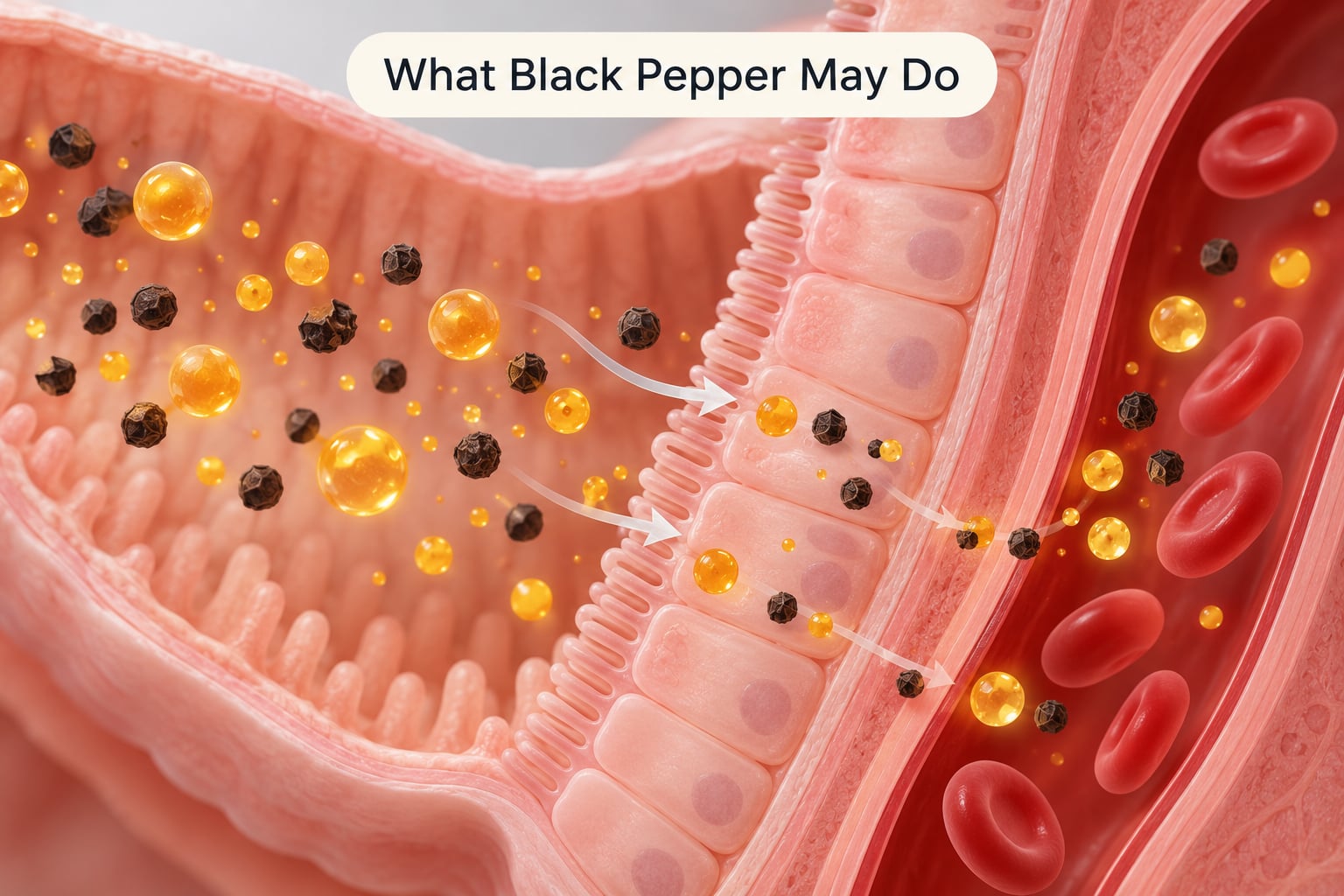
Piperine is an alkaloid that gives black pepper its heat. Researchers have tested it against a range of compounds because it seems to slow several drug-handling systems at once.
Two effects come up repeatedly in the literature. Piperine has been reported to inhibit intestinal and hepatic drug-metabolising enzymes, including members of the cytochrome P450 family, and to interfere with transporters that pump substances out of cells.
That breadth is worth pausing on. A compound that slows drug clearance is useful in a curcumin study and potentially unhelpful in someone taking a prescription medicine with a narrow safety margin.
A plausible mechanism is not proof of a useful effect. Most of this piperine work comes from animal studies, cell cultures, or small human pharmacokinetic trials that measured blood concentrations over a few hours.
Why Turmeric Absorption With Black Pepper May Improve
The idea is straightforward in plain terms. Curcumin enters the gut, gets partly tagged and cleared by enzymes, and only a fraction reaches the blood. If piperine slows both the tagging enzymes and the transporters that push compounds out of intestinal cells, a larger share of the dose stays intact long enough to cross into circulation.
Small human pharmacokinetic studies that measured curcuminoid concentrations after dosing reported higher blood exposure when curcumin and piperine were given together than when curcumin was given alone. That is the observation behind nearly every turmeric-plus-pepper claim you will read.
It is worth noticing what those studies measured. They measured concentration over time, usually in a handful of volunteers, usually once. They did not measure joint pain, mobility, exercise recovery, or any other outcome a person would actually notice.
What Human Research Actually Shows
The number behind most turmeric marketing, 2000 percent higher absorption, traces back to a small 1998 pharmacokinetic study using a specific curcumin formulation with a fixed piperine amount. It has never become a firmly replicated finding.
Several independent research groups have since attempted to reproduce that result and reported more modest increases, or results that depended heavily on the specific formulation and assay method used. Formulas vary in particle size, curcuminoid content, and whether the piperine was a standardised extract.
Two issues recur when reading these papers. Sample sizes are small, so a few participants move the averages a long way. And blood curcuminoid levels are measured with analytical methods that differ in sensitivity, which makes cross-study comparison awkward.
Trials measuring meaningful outcomes are another matter. Studies of curcumin for joint discomfort, exercise recovery, or inflammatory markers often test curcumin alone, sometimes with fat, and rarely use piperine. That leaves the specific pairing largely untested where it counts most.
Does the Combination Improve Health Outcomes?
Probably not established, and this is where turmeric absorption with black pepper gets oversold. Increasing plasma exposure of a compound is a surrogate outcome. It says the molecule reaches the blood, not that it does anything useful there.
Some researchers make a different argument entirely: curcumin is poorly absorbed because the body converts it quickly into metabolites such as tetrahydrocurcumin, and those metabolites may be where much of the activity sits. On that view, suppressing metabolism is not obviously a benefit.
Gut bacteria also chop curcuminoids into smaller compounds in the large intestine. That is a second pathway the 2000 percent figure does not describe at all.
My read of the evidence: the pharmacokinetic effect is plausible and partly supported, the health-outcome case is not established, and no honest writer should promise that the pair treats arthritis, cancer, cardiovascular disease, or infection.
Food, Supplements, and Formulation Differences
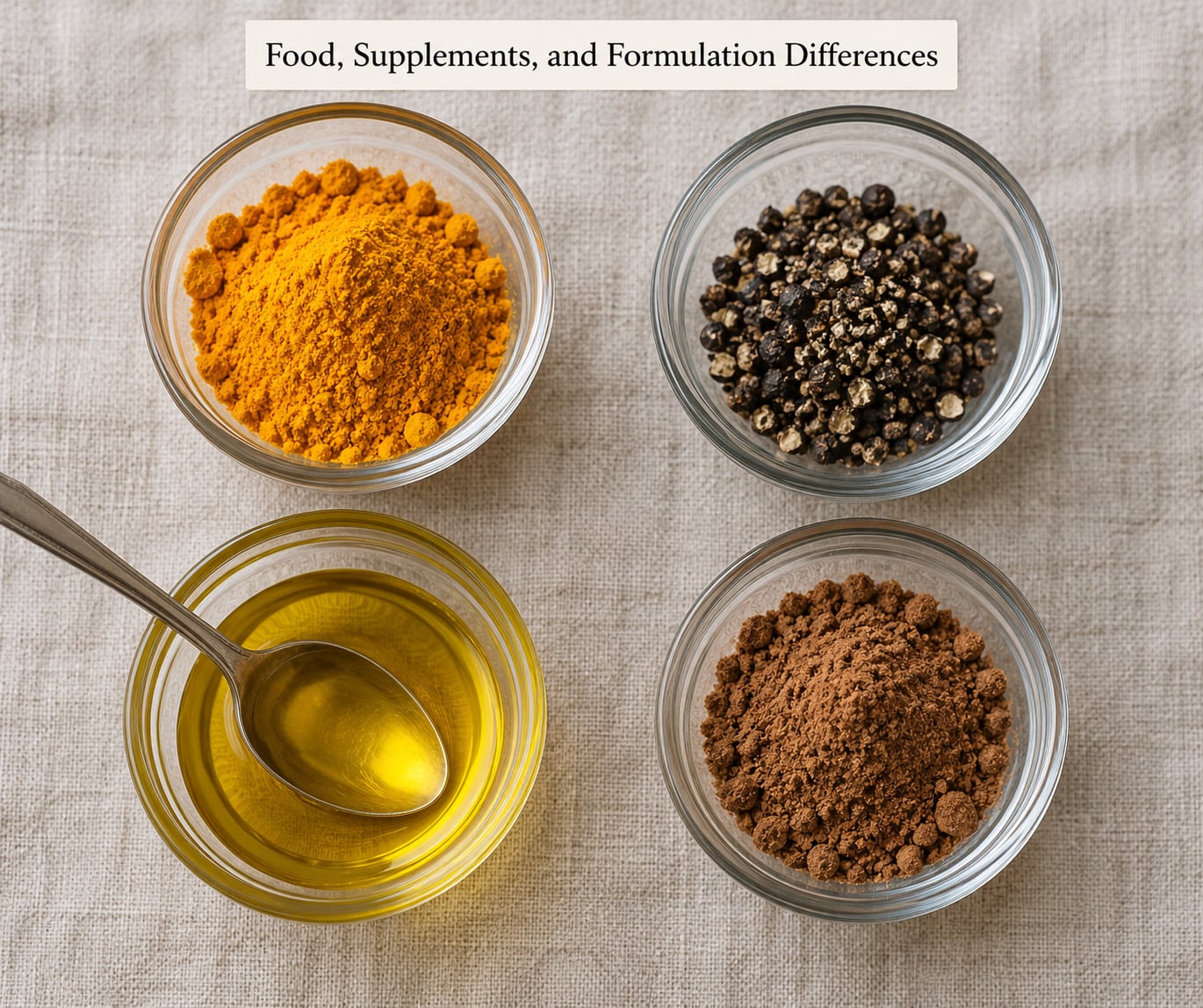
A pinch of pepper in a dal is not a piperine supplement. Culinary turmeric is a plant powder used as a seasoning, and the piperine arrives as part of a food matrix along with other pepper compounds.
Concentrated curcumin supplements are a different category entirely: higher curcuminoid content, often standardised, frequently combined with a purified piperine extract, and taken in a dose no kitchen practice reproduces.
Other factors change absorption too. Curcumin is fat-soluble, so a meal containing fat generally helps more than taking a supplement with water. Particle size matters as well, which is why some formulations use fine powders, micelles, or liposomal preparations that keep the compound dispersed.
Fermented turmeric is a third route. Fermentation changes the plant material, and the products sold on that basis are not directly comparable with either plain powder or piperine-standardised capsules.
Labels vary in what they test and report. A number on a label tells you what was measured, not what happens in your body, so treat two products with identical headline curcuminoids as different until something says otherwise.
Safety and Interactions
Most culinary use carries very little concern. Concentrated curcumin and piperine products are a separate question, and regulators have seen reports of liver injury associated with them.
The pattern in case reports is worth knowing. Injury tends to appear after weeks or months of regular concentrated use, and it often resolves when the product is stopped. People who already have liver or gallbladder conditions seem more prone to problems.
Piperine also slows drug handling, which cuts both ways. It may increase exposure to medicines you take, including anticoagulants and antiplatelet drugs, some diabetes medicines, and drugs with a narrow therapeutic window where a small rise in blood level matters.
That is why anyone on daily prescriptions should ask a pharmacist before adding a piperine product, not because a pinch of pepper in food is dangerous but because a standardised extract is a pharmacologically active substance.
Gastrointestinal upset, nausea, and reflux are also reported more often with concentrated curcumin, and taking it on an empty stomach tends to be harder on some stomachs than taking it with food.
Who Should Ask a Healthcare Professional First
Check with a doctor or pharmacist before a concentrated turmeric or piperine supplement if you are pregnant or breastfeeding, if you have gallbladder or bile-duct disease, or if you are scheduled for surgery in the near term.
The same applies if you have an existing liver or kidney condition, a history of reaction to supplements, or take any prescription medicine regularly.
Food-level use is generally treated as distinct from high-dose supplementation, and the two are often discussed as if they carried the same risk. They do not. A qualified clinician can tell you which category any given product falls into.
Frequently Asked Questions
Does black pepper really increase turmeric absorption?
Small human pharmacokinetic studies report higher blood curcuminoid levels when curcumin and piperine are taken together, and the mechanism is well described: piperine slows enzymes and transporters that clear curcumin. The widely quoted 2000 percent figure comes from a single small 1998 study that later groups have struggled to reproduce. Expect a real but more modest effect, and treat blood levels as a laboratory measure rather than a health benefit.
How much turmeric should I take with black pepper?
This is a question for a doctor or pharmacist, especially if you take prescription medicines, because both curcumin and piperine can affect how drugs are handled and there is no single dose that suits everyone. What is well documented is that curcumin is fat-soluble, so taking it with a meal containing some fat generally helps more than taking it on an empty stomach.
Is turmeric with black pepper better than turmeric alone?
Better for one narrow thing: getting more curcumin into your bloodstream. Whether that produces better joint comfort, recovery, or any other measured health outcome is not established, because most trials of those outcomes use curcumin without piperine. Some researchers also argue that blocking curcumin metabolism is not necessarily a benefit, since its metabolites may be where much of the activity sits.
Can you absorb curcumin without black pepper?
Yes, partially. Curcumin reaches the blood without piperine, just at much lower levels, and it is converted into metabolites along the way. You can also improve absorption without black pepper by taking it with a meal containing fat, choosing a finer or micellar formulation, or using fermented turmeric. The popular belief that turmeric is useless without piperine is a simplification, not a fact.
Can turmeric and black pepper interact with prescription medicines?
They can, and piperine is the main reason. Piperine has been reported to slow cytochrome P450 enzymes and drug transporters, which can raise blood levels of other medicines. Concerns are highest for anticoagulants, antiplatelet drugs, some diabetes medicines, and any drug with a narrow therapeutic range. Ask a pharmacist to check your specific list before starting a concentrated supplement.
Conclusion
Black pepper’s piperine may raise curcumin exposure, and that mechanism is real enough to explain why the pairing looks sensible. Strong evidence that it improves health outcomes is limited, and the famous percentage behind the idea rests on a small study that has not been reliably repeated.
Start by treating turmeric in food as food, and give it some fat in the same meal. Read supplement combination labels carefully, since a standardised piperine extract is not the same as seasoning your rice. If you take any daily medicine, ask a pharmacist or doctor about interactions before adding a concentrated product.