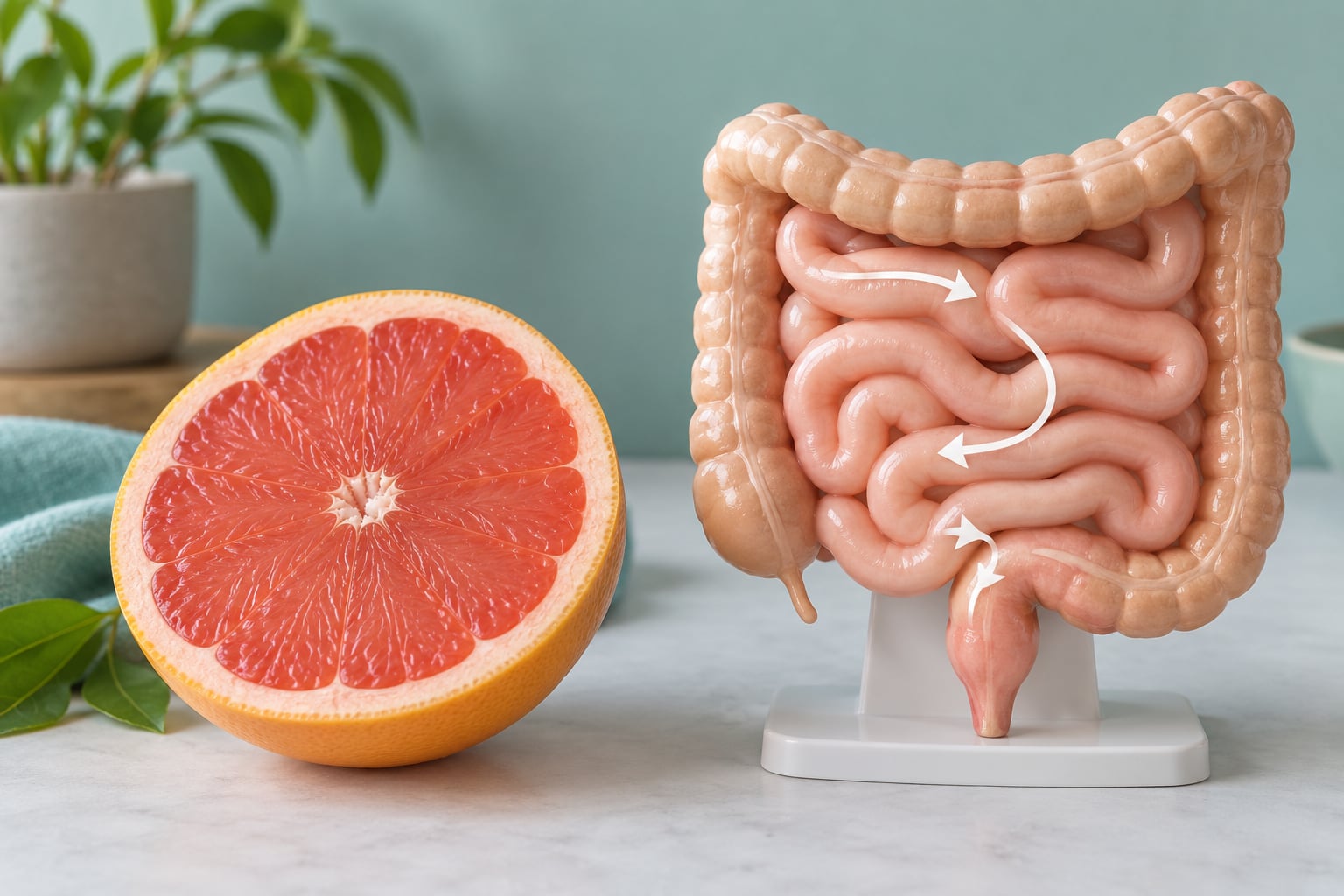
Grapefruit affects medication absorption because compounds called furanocoumarins in the fruit switch off an enzyme in your gut wall called CYP3A4. That enzyme normally destroys part of an oral dose before it reaches the bloodstream. Block it and more of the drug gets in, sometimes several times more than intended, which is why a harmless piece of fruit can turn a correctly dosed medicine into something that feels like an overdose.
This is a food-drug interaction, and it is not exotic or rare. Drug interaction checkers flag grapefruit against dozens of common prescriptions, from cholesterol-lowering statins to blood pressure tablets. The mechanism behind why grapefruit affects medication absorption was mapped by Bailey and colleagues in a review published in the Canadian Medical Association Journal, and their team has kept counting the drugs affected: the number of serious offenders rose from 17 to 43 between 2008 and 2012, and it keeps climbing as new medicines are designed around this same enzyme.
Below is what is actually happening in the body, which medicines are involved, and the questions worth asking a pharmacist. Nothing here is a substitute for individual medical advice.
Table of Contents
- 1Why Grapefruit Affects Medication Absorption
- 2How Grapefruit Affects Medication Absorption Step by Step
- 3Why the Effect Lasts Up to Three Days
- 4Which Medications Can Be Affected?
- 5Drugs That Are Not Affected Within the Same Class
- 6When Grapefruit Lowers Absorption Instead
- 7Why Some People Are More Vulnerable
- 8What Other Citrus Fruits Can Do
- 9How to Check Before Taking a Medicine
- 10Frequently Asked Questions
- 11How long does a grapefruit interaction last?
- 12Does grapefruit interact with every medicine I take?
- 13Is it safe to eat grapefruit while taking medication?
- 14Can grapefruit affect the absorption of supplements?
- 15What should I do if I took grapefruit with a medicine?
- 16Are oranges and other citrus fruits safer than grapefruit?
- 17What to Do First
Why Grapefruit Affects Medication Absorption
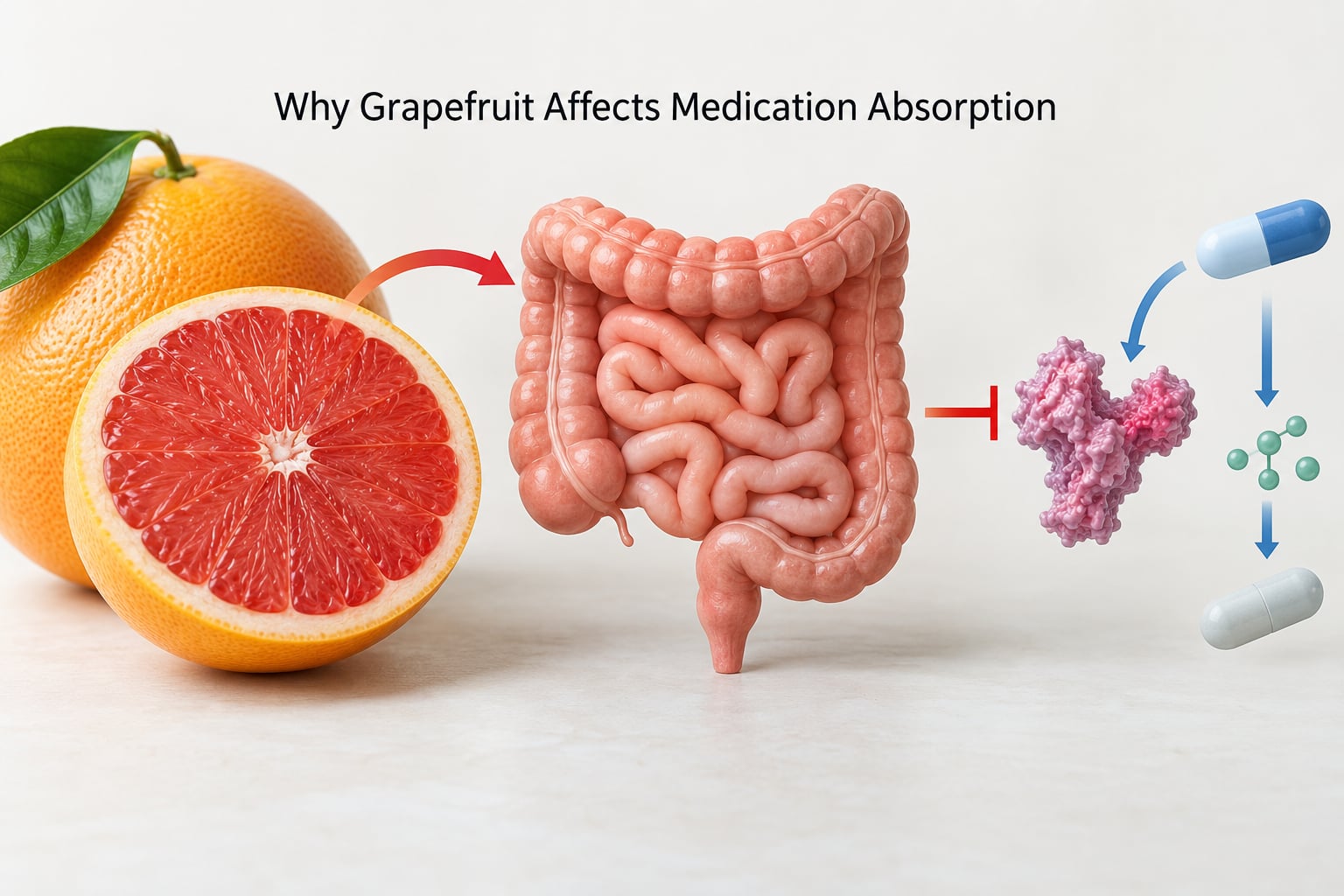
The short version: grapefruit does not add anything to the medicine. It removes part of your body’s filtering system for about a day to three days, and a drug that was designed to be partly discarded in the gut now passes through almost intact.
Three terms do most of the explaining here. CYP3A4 is a member of the cytochrome P450 family of enzymes, present in the liver and in the lining of the small intestine, that chemically breaks down a large share of the medicines people swallow. First-pass metabolism is the ordinary filtering step in which the gut and liver destroy some of an oral dose before it reaches circulation. Bioavailability is the share of the dose that reaches the bloodstream intact. Change the first and the third move together.
So the logic of why grapefruit affects medication absorption is straightforward. Block the gut enzyme, less of the dose gets destroyed on the way in, and the amount circulating in the blood goes up.
How Grapefruit Affects Medication Absorption Step by Step
- You swallow grapefruit products. Juice, whole fruit, marmalade and extracts all carry the active compounds, and juice delivers a far larger and more consistent dose than a segment does.
- Furanocoumarins reach the gut lining. These plant compounds are the ones doing the interfering. The most studied of them is 6′,7′-dihydroxybergamottin, usually shortened to DHB.
- Intestinal CYP3A4 is inhibited. The enzyme is not merely slowed, it is switched off in a way that does not reverse when the compound leaves. Scientists call this mechanism-based, or irreversible, inhibition.
- Less drug is metabolised before absorption. The gut no longer filters the tablet, so the share that reaches the bloodstream climbs. Blood concentration rises and side effects appear that the dose was never meant to cause.
One detail worth holding on to: the liver’s copy of CYP3A4 matters less here than the gut’s. The gut wall is the dominant site for this interaction, which is why a large glass of juice matters more than a few segments and why daily drinkers are the group most often affected.
Why the Effect Lasts Up to Three Days
The most persistent myth in this topic is that spacing doses out solves the problem. It does not. If you ate grapefruit this morning and take the tablet tonight, the enzyme is still blocked tonight.
The recovery is slow because the inhibition is irreversible. Your body does not repair the blocked enzyme; it discards it and manufactures new protein, and synthesising fresh CYP3A4 takes roughly one to three days. Health Canada’s public health guidance and other public health authority pages are explicit that an interaction can still be relevant up to three days after the fruit.
That has a practical consequence. The risk from a drug is not tied to how much grapefruit you had on one afternoon; it is tied to how often you have it. A single segment once in a while and a daily glass of juice are different situations, and a person who drinks a quart of juice every day is in a different category again.
Which Medications Can Be Affected?
Only oral drugs that are meaningfully metabolised by intestinal CYP3A4, and that have low or moderate bioavailability to begin with, are candidates. A drug that is mostly broken down elsewhere, or almost fully absorbed anyway, has less to lose. Two features from the Bailey review are worth remembering: the medicine has to be taken by mouth, and it has to rely on the gut for a large share of its clearance.
| Medicine group | Examples | Direction of effect | What a person may notice |
|---|---|---|---|
| Cholesterol-lowering statins | Simvastatin, atorvastatin, lovastatin | Levels rise substantially | Muscle pain and weakness, and in rare cases severe muscle breakdown |
| Calcium channel blockers | Nifedipine, felodipine, amlodipine | Levels rise | Dizziness, flushing, low blood pressure, ankle swelling |
| Antiarrhythmics | Amiodarone, dronedarone | Levels rise | Palpitations, a slow or irregular pulse, feeling light-headed |
| Immunosuppressants | Tacrolimus, cyclosporine, sirolimus | Levels rise sharply | Kidney effects, tremor, mouth ulcers; transplant patients are monitored closely for this |
| HIV protease inhibitors | Saquinavir and related agents | Levels rise | Unwanted effects that can compromise treatment |
| Erectile dysfunction medicines | Sildenafil, tadalafil | Levels rise | Prolonged erection, flushing, low blood pressure |
| Anti-anxiety and sedative medicines | Diazepam, buspirone, sertraline | Levels rise | Extra drowsiness, slowed reactions, unsteadiness |
| Some pain and anti-nausea medicines | Fentanyl, some opioids and antiemetics | Levels rise | Sedation, confusion |
| Some antihistamines | Fexofenadine | Absorption goes down | The dose simply works less well; the fruit nullifies the medicine |
Yes, grapefruit can affect blood pressure medication. Calcium channel blockers such as nifedipine and felodipine are on that list, and a 2007 analysis in US Pharmacist reported felodipine exposure rising by about 200 percent and amiodarone exposure by about 50 percent with grapefruit juice.
The most cited single figure comes from the simvastatin trial summarised by Western University’s Schulich School of Medicine: 200 mL of grapefruit juice daily for three days produced about 330 percent of the systemic concentration that water produced. Not every person gets that response, but it explains why regulators treat the fruit seriously rather than fussily.
Drugs That Are Not Affected Within the Same Class
This is the part most warning labels skip, and it matters because blanket avoidance sounds safer than it is. Not every statin interacts, and not every sedative does.
- Statins: pravastatin, rosuvastatin and fluvastatin are not metabolised by CYP3A4, so grapefruit does not raise their levels the way it does for simvastatin or atorvastatin. A doctor can switch within the class rather than change the treatment goal.
- Benzodiazepines: lorazepam and oxazepam undergo a different metabolic route and are considered unaffected, while diazepam and similar long-acting agents are on the affected list.
- Non-oral routes: anything injected, implanted or taken as a skin patch bypasses the gut wall entirely.
- Many over-the-counter products: most are not CYP3A4 substrates at all, which is why some people meet this warning on a prescription and assume every pill on the shelf is affected.
Two questions from the discussion layer come up constantly here: can I drink grapefruit juice while taking lorazepam, and is it safe to eat grapefruit while taking Zoloft? Lorazepam falls in the unaffected group. Sertraline is metabolised by CYP3A4 to some extent, so it belongs in the group where you ask a pharmacist rather than assume either way.
When Grapefruit Lowers Absorption Instead
Most people hear “interaction” and picture too much drug. Not all of them go that way. Fexofenadine is the standard example: grapefruit and some other fruit juices reduce how much of it is absorbed, so the medicine underperforms and the allergy relief fades.
Two mechanisms explain this. Fruit juices are acidic and can change the environment that lets a drug dissolve and cross the gut lining, and they can inhibit transporters such as P-glycoprotein that help move drug molecules across cell membranes. This is the clearest answer to why grapefruit affects medication absorption in both directions, and it is the reason a nullified dose deserves the same attention as a doubled one.
Why Some People Are More Vulnerable
The interaction is dose-independent in an unusual sense: it is not about how many pills you take, it is about whether the medicine you take happens to be a CYP3A4 substrate. That means a person on one qualifying tablet a day can have a serious interaction, and a person on ten unrelated tablets can have none.
Risk climbs in a few predictable ways.
- Age. The Bailey review and the summaries of it flag people over 45 as the highest-risk group. They buy and drink more grapefruit, hold more prescriptions, and tolerate high drug levels less well.
- Several medicines at once. Each additional qualifying drug is another chance for an interaction, and combination products often hide a CYP3A4 substrate under a familiar brand name.
- Liver or gut health. People with existing liver disease or a history of liver transplant have less metabolic capacity to absorb a surprise dose safely.
- Daily versus occasional intake. Most published thresholds describe regular, large volumes. About 32 ounces, roughly a quart, a day is the figure public pharmacist sources cite for clinically meaningful CYP3A4 inhibition, and juice concentrates and extracts sit above ordinary fruit again.
- Transplant care. Immunosuppressant recipients are the classic high-risk group, and their blood levels are measured closely for exactly this reason.
None of this is a reason to stop a medicine. Transplant drugs, seizure medicines, heart medications and steroids are stopped or adjusted only under a clinician’s direction, and an unplanned change can be more dangerous than the fruit.
What Other Citrus Fruits Can Do
The most-asked question in reader discussions is why grapefruit gets singled out while oranges and lemons are fine. The answer is chemistry, not tradition: oranges, lemons, limes and tangerines contain no meaningful furanocoumarin load, so they do not inhibit CYP3A4. Grapefruit is not a citrus synonym, it is a specific chemistry.
A small group of other citrus and citrus-like fruits do carry furanocoumarins and belong in the same conversation.
| Fruit or product | Furanocoumarins | How to treat it |
|---|---|---|
| Grapefruit, juice, marmalade, extract | Present | Treat as the main offender |
| Seville orange (bitter orange) | Present | Treat like grapefruit |
| Pomelo (citrus maxima) | Present | Treat like grapefruit |
| Lime and mandarin, especially certain hybrids | Varies by variety | Ask a pharmacist rather than assuming |
| Orange, mandarin, lemon, common lime | Not meaningfully present | No CYP3A4 concern from the fruit itself |
| Grapefruit-flavoured soda, gum, flavoured water, gummies | Depends on juice content | Check the label; a trace flavouring is not the same as a glass of juice |
| Herbal and supplement products | Varies | Bring the label to the pharmacist |
Hidden sources cause most of the confusion. Grapefruit appears in soft drinks, flavoured waters, candy, salad dressings and some herbal blends, and a label may say “natural flavour” without stating whether juice is present. A heavily juiced blend soda and a grapefruit-scented hand soap are not the same exposure, and a pharmacist can tell you which one you are actually dealing with if you bring the product.
Because citrus compounds travel in plant families rather than fruit names, some herbal products deserve the same caution. That is a useful link between this mechanism and the way plant medicines are assessed in general: the question is always which compounds are present, not what the label calls the plant.
How to Check Before Taking a Medicine
You do not need to memorise a drug list. You need five habits.
- Read what your medicine says. Package inserts and pharmacy leaflets list food interactions in the warnings section, and the ones that matter here mention grapefruit or juice by name.
- Ask a pharmacist the specific question. “Does grapefruit interact with this?” is better than “Is fruit bad with my pills?” Give them the exact fruit product, including whether it is juice, marmalade, a blend soda or a scented supplement.
- Run it through an interaction checker. Free checkers from pharmacy chains and health systems are useful for a first pass, and the pharmacist confirms what the tool found.
- Keep one written list. Prescriptions, over-the-counter medicines, vitamins and herbal products in one place, and share it at every visit. People usually discover this interaction late, after a pharmacy error or an emergency visit, and a list prevents that.
- Do not self-adjust. Skipping a dose, doubling up, or spacing tablets around the fruit are all decisions for a clinician, especially with medicines that have a narrow safe range.
If you have already eaten grapefruit and taken a qualifying medicine, the sensible move is to note the date, the amount and the medicine, and mention it to your pharmacist or prescriber at the next contact. Some people are asked to have a blood level checked. Nobody should stop the medicine on their own.
Watch for symptoms that people rarely connect to a piece of fruit. Unexplained muscle pain or weakness on a statin, unusual sleepiness or slowed reactions on a sedative, dizziness or a drop in blood pressure on a blood pressure tablet, or an erection lasting longer than expected on an erectile dysfunction medicine. Anyone who cannot breathe properly, faints, or develops a rapid or irregular heartbeat needs urgent medical care rather than a next-week appointment.
Frequently Asked Questions
How long does a grapefruit interaction last?
Because the inhibition of intestinal CYP3A4 is irreversible, the effect fades only as your body builds new enzyme, which usually takes about one to three days. A dose taken the evening after the fruit is not protected from an interaction that happened that morning. People who drink grapefruit juice regularly stay in the affected state continuously rather than recovering between glasses.
Does grapefruit interact with every medicine I take?
No. It matters for oral drugs that are substantially metabolised by intestinal CYP3A4 and that are not already almost fully absorbed. Many medicines are unaffected, and even within one class the answers differ: atorvastatin interacts while rosuvastatin and pravastatin do not, and diazepam interacts while lorazepam does not. Anything injected or taken as a patch bypasses the gut entirely.
Is it safe to eat grapefruit while taking medication?
It depends entirely on the medicine, and that is a question for your pharmacist rather than a general rule. On some drugs a small occasional serving is unremarkable, on others it is genuinely risky. Public sources often cite about 32 ounces of juice a day as the level associated with clinically meaningful enzyme inhibition, but individual response varies. Bring the exact medicine and the exact fruit product to the counter.
Can grapefruit affect the absorption of supplements?
Supplements are not automatically exempt. Anything with a herb or botanical ingredient can contain compounds that act on the same enzymes and transporters, and grapefruit-flavoured gummies and drink mixes do contain juice. Dietary supplements are also poorly studied, so interaction data is thinner than for prescriptions. Bring the label to a pharmacist instead of assuming a supplement counts as food.
What should I do if I took grapefruit with a medicine?
Do not stop or change the medicine yourself. Write down the fruit, the amount and the time, then tell your pharmacist or prescriber, ideally the same day. Depending on the drug they may want to monitor you or check a blood level. Seek urgent care for difficulty breathing, fainting, or a fast or irregular heartbeat, and contact a clinician for severe muscle pain or marked drowsiness.
Are oranges and other citrus fruits safer than grapefruit?
Ordinary oranges, lemons, mandarins and common limes contain no meaningful furanocoumarin load, so they do not inhibit CYP3A4 in the way grapefruit does. The exceptions worth checking are Seville or bitter oranges, pomelos, and certain lime and mandarin varieties. A short list is misleading, though, because some medicines interact with citrus for acidity or transporter reasons that have nothing to do with furanocoumarins.
What to Do First
Start with two specifics: the name of the medicine and the exact grapefruit product. Take both to a pharmacist and ask whether the combination is safe for you, because the answer depends on which enzyme route your medicine uses, not on the fruit in general.
Grapefruit is not a legitimate way to change how a medicine is absorbed, and no one should stop, restart or reschedule a medication without professional guidance. If you have already had the fruit, note it, keep taking the medicine as prescribed, and mention it at your next contact.
Mechanistic claims here draw on the Bailey and colleagues review in the Canadian Medical Association Journal, public health authority guidance on drug-food interactions, and analysis published in US Pharmacist. Individual questions belong with a doctor or pharmacist who can see your full medication list.