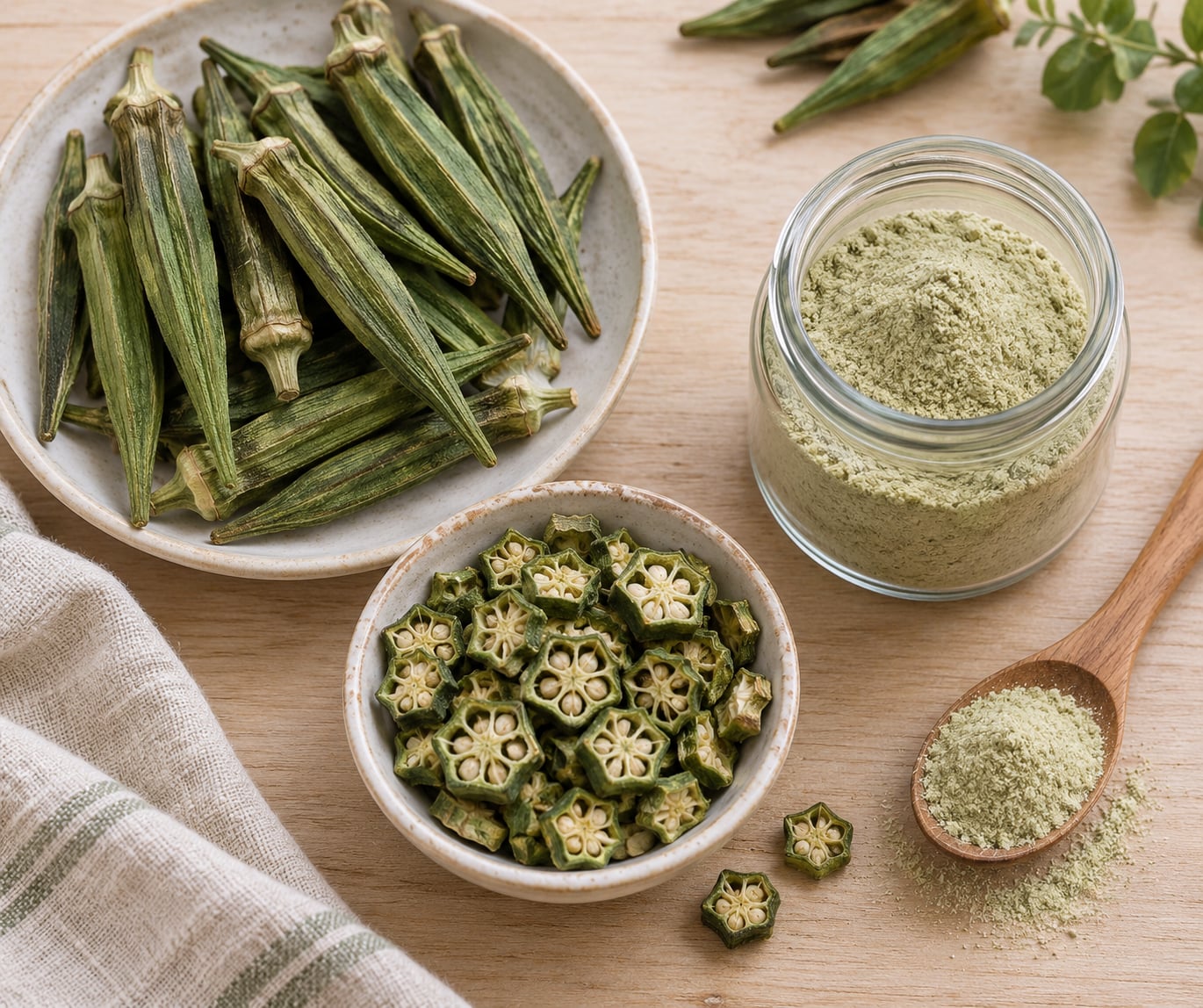
Dried okra is fresh okra (Abelmoschus esculentus) with the water taken out, and it arrives in four useful forms: whole dried pods, sliced okra chips, okra powder made from ground dried pods, and dried okra seeds. This guide walks through dried okra uses and preparation for home cooks, from choosing and storing a jar to soaking, cooking and storing it, plus the nutrition, safety and quality problems worth knowing about.
The short answer is that drying solves two problems at once. It turns okra that would have gone soft in the fridge into something that keeps for a year in a fraction of the space, and it removes the slippery mucilage that turns a lot of people off the vegetable altogether.
Okra is called okro across much of West Africa, and both spellings show up in recipes. Here I use both, because if you search one term you will miss half the useful cookery information.
Table of Contents
- 1What Are Dried Okra Pods?
- 2The four forms you will actually find
- 3What Are the Main Dried Okra Uses?
- 4Thickening soups and stews
- 5Dried okro powder in West African soups
- 6Seasoned okra chips
- 7Long-term food stores and soup mixes
- 8Dried okra seeds
- 9Where the traditional claims stop
- 10How Do You Choose and Store Dried Okra?
- 11How Do You Prepare Dried Okra for Cooking?
- 12Dried Okra Uses and Preparation Methods
- 13How Do You Cook Dried Okra Without Making It Slimy?
- 14How Much Dried Okra Should You Use?
- 15What Are the Health Benefits and Limits?
- 16What Safety and Quality Problems Should You Watch For?
- 17Frequently Asked Questions
- 18Can dried okra be ground like okra powder?
- 19Why does my dried okra remain hard after soaking?
- 20Can dried okra be used in place of fresh okra?
- 21How can I tell whether dried okra is still good to use?
- 22Are fermented or sprouted dried okra preparations safe to make at home?
- 23Does dried okra provide the same nutritional value as fresh okra?
- 24Conclusion
What Are Dried Okra Pods?
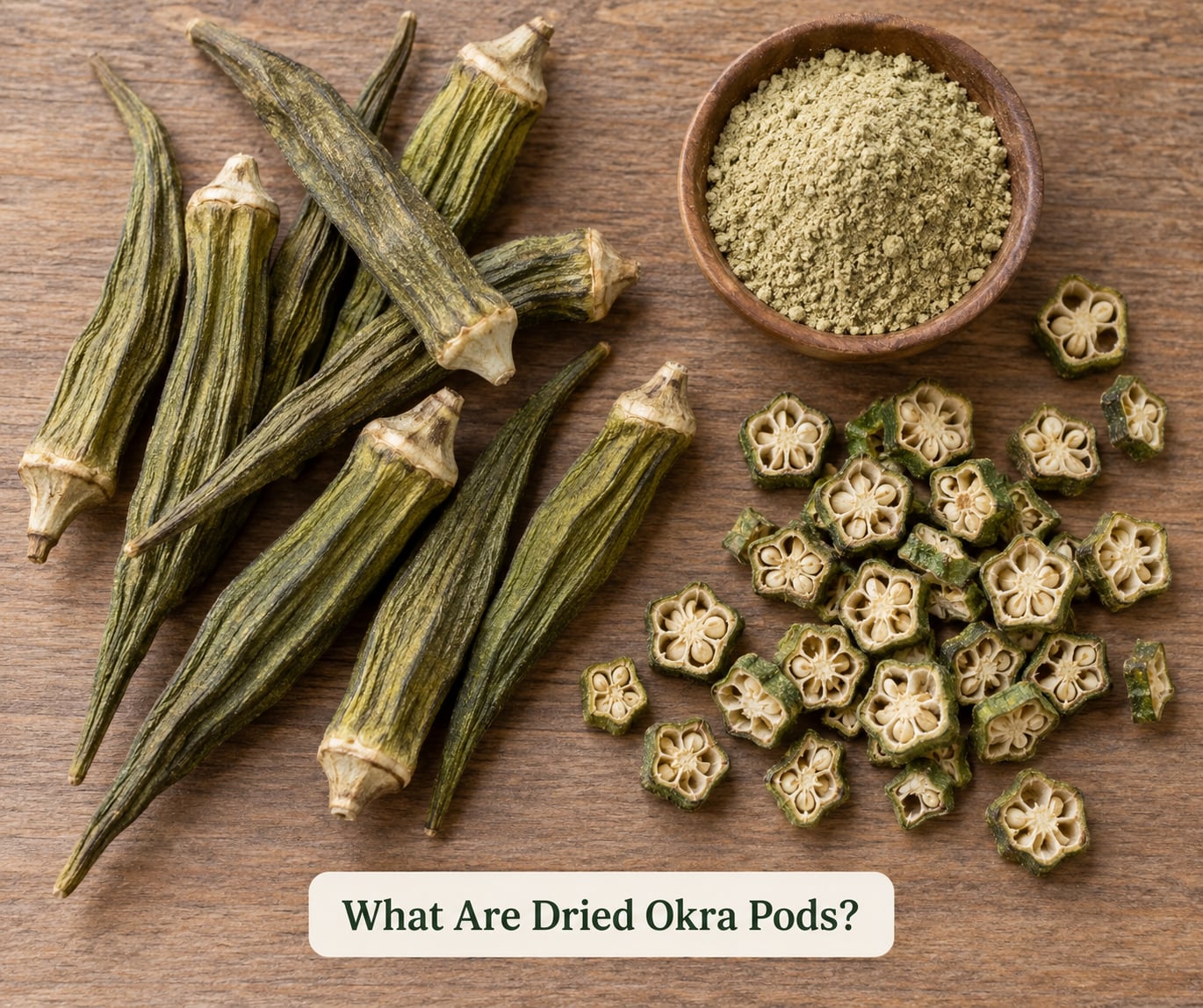
Drying changes three things at once: texture, flavour and how long the pod keeps. The soft, slippery bite becomes something crisp or leathery depending on the method, the grassy vegetable flavour concentrates into something closer to a nuttier, more intense note, and the shelf life moves from a few days in the fridge to a year or more in a sealed jar.
The slipperiness itself has a name. Mucilage is the gel that okra releases when its pods are cut or chopped, a soluble polysaccharide that swells with water and thickens whatever it sits in. That same gel is why fresh okra works as a thickener in gumbo and ogbono soup. Drying collapses it, which is why dried okra behaves so differently in the pot.
The four forms you will actually find
- Whole dried pods kept intact for storage, then broken or soaked before cooking. They take the longest to rehydrate.
- Sliced okra chips dried thin, with or without seasoning, eaten as a snack or crumbled into soups and stews.
- Okra powder also called dried okro powder or ochi in some regions, ground from fully dried pods. It dissolves into soup and is the form used most often in West African cookery.
- Dried okra seeds saved from mature pods, used as a spice, a tea-like infusion, or kept for planting next season.
One warning about sourcing: plenty of dried okra sold online is decorative material meant for crafts. If a listing never mentions food, ingredients or a use-by date, it is not what you want in a pot.
What Are the Main Dried Okra Uses?
Four uses cover almost everything people do with dried okra: thickening, seasoning, snacking and storing. Knowing which form you hold tells you which of the four you can do today.
Thickening soups and stews
Yes, dried okra thickens. Ground powder stirred into a simmering pot gives body to soups, stews and sauces much the way fresh okra does, and rehydrated slices do the same job more gently. Add it in stages, whisk or stir between additions, and give it a few minutes to swell before judging the consistency.
Dried okro powder in West African soups
This is the largest culinary use of dried okra anywhere in the world, and the one least covered in English-language guides. Dried okro powder goes into egusi soup and ilela soup, the thickened soups built on ground melon or similar seeds, and into lighter soups where only the vegetable body is wanted. It works with ogbono, the draw-thickened soup, though ogbono has its own dried draw substitute and many cooks use one or the other rather than both.
Egusi is a seed-based soup, not okra soup, and that distinction trips people up. Okra powder in that pot is there for body and flavour alongside the egusi seeds, and cooks add locust bean paste for depth and fermented flavour.
The technique matters more than the quantity. Bring the pot to a simmer first, then add the powder a spoonful at a time while stirring. Powder dumped into cold liquid clumps, and no amount of later stirring gets those lumps out.
Seasoned okra chips
Slice pods thin, dip or brush them in a little vinegar, dust with paprika, then dry. Garlic, chili, cumin and smoked salt all work. The vinegar is not optional in the best versions: it seasons the slice and it helps the finished chip stay brittle rather than leathery.
Long-term food stores and soup mixes
Dried okra is lightweight, keeps without refrigeration and rehydrates in minutes, which makes it a sensible component of an emergency food supply or a layered soup mix packed in a jar. Ground okra travels well in a sealed pouch and needs no special handling.
Dried okra seeds
Seeds from fully mature, dry pods are edible once roasted or ground as a spice, and they brew as an infusion in several traditions. Savers keep them whole and dry for the next planting season, which is a different use from the same seed.
Where the traditional claims stop
Okra features in African, South Asian and Caribbean foodways, and it appears in a long list of folk remedies for everything from coughs to high blood sugar. Food is not medicine and tradition is not evidence. Some laboratory and small human studies have looked at okra extracts and okra fibre, and they are interesting, but they do not establish dried okra as a treatment for any condition. Treat those claims as cultural history, and talk to a clinician about anything affecting your health.
How Do You Choose and Store Dried Okra?
Good dried okra looks dull and feels boring. You want even colour, a clean smell, and pieces that snap rather than bend. If the bag feels soft and cold in the middle, the drying never finished and mould is already working inside.
Look for a visible ingredient or country-of-origin line on the packet, a use-by date where the seller provides one, and packaging that is properly sealed. Decorative craft okra usually has none of these, which is the fastest way to tell the two apart.
Once it is home, moisture is your enemy. Airtight glass jars with a desiccant packet work well; vacuum-sealed pouches do better. Label the jar with the date you filled it, and keep it in a cool dark pantry rather than beside the stove.
When you open a jar for the first time, the pieces should be hard and rigid. If they bend like fresh okra, put them back in a dehydrator or low oven with the tray out for a few more hours. Condensation on the inside of the jar usually means the batch was still damp when it was sealed.
| Form | Container | Expected shelf life (cool, dark, airtight) |
|---|---|---|
| Whole dried pods | Airtight glass jar, desiccant packet | 9 to 12 months |
| Sliced okra chips | Airtight jar or vacuum pouch | 3 to 6 months before losing crunch |
| Okra powder | Sealed jar or pouch | 9 to 12 months |
| Dried okra seeds | Dry jar | 1 to 2 years for replanting; 6 months ground as spice |
Treat those as realistic figures rather than guarantees. Humidity, a failed seal or a warm kitchen shortens every one of them.
How Do You Prepare Dried Okra for Cooking?
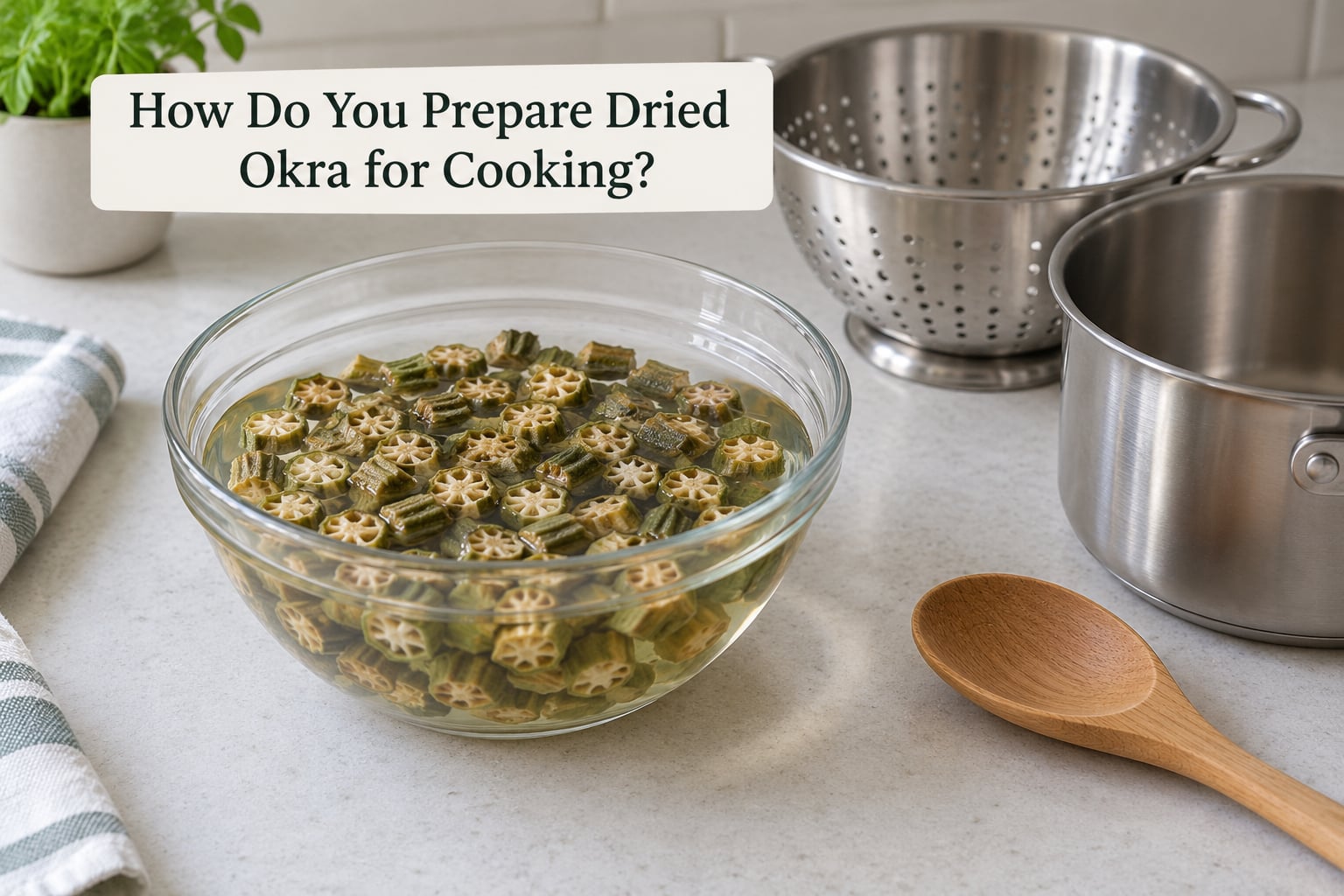
Preparation depends entirely on the form. Powder skips straight into the pot. Whole pods need time. Chips need almost none.
- Pick over the batch. Tip the dried okra onto a plate and remove anything that is not okra. Grit, stem fragments and small stones turn up more often in whole pods than in powder.
- Rinse briefly. Run the pieces under cold water for a few seconds. Dried okra does not need a long rinse like dried beans, and a hard scrub can wash away flavour.
- Decide whether to soak. Whole pods and thick slices usually benefit from 20 to 40 minutes in cool water. Thin chips and powder do not. Soaking long enough to need it is the usual cause of mushy dried okra.
- Drain well. Tip the soaking water away and press the pieces dry in a colander or a clean towel. Water carried into the pot is water that thickens the broth unevenly.
- Break or cut to size. Whole dried pods snap easily into 2 to 3 cm lengths. Cutting smaller means more surface, more moisture loss and a thinner texture.
- Add to the pot in stages. Whole pieces and slices go in with your other vegetables early enough to cook through. Powder goes in to simmering liquid, a spoonful at a time, with stirring.
- Test for tenderness. A piece should bend without snapping when squeezed and should cut easily with a spoon. If it still feels fibrous after the rest of the dish is done, give it ten more minutes rather than serving it tough.
Dried Okra Uses and Preparation Methods
| Method | Rehydration | Resulting texture | Best for | Watch out for |
|---|---|---|---|---|
| Cook straight from dry, sliced | None | Firm, slightly fibrous | Soup, stew, gumbo added early | Needs long simmering; season at the end |
| Soak first, then cook | 20 to 40 minutes | Softer, rounder | Stews, sauces, mixed vegetables | Over-soaking turns it to paste |
| Whole pod, rehydrated | 40 minutes or more | Soft with a slight chew | Battered and fried, whole-pod dishes | Check the centre, not just the outside |
| Ground powder | Stirred into hot liquid | Smooth body, no pieces | Egusi, ilela, soups, sauces, marinades | Lumps if added to cold liquid fast |
| Sprouted or fermented | Several days in water | Soft, sour, sprouted | Traditional preparations by experienced hands | Needs controlled conditions; see safety section |
How Do You Cook Dried Okra Without Making It Slimy?
The mucilage comes back the moment dried okra meets water, so you manage it rather than fight it. Five levers do most of the work: soak time, cut size, heat, liquid volume and how the dish is served.
Cutting smaller releases more gel. If you want visible pieces with a clean flavour, keep cuts chunky and add them late in the cooking. If you want a thick, smooth body, cut small, add early and stir often.
Heat keeps the difference too. A hard boil agitates the gel and makes it ropey, so simmer dried okra gently and stir at the bottom of the pot where it settles.
Liquid does the opposite of what people expect. More liquid thins the finished soup; less liquid concentrates the gel. A thin gumbo with plenty of broth gives you body without a slick surface, which is the standard way this is solved.
And serve it well. Dried okra fried or crisped after cooking carries almost no slipperiness, while the same pieces ladled over rice in a heavy broth carry a lot. That is why okra rice dishes work: the grain and the heat take the texture somewhere pleasant.
In practice, then: soak only the thick pieces, simmer rather than boil, add powder slowly to hot liquid, and give the dish a final stir just before it leaves the heat.
How Much Dried Okra Should You Use?
Think in kitchen ratios rather than doses. Nobody measures dried okra with a medicine spoon, and no published figure exists for a health benefit, because dried okra is a food.
For a pot of soup serving four to six, a tablespoon or two of okra powder is a sensible start. For a whole-pod dish, six to eight dried pods, broken into pieces, covers the same crowd. For a snack plate, a handful of chips per person is plenty because they are light.
Three things move those numbers. Pod size varies enormously, so count pieces rather than weight when you can. Cut size changes the surface that absorbs liquid, so smaller pieces swell more. And grind size matters for powder, because fine powder goes thick faster than coarse.
The reliable method is the one most experienced cooks use: start at the low end, taste, and add more. You cannot take thickening out of a pot, but you can always add broth or water.
What Are the Health Benefits and Limits?
Okra is a nutrient-dense vegetable with soluble and insoluble fibre, vitamin C, vitamin K and potassium. Dried okra keeps the fibre and concentrates everything else per gram, which is why a spoonful of powder carries more than a spoonful of fresh sliced pods.
Here is what the reference picture looks like for fresh okra, and what drying does to it. Values are approximate, per 100 g, from standard composition tables.
| Nutrient (per 100 g) | Fresh okra | What drying changes |
|---|---|---|
| Water | About 90 g | Removed almost entirely; this is the whole point |
| Energy | About 33 kcal | Far higher per 100 g, since water carried no calories |
| Dietary fibre | About 3.2 g | Concentrated; some becomes insoluble and less soluble |
| Protein | About 2 g | Concentrated |
| Vitamin C | About 60 mg | Partly lost to heat and air during drying |
| Vitamin K | About 19 mcg | Reasonably well retained |
| Potassium | About 300 mg | Concentrated |
Read that table carefully rather than as a health claim. Dried okra is not a supplement, and concentrated values per 100 g simply reflect the absence of water. Vitamin C, which is fragile, drops during drying.
Okra cannot be described as a cure for anything. Fibre in the diet supports normal digestion, and vegetables fit into patterns that support long-term health, but no good clinical evidence shows dried okra treating high blood sugar, cholesterol or any other condition. If someone has told you otherwise, a registered dietitian or your doctor is the right person to ask.
Ask a clinician before eating a lot of dried okra if you take medication for diabetes or blood clotting, since okra fibre and its compounds can affect how those drugs work. The same applies during pregnancy and for anyone managing kidney conditions.
What Safety and Quality Problems Should You Watch For?
Drying is not a sterilisation step. It removes the water that spoilage organisms need, and done well it is safe, but a batch that was packed damp gives those organisms their chance back.
Inspect every batch before it goes into a jar. Mould shows as white, green, blue or black growth, and any visible fuzz means the whole jar goes in the bin, not just the affected piece. Smell it too: musty, sour or damp odours mean mould has started even where you cannot see it.
Watch for webbing, live larvae or small holes. Those are insect damage, and they mean the storage area is warm and humid enough for pests. A desiccant packet and a cool pantry prevent most of it.
Check what was added. Plain dried okra is a single ingredient. Some snack products carry oils, salt, garlic powder or anti-caking agents, and some seasoning blends carry colour or anti-caking additives. Read the label, especially if you are avoiding salt, oils or allergens.
Okra is a member of the mallow family, and some people react to it through latex and related fruits such as banana, avocado and kiwi. If you have ever reacted to one of those, treat dried okra as a possible trigger and mention it to your doctor.
Sprouting and fermenting dried okra are traditional techniques that work, and they also create conditions where contamination is easy to miss. They need controlled water, controlled temperature and time you can actually verify. If you are new to this, work from a tested recipe with measurements rather than going by feel.
Seek medical advice rather than a food forum answer for signs such as vomiting, swelling, difficulty breathing or a reaction spreading after eating. Those need a clinician.
Frequently Asked Questions
Can dried okra be ground like okra powder?
Yes. Fully dried, brittle okra grinds into a powder with a blender, a spice grinder or a food mill, and that powder is exactly what is sold as okra powder or dried okro powder. Grind in short bursts, since fine dust escapes easily. Sift out any fibrous bits that will not break down, and store the powder in an airtight jar in a cool dark place for up to a year. Toast the seeds first if you want a nuttier note.
Why does my dried okra remain hard after soaking?
Three causes account for most cases. The pods were cut too thick, so the outside rehydrates while the centre stays rigid. The soak was too short, which is common for large whole pods that need well over 40 minutes. Or the batch was under-dried in the first place, so no amount of soaking rescues it. Slice thinner, soak longer in cool water, and finish by simmering the pieces in your soup until a spoon cuts through them easily.
Can dried okra be used in place of fresh okra?
For soups, stews, sauces and thickening, yes. Ground dried okra gives body the way fresh sliced pods do, and a spoonful or two per pot is a fair starting point. It is not a one-for-one swap for the vegetable itself, because dried okra concentrates flavour and adds soluble gel, so it thickens faster and tastes stronger. Add it to hot liquid in stages and taste before adding more.
How can I tell whether dried okra is still good to use?
Good dried okra is hard, rigid and dry to the touch, with a faint vegetable smell and no mustiness. Discard anything with visible mould, webbing, live insects or a damp or sour smell, and discard the whole jar rather than picking out the affected pieces. If the okra bends easily or feels soft in the middle, it absorbed moisture during storage and will not crisp again, so use it in soup or return it to a dehydrator for a few hours.
Are fermented or sprouted dried okra preparations safe to make at home?
They are traditional techniques with a long history, and they are doable, but they create a warm, wet, nutrient-rich environment that suits spoilage organisms as well as the ones you want. The difference between a controlled ferment and a contaminated one is temperature control, clean vessels, salt ratios and time, none of which you can check by smell alone. Follow a tested recipe with measurements rather than working by feel, and never eat a preparation that smells putrid.
Does dried okra provide the same nutritional value as fresh okra?
No, not quite. Drying concentrates fibre, protein, potassium and calories per gram simply because the water is gone, and vitamin C is partly lost to heat and air. What it does not do is make dried okra a supplement. It remains a vegetable, with most of its value intact, and the sensible move is to eat it as part of an ordinary varied diet. Anyone on medication for diabetes or blood clotting should ask a clinician first.
Conclusion
Start small. Buy clean dried okra from a source that lists food ingredients and a use-by date, check that the pieces snap rather than bend, and cook one small batch to see how it behaves in your own kitchen. Once you know whether your style of cooking suits powder, slices or whole pods, drying your own surplus is an easy next step.
On the health side, dried okra is a shelf-stable vegetable, not a treatment. If you are considering it alongside medication, during pregnancy or alongside a chronic condition, a doctor or registered dietitian can give you advice that fits your situation. Last reviewed for 2026.